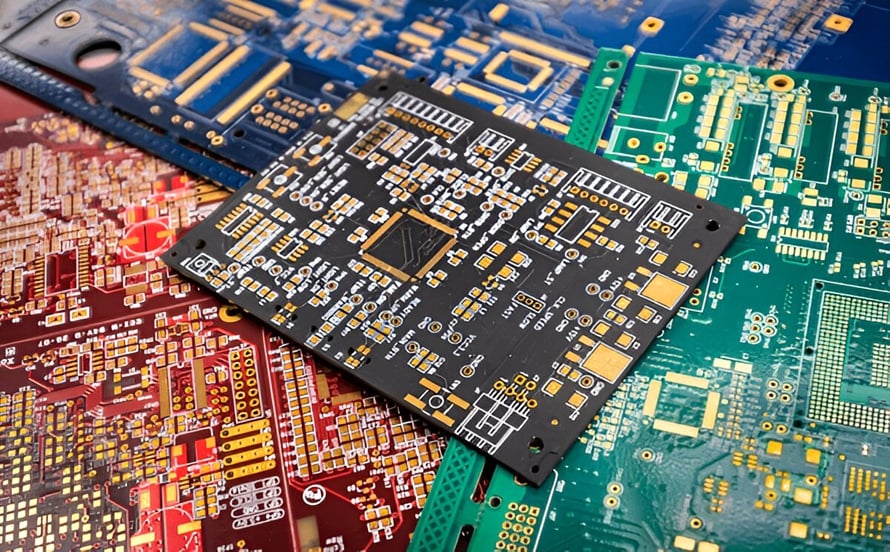
Industrial PCB: PCB Design, PCB Manufacturing, Materials & Applications
Industrial printed circuit boards (PCBs) are essential components in modern industrial automation, control systems, power electronics, networking equipment, instrumentation, and manufacturing infrastructure. Unlike consumer-grade PCBs, industrial boards must often operate reliably for long periods under demanding environmental and electrical conditions.
Although the qualification requirements for an industrial PCB may not always be as stringent as those for aerospace or military electronics, they are generally more demanding than those for ordinary commercial products. Industrial applications may expose PCBs to high temperatures, vibration, dust, moisture, corrosive chemicals, electrical noise, and continuous operating cycles.
These conditions directly influence PCB Design, material selection, component selection, thermal management, mechanical construction, testing, and PCB Manufacturing.
An industrial PCB must therefore be designed not only to perform its intended electrical functions but also to maintain stable performance throughout its expected service life.
This guide explains what an industrial PCB is, its key characteristics, commonly used materials, design considerations, manufacturing requirements, applications, and the factors engineers should consider when selecting an industrial PCB manufacturing partner.
What Is an Industrial PCB?
An Industrial PCB is a printed circuit board specifically designed and manufactured for industrial equipment and systems.
Industrial PCBs may need to operate under conditions such as:
- High or low temperatures
- Continuous 24/7 operation
- High mechanical vibration
- Mechanical shock
- Dust and particulate contamination
- High humidity
- Chemical exposure
- Electrical noise
- Electromagnetic interference (EMI)
- Electrostatic discharge (ESD)
- High power loads
- Repeated thermal cycling
Because of these conditions, industrial boards generally require greater mechanical strength, thermal stability, electrical reliability, and environmental protection than many commercial PCBs.
The exact requirements depend on the application. A control board installed inside a climate-controlled industrial cabinet may have very different requirements from a PCB installed directly inside a motor drive, outdoor communication system, or industrial sensor.
Therefore, industrial PCB specifications should be established from the actual operating environment rather than simply applying a generic “industrial-grade” specification.
Key Characteristics of Industrial PCBs
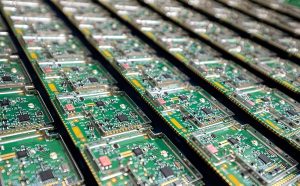
Industrial PCBs typically incorporate several design and manufacturing characteristics that distinguish them from ordinary commercial boards.
1. High Durability and Reliability
Industrial equipment is often expected to operate continuously for years.
An industrial PCB therefore needs to withstand environmental stress while maintaining stable electrical performance.
Important considerations include:
- Thermal cycling
- Mechanical vibration
- Shock
- Humidity
- Dust
- Chemical exposure
- Long operating periods
- Repeated power cycles
Material selection, copper thickness, via reliability, solder-joint design, and thermal management all contribute to long-term PCB reliability.
2. EMI and EMC Protection
Industrial environments can contain significant sources of electrical noise, including:
- Motors
- Variable-frequency drives
- Relays
- Switching power supplies
- Contactors
- High-current cables
- Industrial communication equipment
These sources can generate electromagnetic interference that affects sensitive electronic circuits.
Consequently, industrial PCB Design often incorporates:
- Continuous ground planes
- Controlled return-current paths
- EMI filtering
- Shielding
- Differential signaling
- Proper cable and connector grounding
- Careful high-speed routing
- Separation between noisy and sensitive circuits
EMC performance should be considered at the system level. PCB shielding alone cannot compensate for poor grounding, inappropriate routing, inadequate filtering, or poor enclosure design.
3. Industrial-Grade Components
The PCB itself is only one part of system reliability.
If an industrial board uses components that cannot tolerate the operating environment, the reliability of the complete assembly will still be limited.
Industrial-grade components are commonly selected according to their temperature ratings, electrical specifications, expected lifetime, and environmental requirements.
A frequently encountered commercial temperature range is approximately 0°C to 70°C, while industrial components may commonly support a wider range such as -40°C to +85°C. Some specialized components support even wider temperature ranges.
Component selection should always follow the manufacturer’s actual datasheet rather than assuming that every industrial component has the same temperature rating.
4. Repairability and Rework
Industrial equipment can be expensive to shut down. In some applications, repairing an electronic assembly may be more practical than replacing an entire control board.
Therefore, industrial PCB designs may consider:
- Accessible test points
- Replaceable components
- Adequate component spacing
- Robust solder pads
- Rework-compatible materials
- Thermal durability
- Service access
High-Tg laminates can be beneficial in applications requiring repeated thermal exposure or rework because they generally provide better dimensional stability at elevated temperatures.
This can be particularly important when replacing large thermal-mass components or components with exposed thermal pads that require controlled reflow or rework temperatures.
5. Strict Inspection and Quality Control
Industrial electronics often require stronger quality-control procedures than ordinary consumer products.
Depending on the application, PCB manufacturers may perform:
- Automated Optical Inspection (AOI)
- X-ray inspection
- Electrical testing
- Solderability testing
- Microsection analysis
- Impedance testing
- Dimensional inspection
- Thermal stress testing
- Reliability testing
Customers may also require documented quality systems, traceability, material certifications, and process-control records.
The specific certification requirements should be determined by the product, market, and applicable industry standards.
6. Conformal Coating
Conformal coating can protect a PCB from environmental contamination such as moisture, dust, chemicals, and certain corrosive substances.
Common coating materials include:
- Acrylic
- Silicone
- Polyurethane
- Epoxy
- Parylene
The correct coating depends on temperature, chemical exposure, flexibility requirements, repairability, and electrical insulation requirements.
It is important to distinguish conformal coating from an IP enclosure rating. An IP rating generally describes the protection provided by an enclosure or system against solids and liquids; applying conformal coating to a PCB does not automatically give the complete product a specific IP rating.
Materials Used for Industrial PCBs
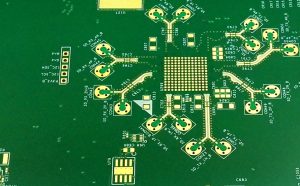
Material selection is one of the most important decisions in industrial PCB Manufacturing.
The appropriate material depends on temperature, frequency, mechanical stress, thermal requirements, dielectric performance, and cost.
High-Tg FR-4
High-Tg FR-4 is one of the most practical materials for industrial PCB applications.
Compared with standard FR-4 formulations, high-Tg materials can provide improved thermal stability at elevated operating and processing temperatures.
Advantages may include:
- Good mechanical stability
- Improved thermal performance
- Reasonable cost
- Good manufacturability
- Broad availability
- Compatibility with conventional PCB processes
High-Tg FR-4 is suitable for many industrial control, automation, instrumentation, and power-management applications.
However, it is not automatically the best solution for every high-temperature or high-frequency application.
Polyimide
Polyimide is known for its excellent thermal stability and mechanical properties.
It can be used in both rigid and flexible PCB constructions, making it particularly useful when an application requires:
- High-temperature performance
- Flexibility
- Repeated bending
- Compact packaging
- Thermal durability
Flexible polyimide PCBs are often used in industrial sensors, instrumentation, robotic systems, and applications where space is limited.
High-Frequency RF Laminates
Specialized high-frequency laminates can be used when an industrial PCB must process RF or microwave signals.
For example, Rogers RO4350B is a widely used high-frequency laminate with electrical properties suited to RF and high-speed applications.
Such materials can provide more predictable dielectric behavior than conventional FR-4 at higher frequencies.
However, using a specialized RF laminate when the circuit does not require its electrical performance can unnecessarily increase material cost.
Material selection should therefore be based on actual electrical requirements rather than simply choosing the most advanced material available.
Metal-Core PCB
Metal-core PCBs are particularly useful for applications requiring efficient heat dissipation.
Aluminum-core PCBs are widely used because aluminum provides an effective thermal path while maintaining relatively low material and manufacturing costs.
Typical applications include:
- Industrial LED lighting
- Power electronics
- Motor control
- High-power converters
- Industrial lighting systems
- Thermal-management modules
Metal-core construction can improve thermal performance, but it can also make certain rework operations more difficult because the metal core can rapidly conduct heat away from the soldering area.
Therefore, component replacement and rework procedures should be considered during design.
Industrial PCB Design Considerations
Reliable industrial electronics require more than selecting a durable laminate.
Thermal Management
Heat is one of the primary causes of electronic component degradation.
Industrial PCB Design should consider:
- Component power dissipation
- Copper thickness
- Thermal vias
- Copper planes
- Heat sinks
- Metal-core construction
- Airflow
- Enclosure thermal characteristics
For high-power circuits, thermal simulation or measurement may be required to verify that component temperatures remain within their specified limits.
Mechanical Reliability
Industrial equipment can generate continuous vibration and mechanical shock.
Design considerations may include:
- PCB mounting points
- Screw-hole placement
- Board thickness
- Component height
- Connector retention
- Heavy-component support
- Vibration-sensitive components
Large components should be mechanically supported where necessary to prevent excessive stress on solder joints.
Creepage and Clearance
High-voltage industrial electronics require careful consideration of creepage and clearance.
The required distances depend on factors such as:
- Working voltage
- Pollution degree
- Insulation category
- Material properties
- Environmental conditions
- Applicable safety standard
Increasing voltage without reviewing these parameters can create electrical safety and reliability problems.
Power Distribution
Industrial equipment frequently contains high-current or high-power circuits.
PCB power distribution must account for:
- Trace width
- Copper thickness
- Current density
- Temperature rise
- Voltage drop
- Connector ratings
- Via current capacity
Heavy-copper PCB construction may be appropriate for certain high-current applications.
Signal Integrity
Modern industrial equipment increasingly includes high-speed processors, Ethernet, fieldbus interfaces, data converters, and wireless communication.
Consequently, industrial boards may require:
- Controlled impedance
- Differential-pair routing
- Proper reference planes
- Low-loss materials
- Careful via transitions
- Crosstalk control
The stackup should be established before high-speed routing begins.
Industrial PCB Applications
Industrial PCBs are used in a wide range of equipment and systems.
1. Industrial Sensors
Sensors are among the most common applications for industrial electronics.
Industrial sensors may measure:
- Temperature
- Pressure
- Flow
- Vibration
- Position
- Proximity
- Humidity
- Force
- Chemical parameters
Sensor PCBs often need to combine compact dimensions with high reliability.
Flexible polyimide PCBs may be useful when sensor electronics must fit into constrained spaces or unusual mechanical structures.
2. Industrial Power Supplies
Industrial power systems may need to operate continuously, sometimes around the clock.
Applications include:
- Switch-mode power supplies (SMPS)
- DC-DC converters
- AC-DC converters
- Motor drives
- Battery-management systems
- Power controllers
Power-supply PCBs must manage heat, current, switching noise, insulation, and component stress.
Some industrial power systems also include replaceable or serviceable protection components such as fuses. In such applications, PCB pads and solder joints may need to withstand controlled rework operations.
3. Industrial Networking Equipment
Industrial Ethernet switches, gateways, wireless access equipment, routers, and communication controllers often operate in environments with significant EMI, vibration, and temperature variation.
Their PCBs may require:
- Strong EMI/EMC control
- ESD protection
- Controlled impedance
- High-quality laminates
- Robust connectors
- Thermal management
- High-speed differential routing
Industrial networking equipment must also maintain reliable communication under environmental conditions that may be unsuitable for conventional commercial networking hardware.
4. Industrial Computers
Industrial computers are designed for demanding environments where ordinary consumer PCs may not be appropriate.
Industrial computer motherboards may need to operate over wider temperature ranges and withstand vibration, dust, and continuous operation.
Many industrial computers also use fanless or reduced-maintenance thermal architectures.
This places greater demands on the PCB and system-level thermal design because the heat generated by processors, memory, power converters, and other components must be dissipated without relying heavily on forced-air cooling.
Industrial computer PCBs may also contain high-speed interfaces such as:
- DDR memory
- PCIe
- Ethernet
- USB
- Display interfaces
- Storage interfaces
These interfaces require appropriate stackup, impedance control, and signal-integrity analysis.
5. Industrial Automation and Control Systems
Industrial automation is one of the most important application areas for industrial PCBs.
Typical equipment includes:
- PLCs
- Motor controllers
- Servo drives
- Robotics controllers
- Human-machine interfaces
- Industrial I/O modules
- Motion-control systems
- Machine-vision equipment
These systems often combine analog sensing, digital processing, communication, and power-control functions on the same platform.
6. Robotics
Robotic systems require electronics that can withstand continuous movement and mechanical vibration.
PCB requirements may include:
- Lightweight construction
- Mechanical reinforcement
- High-density routing
- Flexible circuits
- High-speed communication
- Motor-control circuitry
- Thermal management
Rigid-flex PCB technology can be particularly useful when electronics must conform to complex mechanical structures.
7. Test and Measurement Equipment
Industrial measurement systems require stable and accurate electrical performance.
PCBs used in these systems may incorporate:
- Precision analog circuits
- ADCs and DACs
- Sensor interfaces
- Signal conditioning
- High-speed digital processing
- Communication interfaces
Low-noise layout, grounding, shielding, and thermal stability can all affect measurement accuracy.
Industrial PCB vs. Commercial PCB
Industrial and commercial PCBs can share similar basic manufacturing technologies, but their design priorities can differ significantly.
| Feature | Commercial PCB | Industrial PCB |
|---|---|---|
| Operating Environment | Generally controlled | Often harsh or variable |
| Temperature Requirements | Usually moderate | Often wider |
| Vibration Resistance | Application-dependent | Frequently important |
| EMI/EMC Requirements | Application-dependent | Often demanding |
| Component Grade | Commercial or consumer | Industrial-grade or application-specific |
| Reliability Target | Product-dependent | Typically higher |
| Thermal Management | Moderate to high | Often critical |
| Conformal Coating | Less common | More common when environmental exposure requires it |
| Service Life | Product-dependent | Often designed for long-term operation |
| Manufacturing Controls | Standard | Often enhanced according to application |
| Cost | Generally lower | Generally higher |
The difference is not simply that an industrial PCB uses more expensive materials. It is the result of designing the complete PCB assembly around the expected operating environment and service life.
Industrial PCB Manufacturing Considerations
A successful industrial PCB requires close coordination between design engineering and manufacturing.
Important PCB Manufacturing considerations include:
Material Traceability
The manufacturer should maintain appropriate records for laminate, copper, solder mask, surface finish, and other critical materials when traceability is required.
Process Control
Important manufacturing processes should be monitored to maintain consistent:
- Layer registration
- Copper thickness
- Hole dimensions
- Plating thickness
- Trace geometry
- Solder mask coverage
- Surface finish quality
Reliability Testing
Depending on the application, testing may include:
- Thermal cycling
- Thermal shock
- Humidity testing
- Vibration testing
- Mechanical shock
- Electrical testing
- Insulation testing
- High-voltage testing
- Solder-joint evaluation
The appropriate tests should be determined by the product’s actual operating conditions and applicable standards.
DFM Review
Design-for-manufacturing review is particularly important for industrial PCBs because reliability requirements may be combined with complex materials, high-current structures, fine-pitch components, and demanding mechanical constraints.
A DFM review can identify issues before the first production run.
Standards and Compliance for Industrial PCBs
Industrial electronics may be subject to different standards depending on the application and market.
Potential considerations include:
- IPC standards
- UL requirements
- RoHS
- REACH
- IEC standards
- EMC requirements
- Product-specific safety standards
- Industry-specific environmental requirements
The applicable standards should be determined based on the finished product rather than assuming that every industrial PCB requires the same certification.
A qualified PCB manufacturer should be able to provide appropriate documentation and demonstrate that its manufacturing processes are aligned with the customer’s specified requirements.
Common Industrial PCB Design Challenges
Several challenges frequently appear in industrial PCB projects.
High Temperature
Excessive temperature accelerates component aging and can reduce reliability.
Thermal design should therefore begin during schematic and stackup planning rather than after PCB routing is complete.
Strong Electromagnetic Noise
Motors, relays, switching converters, and industrial cables can create substantial EMI.
Proper grounding, filtering, shielding, and routing are essential.
Continuous Operation
A PCB operating 24/7 experiences significantly more thermal cycles and electrical stress than a board used intermittently.
Component lifetime and thermal margins should therefore be considered carefully.
Vibration and Mechanical Stress
Heavy components, connectors, and mounting structures can experience mechanical forces during continuous vibration.
Mechanical reinforcement may be required for certain applications.
Difficult Maintenance Environments
Some industrial systems are installed in locations where replacing a PCB is expensive or time-consuming.
Designing for diagnostics, serviceability, and field replacement can reduce maintenance downtime.
How to Choose an Industrial PCB Manufacturer
Selecting an appropriate manufacturing partner is an important part of industrial PCB development.
Consider the manufacturer’s:
- Experience with industrial electronics
- Material capabilities
- High-Tg and specialized laminate options
- Controlled-impedance capabilities
- Heavy-copper manufacturing capability
- Via and HDI technology
- AOI and X-ray inspection
- Electrical testing capabilities
- Quality-management systems
- Traceability and documentation
- DFM support
- Production and assembly capabilities
The manufacturer’s actual process capabilities should be matched to the PCB’s requirements rather than selecting a supplier solely according to price.
Kingda Industrial PCB Manufacturing
Industrial PCB projects require a manufacturing partner that understands the relationship between material selection, stackup design, component reliability, thermal management, mechanical requirements, and manufacturing processes.
Kingda can support industrial PCB projects involving multilayer boards, high-Tg materials, high-current designs, controlled impedance, thermal management, and demanding PCB assembly requirements.
During the engineering review, factors such as material selection, copper thickness, via structures, layer stackup, component placement, thermal management, manufacturability, and testing requirements can be evaluated before production.
This early collaboration helps engineers identify potential manufacturing risks before fabrication and develop a PCB that balances reliability, electrical performance, manufacturability, and overall cost.
Conclusion
An Industrial PCB is far more than a passive platform for connecting electronic components. It is a carefully engineered part of an industrial system that must maintain reliable electrical and mechanical performance under demanding operating conditions.
Industrial PCB requirements can influence virtually every aspect of development, including PCB Design, material selection, component selection, thermal management, EMI/EMC control, mechanical construction, surface protection, inspection, testing, and PCB Manufacturing.
High-Tg FR-4 is suitable for many industrial applications, while polyimide, high-frequency laminates, metal-core PCBs, and other specialized materials can be selected when specific thermal, mechanical, RF, or power requirements demand them.
Ultimately, the most appropriate industrial PCB is not necessarily the one with the most expensive materials or the highest number of layers. It is the PCB whose construction, components, manufacturing process, and validation strategy are properly matched to the actual operating environment.
Working with an experienced manufacturer such as Kingda can help engineers translate demanding industrial requirements into a manufacturable and reliable PCB solution.