Kapton PCB: PCB Design, PCB Manufacturing, Materials, Benefits & Applications
Flexible printed circuit boards (PCBs) have become an essential part of modern electronic products. Unlike rigid PCBs, flexible circuits can bend, fold, and conform to limited spaces while reducing overall weight and assembly volume. These characteristics make flexible PCBs particularly useful in applications where conventional rigid circuit boards cannot provide sufficient mechanical flexibility.
Several materials can be used to manufacture flexible circuits, including polyethylene terephthalate (PET), polyethylene naphthalate (PEN), and polyimide. Among them, Kapton has become one of the most recognized polyimide film materials for high-performance flexible electronics.
A Kapton PCB combines the flexibility of a polyimide substrate with the electrical functionality of a printed circuit. Its thermal stability, mechanical flexibility, chemical resistance, and relatively low outgassing characteristics make Kapton-based flexible circuits suitable for demanding applications ranging from aerospace and industrial electronics to automotive systems and wearable devices.
This article explains what a Kapton PCB is, its material properties, advantages, applications, and important considerations for PCB Design and PCB Manufacturing.
What Is a Kapton PCB?
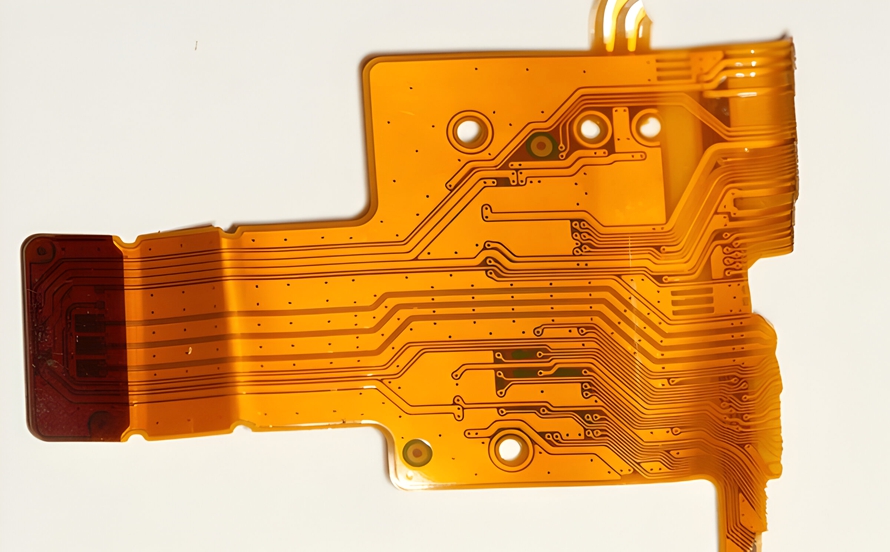
A Kapton PCB is a flexible printed circuit that uses Kapton polyimide film as its flexible substrate or coverlay material. Kapton is a family of polyimide films originally developed by DuPont for applications requiring high thermal and chemical stability.
Polyimide films became particularly important in aerospace and other demanding environments because they can maintain useful mechanical and electrical properties over a very wide temperature range. Kapton films have also been used as electrical insulation and thermal protection materials in aerospace systems.
It is important to distinguish between Kapton film itself and a finished flexible PCB. A flexible circuit normally contains several functional layers, including:
- Polyimide substrate
- Copper conductor
- Adhesive or adhesiveless bonding system
- Coverlay
- Stiffeners where required
- Surface finish
- Optional shielding or reinforcing structures
The resulting Kapton Flexible PCB can bend or flex while maintaining electrical connections between components or between different parts of an electronic system.
Kapton should therefore be viewed primarily as a high-performance polyimide material used in flexible circuit construction rather than as a separate PCB category based solely on the brand name.
Key Properties of Kapton PCB Materials
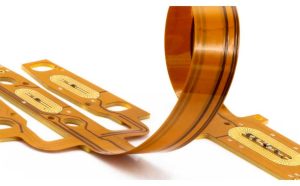
Kapton-based flexible circuits are valued because polyimide combines thermal stability, electrical insulation, chemical resistance, and mechanical flexibility.
However, exact electrical and mechanical properties depend on the specific Kapton film grade, copper configuration, adhesive system, coverlay, frequency, temperature, and manufacturing construction. Therefore, engineers should always use the manufacturer’s datasheet when selecting materials for a specific PCB Design.
Dielectric Properties
Polyimide films generally provide stable dielectric performance and good electrical insulation. The dielectric constant and dissipation factor depend on the specific film formulation, frequency, temperature, and test method.
For high-speed or RF applications, designers should use the actual material data at the target operating frequency rather than relying on a single nominal Dk or Df value.
Thermal Stability
One of the most important advantages of polyimide is its ability to maintain performance across a broad temperature range.
Kapton films are available in grades designed for demanding thermal environments. However, the continuous operating temperature of a completed Kapton PCB is not necessarily identical to the temperature rating of the raw Kapton film.
Copper, adhesive, coverlay, solder, components, and other materials can impose additional thermal limitations. Therefore, the complete flexible PCB construction must be evaluated rather than the substrate alone.
Chemical Resistance
Polyimide has good resistance to many chemicals, oils, and solvents. This characteristic is valuable for flexible circuits used in industrial and automotive environments.
Nevertheless, chemical resistance varies depending on the exact formulation and exposure conditions. Strong alkaline environments and certain aggressive chemicals can affect polyimide or other PCB construction materials.
Low Outgassing
Low outgassing is particularly important in aerospace and vacuum applications.
Certain Kapton film constructions have relatively low outgassing characteristics, making polyimide attractive for spacecraft and other low-pressure environments. However, the outgassing performance of a finished flexible PCB depends on the complete material stack-up, including adhesives, coverlays, coatings, and other components.
Moisture Absorption
Polyimide generally absorbs more moisture than some alternative flexible substrate materials. Moisture can influence dielectric properties, dimensional stability, and processing behavior.
For applications exposed to high humidity or significant temperature cycling, moisture absorption should therefore be considered during PCB Manufacturing and reliability qualification.
Mechanical Flexibility
Flexibility is one of the defining characteristics of a Kapton-based circuit.
The actual bending capability depends on:
- Copper type and thickness
- Number of conductive layers
- Bend radius
- Coverlay construction
- Adhesive system
- Stiffeners
- Dynamic versus static bending
- Temperature and environmental conditions
For this reason, it is not appropriate to assign a universal number of bending cycles to every Kapton PCB. A properly engineered flexible circuit can achieve very high flex-cycle performance, but the actual value must be validated for the specific construction.
Advantages of Kapton PCB
Kapton-based flexible circuits offer several advantages over conventional rigid PCB constructions.
1. Excellent Flexibility
The most obvious advantage is mechanical flexibility. A Kapton circuit can be routed through confined spaces and can conform to curved product geometries.
This makes it useful when rigid PCB assemblies would require multiple boards, connectors, or additional wiring.
2. Lightweight Construction
Flexible circuits can eliminate some connectors, cables, and mechanical structures used in conventional electronic assemblies.
As a result, a Kapton PCB can help reduce system weight and package volume, which is especially valuable in aerospace, wearable, portable, and automotive applications.
3. High Thermal Stability
Polyimide is well suited to applications that experience significant temperature variation.
Compared with many low-cost flexible substrate materials, polyimide provides a wider thermal operating window and better stability in demanding environments.
4. Good Electrical Insulation
Polyimide provides strong electrical insulation between conductive layers and surrounding structures.
This makes it suitable for flexible circuits where reliable insulation is required despite repeated bending or thermal cycling.
5. Chemical Resistance
Kapton-based flexible circuits can provide good resistance to many chemicals and solvents, depending on the complete material construction.
This characteristic is valuable in industrial equipment, automotive systems, and other environments where exposure to oils, solvents, or chemicals is possible.
6. Suitable for High-Reliability Applications
When properly designed and manufactured, polyimide flexible circuits can provide reliable electrical interconnections under mechanical movement, vibration, and temperature cycling.
However, reliability depends on the complete PCB structure rather than the substrate alone. Copper selection, bend radius, via design, coverlay construction, solder joints, and assembly processes all contribute to final reliability.
7. Space-Saving Design
A flexible circuit can replace several rigid boards and cable assemblies with one integrated interconnection structure.
This can simplify mechanical packaging and improve the utilization of internal product space.
Kapton PCB Design Considerations
Although flexible PCB design shares many principles with rigid PCB design, it requires additional mechanical and manufacturing considerations.
Bend Radius
Bend radius is one of the most important parameters in flexible circuit design.
A bend radius that is too small can create excessive mechanical stress in the copper and cause cracks or fatigue during repeated flexing.
The appropriate minimum bend radius depends on the number of layers, copper thickness, material construction, and whether the circuit is designed for static or dynamic flexing.
Copper Selection
Copper foil can be supplied in different types and thicknesses. Rolled annealed (RA) copper is commonly selected for dynamic flex applications because of its favorable flex-fatigue characteristics.
Electrodeposited (ED) copper can also be used in flexible circuits, particularly where cost and manufacturing requirements make it appropriate.
Avoiding Copper Stress Concentration
Sharp corners and abrupt changes in trace width can concentrate mechanical stress.
Flexible PCB traces should generally use smooth routing and curved corners, particularly in areas expected to bend repeatedly.
Component Placement
Components should generally be positioned away from the primary bending zone whenever possible.
Rigid components, solder joints, and vias can create local stress concentrations. Stiffeners may be added beneath component areas to provide additional mechanical support.
Via and Plated-Through-Hole Design
Vias require careful consideration in flexing regions because plated copper can experience mechanical fatigue.
Whenever possible, designers should avoid placing vias directly in highly dynamic bending areas unless the construction has been specifically qualified for that application.
Coverlay and Stiffeners
Coverlay protects copper traces and provides electrical insulation.
Stiffeners can be added beneath connectors, component areas, or other locations requiring greater mechanical rigidity. Common stiffener materials include polyimide and FR-4, depending on the application.
Materials Used in Kapton Flexible PCBs
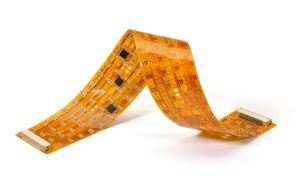
A typical Kapton-based flexible circuit can contain several materials.
| Material | Primary Function | Typical Considerations |
|---|---|---|
| Polyimide | Flexible substrate | Thermal stability, flexibility, electrical insulation |
| Copper | Conductive layer | Thickness, conductivity, flex-fatigue performance |
| Coverlay | Protection and insulation | Flexibility, dielectric protection |
| Adhesive | Bonding | Thermal and mechanical properties |
| Stiffener | Local reinforcement | Connector and component support |
| Surface finish | Copper protection and solderability | ENIG, immersion tin, OSP, etc. |
The exact combination depends on whether the circuit is intended for static flexing, dynamic flexing, high-temperature operation, high-speed signaling, or specialized environmental conditions.
Kapton PCB vs Other Flexible PCB Materials
Kapton is not the only material used for flexible circuits. Engineers may also consider PET, PEN, and other polymer systems.
| Property | Kapton / Polyimide | PET | PEN |
|---|---|---|---|
| Thermal performance | High | Lower | Moderate to high |
| Flexibility | Excellent | Excellent | Excellent |
| Chemical resistance | Generally strong | More application-dependent | Generally good |
| High-temperature applications | Suitable | More limited | Moderate |
| Typical applications | Aerospace, automotive, industrial, medical, high-reliability electronics | Low-cost flexible electronics | Displays, sensors, flexible electronics |
| Relative cost | Higher | Lower | Moderate |
Material selection should always be based on the required electrical, mechanical, thermal, and environmental performance rather than simply choosing the most expensive substrate.
Kapton PCB Manufacturing Process
The Kapton PCB Manufacturing process is similar to other flexible circuit manufacturing processes but requires specialized handling because polyimide substrates are thin and flexible.
1. PCB Design and Engineering Review
The process begins with schematic development, PCB layout, stack-up definition, and manufacturing review.
Engineers evaluate:
- Trace width and spacing
- Copper thickness
- Bend areas
- Minimum bend radius
- Layer count
- Via structures
- Component placement
- Stiffener requirements
- Impedance requirements
- Surface finish
2. Polyimide Substrate Preparation
The selected polyimide film is prepared according to the required flexible circuit construction.
Depending on the design, the copper may be bonded to the polyimide using an adhesive system or manufactured using an adhesiveless construction.
3. Circuit Imaging
A photosensitive process transfers the circuit pattern to the copper surface.
High-density flexible circuits require accurate imaging because fine traces and small spacing can be particularly sensitive to dimensional variation.
4. Copper Etching
Unwanted copper is removed through controlled chemical etching, leaving the required conductive pattern.
Etch compensation must be carefully controlled because trace width directly affects electrical and mechanical performance.
5. Drilling and Via Formation
Holes are created for vias and component mounting where required.
Depending on the construction, mechanical drilling, laser processing, or other specialized processes may be used.
6. Coverlay Application
Coverlay is applied over selected circuit areas to protect copper traces and provide electrical insulation.
The openings in the coverlay must align accurately with solder pads and other exposed conductive areas.
7. Surface Finish
Exposed copper pads can receive a suitable surface finish such as ENIG, OSP, or immersion tin.
The appropriate finish depends on solderability, environmental exposure, contact requirements, cost, and assembly conditions.
8. Stiffener Application
Polyimide or FR-4 stiffeners may be added to connector areas and other regions where additional mechanical support is required.
9. Electrical and Visual Testing
Finished flexible circuits can undergo electrical testing, AOI, dimensional inspection, and other reliability checks.
For high-reliability applications, additional testing may include flex-cycle testing, thermal cycling, peel-strength testing, and environmental qualification.
Kapton PCB Applications
Kapton-based flexible circuits are used across many industries where flexibility, thermal stability, and reliability are important.
Aerospace and Space Electronics
Aerospace systems place strict requirements on weight, reliability, vibration resistance, thermal stability, and environmental performance.
Polyimide flexible circuits can provide compact electrical interconnections while reducing cable and connector requirements.
Kapton materials have also been used extensively in aerospace thermal protection and electrical insulation applications. This historical use should not be confused with Kapton being used specifically as a PCB in every aerospace mission.
Defense and Military Electronics
Defense electronics may experience vibration, shock, temperature extremes, and demanding environmental conditions.
Flexible polyimide circuits can be used for compact interconnections, sensors, communication systems, and electronic modules where conventional rigid wiring is difficult to package.
Automotive Electronics
Modern vehicles contain numerous electronic systems, including:
- Engine control electronics
- Battery management systems
- Sensor modules
- ABS electronics
- Infotainment systems
- Lighting systems
- Camera and radar modules
- Instrument clusters
Kapton-based flexible circuits can help route electrical connections through confined automotive spaces while maintaining flexibility and reducing wiring complexity.
Industrial Equipment
Industrial machinery may expose electronic assemblies to heat, chemicals, vibration, and continuous mechanical movement.
Polyimide flexible circuits can be useful for sensors, instrumentation, control systems, and moving interconnections.
Wearable Electronics
Wearable products require lightweight and compact electronic structures.
Flexible polyimide circuits can conform to curved surfaces and reduce the mechanical constraints associated with rigid PCBs.
However, the choice of substrate must also consider skin-contact requirements, moisture exposure, bending cycles, and the complete product’s safety requirements.
Medical Electronics
Flexible circuits can be used in selected medical devices and diagnostic equipment where compact form factors and mechanical flexibility are required.
For patient-contact or implantable applications, material selection must be based on the complete device’s biocompatibility, sterilization, reliability, and regulatory requirements rather than simply selecting Kapton because it is a polyimide material.
Kapton PCB vs Rigid PCB
| Feature | Kapton Flexible PCB | Rigid PCB |
|---|---|---|
| Mechanical flexibility | Excellent | Limited |
| Weight | Low | Generally higher |
| Space utilization | Excellent | More limited |
| Thermal stability | High | Depends on laminate |
| Dynamic bending | Possible with suitable construction | Generally unsuitable |
| Mechanical support | Lower | High |
| Manufacturing complexity | Higher | Generally lower |
| Typical materials | Polyimide | FR-4 and other rigid laminates |
| Typical applications | Aerospace, automotive, wearables, industrial electronics | Computers, controllers, power electronics, consumer electronics |
Neither type is universally better. The appropriate solution depends on the mechanical geometry, electrical requirements, environmental conditions, cost, and assembly process.
How to Choose a Kapton PCB Manufacturer
Choosing the right manufacturer is particularly important for flexible circuits because manufacturing tolerances can affect both electrical performance and mechanical reliability.
Consider the following factors:
- Flexible PCB manufacturing experience — Verify that the manufacturer has practical experience with polyimide flexible circuits rather than only rigid FR-4 boards.
- Material capabilities — Confirm that the manufacturer can source the required polyimide film, copper foil, coverlay, adhesives, and stiffeners.
- Flexing requirements — Clearly specify whether the circuit will experience static bending or repeated dynamic flexing.
- Controlled impedance capability — High-speed flexible circuits require appropriate stack-up and impedance control.
- Fine-line manufacturing — Check the manufacturer’s capability for the required trace width, spacing, via dimensions, and registration tolerances.
- Testing and inspection — Evaluate electrical testing, AOI, dimensional inspection, and reliability-testing capabilities.
- Assembly capability — If required, choose a supplier capable of providing both flexible PCB fabrication and PCB Assembly.
- Quality management — Review relevant quality systems, process controls, traceability, and industry-specific requirements.
- Engineering support — A capable supplier should be able to review the design for manufacturability and identify potential mechanical or electrical risks before production.
Kapton PCB Manufacturing Support from Kingda
Kingda can support flexible PCB projects requiring polyimide-based constructions for compact and mechanically demanding electronic products.
During the engineering and manufacturing process, key parameters such as substrate selection, copper thickness, bend radius, coverlay configuration, stiffeners, surface finish, impedance requirements, and testing requirements should be defined before production.
For projects involving dynamic flexing, high-speed signals, automotive electronics, aerospace systems, or other demanding applications, Kingda can help evaluate the PCB construction according to the project’s electrical, mechanical, thermal, and manufacturing requirements.
Conclusion
Kapton PCB technology combines the electrical functionality of a printed circuit with the flexibility and thermal stability of polyimide materials. This makes Kapton PCB solutions particularly valuable where conventional rigid PCBs cannot satisfy mechanical packaging or environmental requirements.
The main advantages include excellent flexibility, low weight, thermal stability, chemical resistance, electrical insulation, and suitability for compact electronic assemblies.
However, the performance of a flexible circuit does not depend on Kapton alone. Copper type, copper thickness, coverlay, adhesive system, stiffeners, bend radius, via construction, surface finish, and assembly conditions all influence the final product.
For this reason, successful PCB Design and PCB Manufacturing require the complete flexible circuit construction to be evaluated as an integrated system.
As electronic products become smaller, lighter, and more mechanically integrated, polyimide flexible circuits will continue to play an important role in automotive electronics, aerospace systems, industrial equipment, wearable devices, medical electronics, and other high-reliability applications.