Aerospace PCB Manufacturer Requirements and Production Capabilities
Printed circuit boards are critical components in aerospace electronic systems, serving as the foundation for electrical connections and electronic functions. Their quality and performance directly affect flight safety, system reliability, and mission success.
Manufacturers producing Aerospace PCB products must meet extremely strict requirements in materials, manufacturing technology, equipment, quality management, and engineering capabilities. Only manufacturers with advanced production capabilities and comprehensive quality systems can provide reliable PCB solutions for aerospace applications.
Strict Certification and Compliance Requirements
Aerospace Industry Certifications
Aerospace PCB manufacturing is a highly specialized field with strict industry regulations. Manufacturers must comply with internationally recognized aerospace quality management standards, such as AS9100D certification.
The AS9100D quality management system covers the complete product lifecycle, including design, development, production, installation, and service processes. It ensures that manufacturers have the capability to consistently produce products that meet aerospace reliability requirements.
Depending on regional regulations and customer requirements, aerospace PCB manufacturers may also need additional production qualifications and compliance certifications to demonstrate their ability to meet industry safety standards.
Environmental and Safety Compliance
Aerospace PCB production involves advanced manufacturing processes such as chemical etching, electroplating, and surface treatment, which require strict environmental management.
Manufacturers must establish professional waste treatment systems to ensure proper handling of wastewater, exhaust gases, and industrial waste. Environmental management certifications such as ISO14001 demonstrate a company’s commitment to sustainable manufacturing practices.
In addition, occupational health and safety management systems are essential to reduce production risks and ensure safe working conditions.
Intellectual Property Protection and Confidentiality
Aerospace projects often involve advanced technologies, proprietary designs, and confidential customer information.
Professional aerospace PCB manufacturers must establish comprehensive intellectual property protection systems to safeguard engineering innovations and prevent unauthorized disclosure.
Strict confidentiality procedures are also required when handling aerospace customer data, ensuring sensitive technical information remains secure throughout the manufacturing process.
Advanced Manufacturing Capabilities
High-Performance Material Processing
Aerospace environments involve extreme conditions, including temperature fluctuations, radiation exposure, vibration, and pressure changes. Therefore, aerospace PCB manufacturers must have extensive experience working with advanced materials.
Common aerospace PCB materials include:
- Polyimide substrates
- PTFE high-frequency materials
- Ceramic-based substrates
- High-temperature laminate materials
These materials provide low thermal expansion, excellent electrical insulation, high temperature resistance, and radiation durability.
For example, satellite PCB applications often use polyimide materials because they can withstand radiation exposure in space environments while maintaining dimensional stability and electrical performance during extreme temperature cycles.
Advanced surface finishing and plating technologies are also required. Processes such as pulse electroplating help achieve uniform copper deposition, improve hole reliability, and ensure stable electrical connections during repeated thermal cycling.
Professional Advanced PCB Manufacturing capabilities allow aerospace manufacturers to produce highly reliable circuit boards for demanding environments. Advanced PCB Manufacturing
Precision Manufacturing Technology
As aerospace electronic systems become smaller and more integrated, precision PCB manufacturing has become increasingly important.
Aerospace PCB manufacturers must have advanced capabilities including:
- Microvia fabrication
- High-density interconnection (HDI) technology
- High-layer-count PCB production
- Precise impedance control
- Advanced multilayer alignment technology
Microvia manufacturing capability is essential for high-density designs. Manufacturers must be able to produce extremely small vias, sometimes below 0.1 mm in diameter, to support compact aerospace electronic systems.
Multilayer PCB manufacturing capability is also critical. Aerospace applications often require boards with 20 or more layers, requiring precise layer alignment and advanced lamination control.
In aerospace communication systems, accurate impedance control ensures high-frequency signals maintain signal integrity while reducing transmission loss and distortion.
For complex aerospace designs, professional Multilayer PCB Manufacturing technology ensures reliable interlayer connections and stable electrical performance. Multilayer PCB Manufacturing
Special Environmental Adaptation Technology
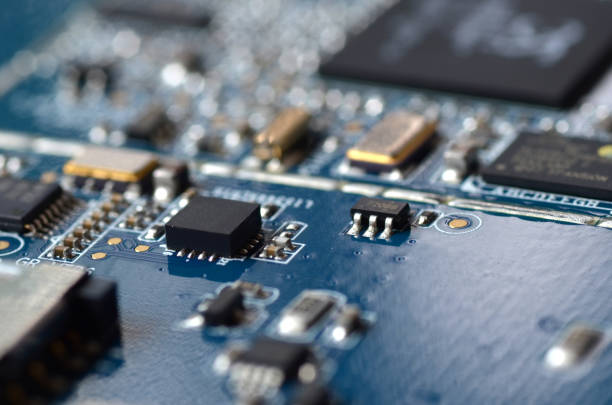
Aerospace PCBs must operate reliably under extreme conditions, including:
- High radiation environments
- Strong mechanical vibration
- Low atmospheric pressure
- Extreme temperature variations
To address these challenges, manufacturers develop specialized technologies.
Radiation resistance can be improved through optimized material selection and shielding design. Mechanical reliability can be enhanced by strengthening solder joints, optimizing component placement, and improving structural design.
Thermal management is another critical factor. High-performance thermal materials and optimized heat dissipation structures help maintain stable operating temperatures in high-temperature environments while preserving material flexibility and electrical performance under cold conditions.
Advanced Equipment and Manufacturing Technology
High-Precision Production Equipment
To achieve aerospace-level manufacturing quality, PCB manufacturers must invest in advanced production equipment.
Key equipment includes:
- Laser drilling systems
- High-precision etching equipment
- Advanced electroplating systems
- Automated assembly equipment
Laser drilling technology enables precise microvia formation with smooth hole walls and accurate positioning.
High-precision etching equipment ensures accurate control of trace width and spacing, reducing risks such as short circuits and open circuits.
Advanced plating systems improve copper thickness uniformity and adhesion strength, while automated assembly equipment ensures accurate placement of miniature components.
Advanced Inspection and Testing Equipment
Aerospace PCB quality requirements are extremely demanding and require comprehensive inspection capabilities.
Common testing equipment includes:
Automated Optical Inspection (AOI)
AOI systems inspect PCB surfaces for defects such as:
- Open circuits
- Short circuits
- Missing components
- Soldering defects
X-Ray Inspection Systems
X-ray inspection technology can examine internal PCB structures, including:
- Hidden solder joints
- Internal connections
- Layer bonding quality
- Potential internal defects
Environmental Reliability Testing
Aerospace PCB manufacturers require environmental simulation equipment, including:
- Thermal vacuum chambers
- Vibration testing systems
- Thermal shock testing equipment
These systems simulate aerospace operating conditions to verify PCB reliability under extreme environments.
For applications requiring strict reliability validation, High Reliability PCB manufacturing processes provide comprehensive testing and quality assurance. High Reliability PCB
Professional Engineering and Manufacturing Teams
Research and Development Engineers
A skilled engineering team is one of the most important competitive advantages for aerospace PCB manufacturers.
Engineers must have expertise in:
- Electronic engineering
- Material science
- PCB design
- Aerospace application requirements
They are responsible for developing optimized PCB solutions according to aerospace system requirements.
For example, when designing PCB solutions for aircraft engine control systems, engineers must understand operating principles, control requirements, thermal conditions, and reliability expectations to develop suitable circuit solutions.
Production Operators
Experienced production operators directly influence manufacturing quality.
They must receive professional training and understand:
- Drilling processes
- Etching procedures
- Electroplating operations
- Assembly processes
- Quality requirements
During high-precision manufacturing operations, operators must accurately control equipment parameters to ensure that microvia dimensions, hole depth, and alignment accuracy meet aerospace standards.
Quality Control Engineers
Quality control teams play a critical role in aerospace PCB production.
They are responsible for:
- Establishing quality management procedures
- Monitoring production processes
- Performing product inspections
- Analyzing quality issues
- Implementing improvement actions
Strict electrical testing and reliability verification ensure that every aerospace PCB product meets required performance standards.
Comprehensive Quality Management System
Full Process Quality Control
Aerospace PCB manufacturers must establish complete quality control systems covering the entire production process.
Quality management begins with raw material selection. Suppliers must be carefully evaluated, and incoming materials must undergo inspection for:
- Electrical properties
- Physical characteristics
- Chemical performance
During manufacturing, multiple quality checkpoints are established throughout each process.
For example:
- Layer alignment inspection before lamination
- Copper thickness testing after plating
- Electrical performance testing after final production
Only products passing all inspection procedures can proceed to delivery.
Quality Traceability System
A complete traceability system is essential for aerospace PCB manufacturing.
Each PCB should have a unique identification number that records:
- Raw material batch information
- Equipment data
- Operator information
- Manufacturing parameters
- Inspection results
If a quality issue occurs during field operation, manufacturers can quickly identify the production history, material source, and process conditions associated with the product.
This enables efficient problem analysis and corrective action.
Continuous Quality Improvement
Quality improvement is an ongoing process in aerospace PCB manufacturing.
Manufacturers should regularly analyze:
- Product yield rates
- Defect distribution
- Customer feedback
- Process performance data
Cross-functional teams can then develop improvement plans and verify their effectiveness through testing and data comparison.
Continuous improvement helps manufacturers maintain stable quality and meet the evolving requirements of aerospace electronics.
Conclusion
Producing aerospace PCBs requires far more than basic PCB manufacturing capabilities. Manufacturers must possess advanced certifications, precision production technologies, specialized materials expertise, professional engineering teams, and comprehensive quality management systems.
From high-performance materials and precision manufacturing to environmental testing and full-process quality control, every stage directly influences aerospace PCB reliability.
With the continuous development of aviation, satellite systems, and aerospace electronics, manufacturers with advanced PCB Manufacturing Services capabilities will continue to play an essential role in supporting safer and more reliable aerospace technologies. PCB Manufacturing Services