Board Handling and Racking Damage Prevention
Handling damage is the defect that everyone recognises and almost nobody measures. A nicked board edge, a scratched solder mask, a chipped corner, a bent pin: each is small on its own, and each is attributed to whoever touched the board last. In practice the damage accumulates across many handling steps, and the step where it becomes visible is rarely the step where it happened. Reducing it requires knowing which steps in the route actually contact the board, and what condition the surfaces that touch it are in.
Where Board Handling Damage Actually Happens
The damage points are the transitions. A board that is transferred from a magazine to a conveyor, from a conveyor to a rack, from a rack to a fixture and back again passes through four contact events in a few minutes. Each involves an edge sliding against something, and each is a candidate for the nick that appears later. Loading and unloading are therefore the highest-risk operations, not the processes themselves.
The second cluster is storage. Boards stacked on a bench, leaned against a wall, or placed on a rack that is too narrow will deform or scratch. A board that is supported on a rough surface will pick up scratches on whichever side faces down, and a board left in the open will collect dust that later appears as a defect in a coating or under a component. Both are consequences of a storage arrangement rather than of a person being careless.

Racks, Magazines and Their Condition
A magazine holds boards by their edges in slots whose spacing matches the board thickness. Where the slots are too wide, the board tilts and its edge rests on the slot bottom, which wears the plating and can crack a laminated edge. Where the slots are too narrow, the board is forced in and the edge is crushed. Where the slots are contaminated, every board that passes through picks up the contamination.
Magazines are consumables and wear in ways that are easy to miss. The slot walls become rough with use, the base becomes bowed under load, and the guides that align the board wear at the entry. A magazine should be inspected periodically for slot damage, for flatness and for contamination, and one that has been dropped should be scrapped rather than straightened. Cleaning a magazine before it is put back into service is a small task with a direct effect on the board surface.
Edge Contact and the Keep-Out Zone
Most board handling touches the board edge, and edge damage starts there, which is why the edge is the right place to allow contact and the reason a keep-out zone is defined around it. The zone excludes components and traces from the strip that the conveyor, the magazine and the fixture will contact, so that a worn belt or a rough guide damages copper rather than a part. Where the design puts a component inside the zone, the handling equipment has to change rather than the design.
The zone has to be respected on both sides of the board, including the side that faces down. A component on the underside inside the contact strip is the most commonly overlooked case, because the underside is the one the operator cannot see when the board is on the conveyor. The assembly drawing should show the zone for both sides, and the conveyor setup should be checked against it whenever a new product is introduced. The depaneling step is often the point where the edge zone is first violated, because the router or the shear has to grip the panel to separate it.
Conveyor and Transfer Damage
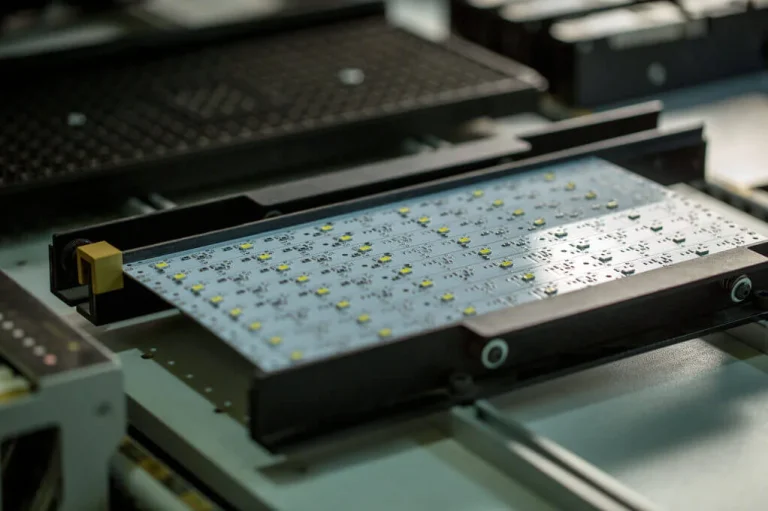
Conveyor damage comes from worn belts, misaligned rails and misadjusted stop gates. A belt that has lost its tension slips, and the board is pushed rather than carried, which scuffs the edge. A rail that is set narrower than the board forces the board down onto the belt, and the resulting pressure marks appear along the edge. A stop gate that engages too hard leaves a mark at the point of contact, and the same mark appears on every board at the same position.
The marks are diagnostic. Damage at a consistent position on every board points at a machine adjustment; damage that varies points at handling. Recording the position of the damage on the board, rather than only its occurrence, therefore halves the investigation. Where the damage appears at the same distance from the leading edge on every unit, the culprit is a transfer or a gate, and it can be found by watching a single board pass through the line. The edge quality criteria and the handling damage criteria should be written separately, because the two are produced by different operations and the corrective actions differ.
Loose Boards, Trays and Stacking
A board that is not in a rack will be stacked, and stacking is the single most damaging storage practice. Two boards in contact will abrade each other as the stack is moved, and any component on one board will press into the other. Trays with moulded pockets solve the problem for populated assemblies and are the standard answer, but they only work if the boards are placed in them rather than on them.
Bare boards have the same problem in a different form. Stacking bare boards scratches the solder mask and can embed particles in the surface, which later appear as a defect in a coating or as a poor wetting area. The interleaf paper that is used to separate them has to be clean and non-abrasive, and it should be replaced when it becomes soiled rather than reused indefinitely. The storage rule should be that a board is either in a rack, in a tray or in its packaging, and that racking is never improvised and never improvised twice for the same board.
Measuring Scrap and Attributing It
Handling damage should be a defect code of its own, recorded at the station where it is found, with a note of where on the board it is. Where the code is merged into a general cosmetic category, the size of the problem is invisible, and no improvement can be measured. The scrap rate from handling damage is often one to three percent of output in a shop that does not measure it, which is enough to justify the effort of measuring.
Attribution follows from the position. Damage at a consistent location points at a machine; damage at random locations points at manual handling; damage on one side only points at a conveyor or a rack. Pairing the position data with the route the board took, including any rework or return to a previous station, identifies the step. The manufacturing yield review should carry handling damage as a separate line, so that the trend is visible even where the total yield is acceptable.
Handling Rules and Their Enforcement
Rules that are written and not enforced are worse than no rules, because they create the impression that the practice is controlled. A workable set is short: handle boards by the edges, use gloves only where the glove is specified, never stack boards, return boards to a rack when they are not being worked on, and report any dropped board to a supervisor. Each rule should be posted at the station where it applies rather than in a manual.
Enforcement should be by observation rather than by inspection of the output, because handling damage is produced by practice. A short periodic observation, recorded on the same sheet as the audit, gives the supervisor something to coach rather than something to punish. Where a rule is repeatedly broken, the arrangement should be examined: a rack that is too far from the machine will be ignored, and the answer is to move the rack rather than to remind the operator. The packing procedure closes the loop at the end of the line, and it should specify the packaging that protects the boards in transit as well as the documents that travel with them.
When Damage Is Found at the Customer
Damage that reaches the customer is a different problem from damage caught internally, because the evidence is gone and the argument is about where it happened. The packaging is usually the first suspect and often the wrong one: a board that was scratched before packing will show the same scratch after shipping, and the packaging cannot be blamed for it. The way to settle the question is a photograph taken at packing, and it is worth taking for any product where a cosmetic claim is plausible.
Where a claim does arise, the position of the damage on the board is again the diagnostic. Damage inside the packing outline that matches the packing material, such as a mark at a support point, points to transit; damage that matches a machine position points to production; damage on the edge points to handling. Recording the position and the packing configuration together is what makes the analysis possible, and it should be part of the packing record rather than a separate investigation.
FAQ
Do gloves reduce handling damage? They reduce contamination from skin contact and they protect the operator, but they do not prevent mechanical damage. A glove can even increase it, because it reduces the sensitivity of the fingers and encourages a firmer grip than is needed.
How often should magazines be cleaned? On a defined interval, and whenever a board is found with contamination that could have come from the rack. Cleaning is a quick task with a brush and a vacuum, and it is preferable to replacing the magazines, which is the alternative once the slots become rough.
Is a scratched solder mask always a reject? It depends on where the scratch is and what it exposes. A scratch that removes the mask over a trace and exposes copper is a reliability concern and usually a reject; a scratch in a non-functional area is cosmetic. The criteria should be written by area rather than as a general rule.