Box Build: From PCBA to a Complete, Tested Unit
A printed circuit board assembly becomes a product only after it has been placed in its enclosure, connected to its cables, loaded with its firmware and tested as a whole. Box build is the term for that final stage, and it is the point at which the responsibility for a board becomes the responsibility for a delivered unit. The work covers mechanics, wiring, software, labelling, testing and packing, and each of those adds a way for a product to fail that a bare board cannot experience.
What the Stage Covers
The mechanical assembly places the board or boards into the housing, secures them with the specified hardware and confirms that the connectors line up with the openings. It is the step where a tolerance that was acceptable in isolation becomes visible: a connector that sits two millimetres away from the cut-out in its own coordinate system may be perfectly correct and still unusable once the enclosure is closed.
The cable harness follows. Harnesses are the most frequent source of intermittent faults in a finished product, because they combine a mechanical connector, a flexible conductor and a human operation. The routing is defined rather than improvised, the strain relief is provided where the cable enters the housing, and the connector is confirmed to be fully seated rather than merely attached.
The firmware loading and the configuration come next, together with the serial number, the calibration data and any identifier that has to be unique to the unit. All of those are recorded against the unit rather than against the batch, because that is the level at which a customer will ask the question.
Assembly Requires Its Own Fixture
A box build without a fixture is a box build whose consistency depends on the operator. A simple jig that holds the housing, presents the board at a workable angle and locates the connectors removes most of the variation, and a fixture that also holds the harness in its required route removes more. The cost of the jig is repaid the first time a batch has to be reworked because two units were assembled in a slightly different order.
The sequence of the build is documented as a work instruction with the torque values, the fastener types and the cable routes stated, and the critical points carry a check that can be signed. Where a step could be performed in the wrong order without failing immediately, the instruction states the order explicitly, because a mistake that only becomes apparent at the end of the line has already consumed the whole unit.
Incoming Checks on the Other Components
A box build consumes more than boards. The housings, the membranes, the displays, the brackets, the fasteners and the cable assemblies all arrive from other suppliers, and any of them can carry a defect that stops the line. The housing finish, the cut-out dimensions, the display window and the thread quality are checked at receipt against the drawing, and a first article of the enclosure assembly confirms that the parts fit together as the drawing intended rather than as each supplier believed.
A fit check before production is notably cheaper than a fit problem during it. A connector that is one millimetre out of position is a supplier conversation at the sample stage and a batch of unusable housings afterwards, and the difference between the two is a single physical assembly of the first parts.
<img src="https://www.gopcba.com/wp-content/uploads/2026/09/78.png" alt="system test of a completed unit before shipment” />
System test and What It Proves
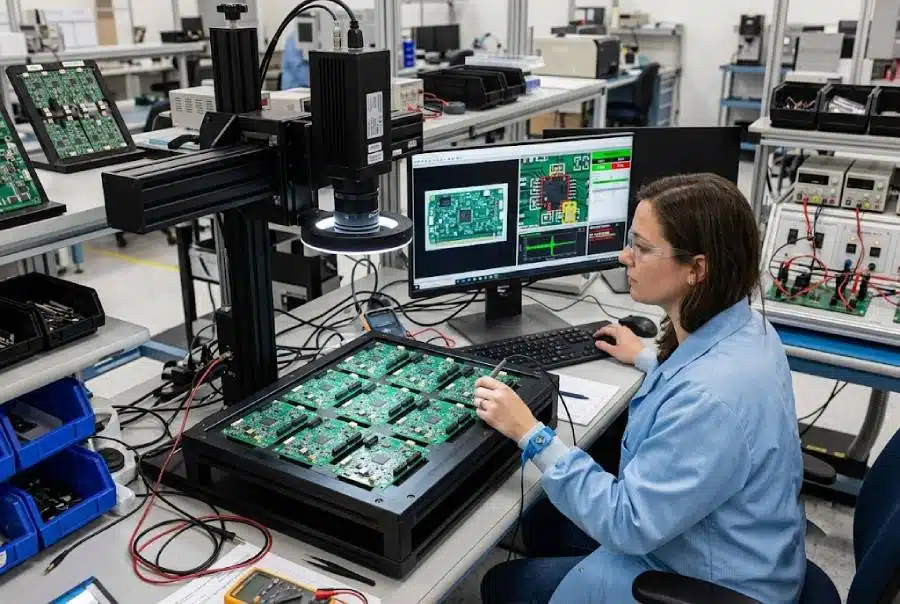
The system test examines the finished unit as the customer will use it. The supply is applied through the intended input, the interfaces are exercised with the intended cables, the display is observed, the wireless connection is established and the firmware revision is read back. Where the product has a calibration, the values are written and verified. Where it has a safety function, that function is tested in the condition in which it is required to operate.
The distinction between a board test and a system test is important, because a board that passes its own test can still fail in the enclosure. A connector that is electrically sound can be mechanically loaded once the housing is closed; a thermal design that works on a bench can be compromised by a housing with no ventilation; a wireless function that works on an open board can be attenuated by a metal enclosure. Each of those is a genuine defect that only the system test can find.
Labelling, Packing and Shipment
The unit is labelled with the identifiers that the customer requires, and the label is confirmed against the record rather than applied from a sheet. The calibration data, the firmware revision and the serial number are stored so that a unit can be identified from its label afterwards, which is what makes a field question answerable.
Packing is specified from the fragility of the unit rather than from the cost of the carton. The parts that survive a bench but not a courier are the connectors, the display, the antenna and any part that protrudes from the housing, and the packing is designed around those. Where a customer has a packing standard, it is applied as given, since a unit that arrives damaged has failed regardless of how well it was built. Our box build assembly operation covers this stage, the boards come from SMT assembly, the functional checks run under PCBA testing, the material is handled by component procurement and the records are held under quality management. Industrial products are built through the industrial PCBA route.
Where the final assembly Stage Fits
The final assembly stage sits between the completed board and the shipped product, and the decision to place it with the board supplier rather than with a separate mechanical assembler is usually made on information rather than on price. The board, the firmware, the calibration data and the identifier all originate in the electronics, and a mechanical assembler who receives them without the surrounding record has to reconstruct what the electronics team already knows.
Keeping the stage with the board supplier also shortens the loop when something does not fit. A connector that is a fraction too far from the opening, a mounting hole that is obstructed by a tall component and a housing that leaves too little clearance for a cable are all faults that have an electrical cause and a mechanical symptom, and they are resolved fastest when the people who can change the board and the people who can change the assembly are in the same building.
The other side of the decision is the packing materials. A product that is assembled and shipped from one location receives one packing specification rather than two, and the standard applied to the finished goods is the standard that the customer agreed rather than the one that survived a handover.
FAQ
What is included in a box build? The mechanical assembly, the harness, the firmware and identifiers, the system test, the labelling and the packing, in whatever combination the product requires.
Why test a finished unit as well as a board? Because the enclosure and the wiring introduce failure modes that do not exist on an open board.
Who supplies the enclosure and the cables? Either side. Where the customer supplies them, they are checked against the drawing at receipt before the build starts.