Ionic Contamination Testing and Cleanliness Why Cleanliness Is Measured The failure mechanisms that cleanliness testing guards against all need an electrolyte, and the electrolyte is almost always the ionic residue left on the board by the assembly process or by the environment. If the residue is below a threshold, the…
No-Clean Flux Residue and Its Risks What No-Clean Means A no-clean flux is formulated so that its residue can be left on the assembly without causing a reliability problem, and the process is designed around that assumption. In practice the term describes a chemistry rather than a guarantee: the residue…
PCB Surface Finish Porosity: Little Holes in the Finish Buyers and engineers often focus on the finished product and forget the production line behind it. In practice, most field failures can be traced back to process decisions made during assembly. Understanding PCB surface finish porosity gives you a practical advantage…
Solder Preforms and Pin-in-Paste Assembly The Problem A through-hole joint needs a fillet on both sides of the board to be mechanically sound, and the volume of solder that requires is far more than the paste that can be printed onto a pad at a normal stencil thickness. In a…
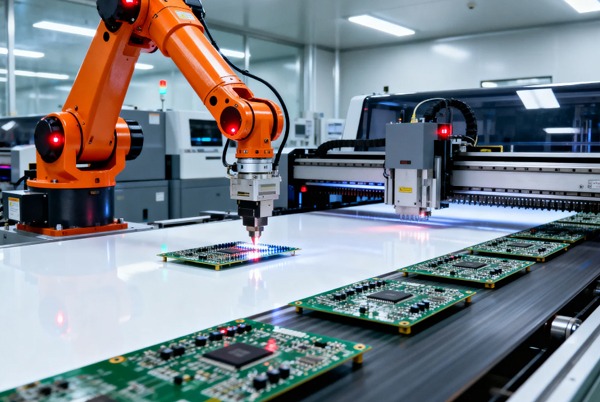
SMT Component Placement Repeatability: The Same Spot Every Time Modern electronics depend on boards that are assembled correctly the first time. Every product – a phone, a charger, a medical instrument or an industrial controller – relies on thousands of solder joints that must conduct current for years. The same…
Shield Can Assembly: Footprint and Solder The Can as an Assembly A shield can is a mechanical part that is also an electrical one, and getting it onto a board reliably is an assembly problem rather than a layout problem alone. The can is a large, thin, flat metal part…
PCB Via Temperature Cycling: Heating and Cooling the Hole Electronics manufacturing has become a discipline of small details. Solder paste volumes, placement accuracy, temperature profiles and inspection limits all add up to the final result. This guide looks at PCB via temperature cycling from the perspective of a PCBA factory…
Humidity and Condensation Testing Why Humidity Is Tested Moisture is involved in a large share of field failures that are not mechanical: it accelerates corrosion, it enables electrochemical migration and conductive anodic filament growth, it changes the dielectric properties of the laminate, it degrades the adhesion between the materials, and…
Thermal Cycling Tests for Assemblies What Cycling Tests A thermal cycling test exposes an assembly to repeated changes in temperature and measures how long it survives. The mechanism it targets is the difference in expansion between the materials: the laminate, the copper, the solder and the component package all expand…
SMT Reflow Solder Paste Shelf Life: How Long the Paste Lasts Electronics manufacturing has become a discipline of small details. Solder paste volumes, placement accuracy, temperature profiles and inspection limits all add up to the final result. This guide looks at SMT reflow solder paste shelf life from the perspective…