
Component Floor Life: Managing Moisture Sensitivity
A plastic package absorbs moisture from the air, and the absorbed water turns to steam when the package is heated to reflow temperature. The pressure that develops can crack the package, delaminate the die attach or lift the bond wires, and much of that damage is invisible from the outside. It is caused by water absorbed before the parts ever reached the assembly line.
Moisture sensitivity management is the set of rules that keeps the absorbed water below the level at which that damage occurs. Floor life, dry packing and the moisture sensitivity level printed on the label are parts of one control system, and the system works only when the clock is started and stopped in the right places.
Why Moisture Matters
The absorbed water is not on the surface, it is distributed through the molding compound and the die attach. Heating drives it out, and if the vapour cannot escape as fast as it forms, the pressure inside the package rises until something gives way. The escape path runs through the molding compound and along the interfaces, and it is narrow.
The failure modes are cracks in the compound, delamination at the interfaces, wire sweep and, in the worst case, a package that splits visibly with the audible popcorning sound. Each reduces reliability, and the visible failures are only a fraction of the population that has been degraded.
What the Level Means
The moisture sensitivity level is a classification describing how long a package may be exposed to a defined ambient before it needs drying. The level comes from a test that exposes the part to controlled humidity, reflows it and then inspects for the failure modes above. A part from one supplier and a part of the same body size from another can carry different levels.
Lower levels are more sensitive. A part at a low level can be exposed for a short time or must be handled in a dry environment, and the classification belongs to the package and the die together rather than to the molding material alone. The figures in a standard are a starting point, and a supplier who demonstrates better performance may publish a longer one.
Floor Life and Its Clock
Floor life counts from the moment the dry pack is opened. Everything after that moment, whether inspection, storage in a normal cabinet or waiting on the line, consumes the allowance, and the count continues whether the parts are being processed or not. The clock belongs to the individual part rather than to the lot once the bag has been opened.

The clock stops when the parts return to a dry environment with a defined humidity. That reset is what makes the classification practical in a plant, and it depends on the humidity of the storage being measured rather than assumed.
Dry Pack and Desiccant
The bag, the desiccant and the humidity indicator are one system. The bag provides a barrier, the desiccant absorbs what passes through it, and the indicator shows whether the desiccant is still working. A saturated desiccant still absorbs slowly, which is why a visual check is not a verification.
A bag opened and resealed repeatedly loses its barrier property, and a bag heat sealed again without new desiccant restarts the exposure with a spent absorber. Seal quality is worth checking, because a poor seal looks like a good one until the indicator is read.
Humidity Indicator Cards
The indicator card is read on opening and the reading is recorded against the lot. It shows the humidity inside the bag at that moment, and a card indicating a saturated condition means the desiccant has been consumed and the parts are no longer in the state the pack was meant to preserve. The card is read within a defined time of opening, because the reading changes as room air enters the bag.
That reading is also a check on the supplier and on the storage before opening. A pack that indicates saturated on arrival has been stored badly somewhere in the chain, and the parts should be treated as having consumed part of their floor life.
Drying and Reset Conditions
Parts whose floor life has expired are returned to a dry state before reflow. The duration and temperature are specified by the applicable standard and by the package thickness, and they are not interchangeable between package types or between body sizes. Drying removes moisture and it also changes the surface condition, which matters for later processes.
The reset is documented rather than assumed. A part that was dried before use has a new clock, and the record of the drying has to travel with the part so the next operation can count from it.
Handling in Production
Production handling is where floor life is consumed fastest, because a magazine of parts waiting for placement is exposed and unaccounted for. Separating the parts in use from the parts waiting, and returning the waiting parts to a controlled cabinet, keeps the count accurate. The cabinet is process equipment, and its humidity is recorded like any other parameter.
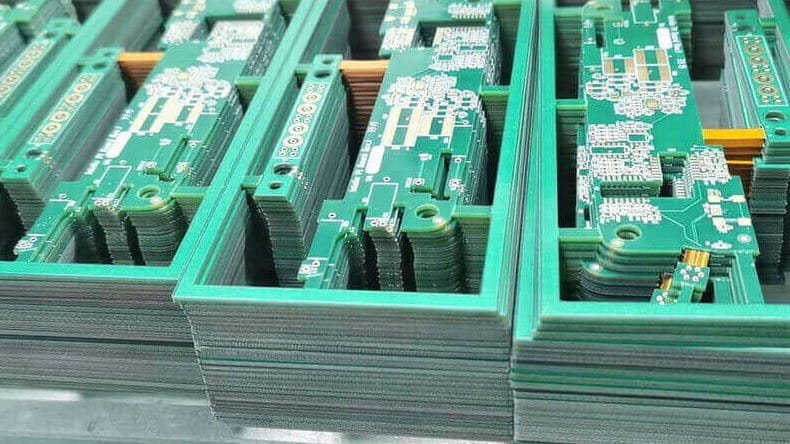
Labels on the magazine carry the time out of the dry environment and the level of the part inside. A magazine without a label holds parts of unknown history, and the safe assumption is that the floor life has been consumed.
Reflow Considerations
The profile matters to a moisture loaded part because the rate at which water is driven out depends on the ramp. A slow ramp lets some moisture leave before the temperature reaches the point at which the internal pressure becomes dangerous, which is why an aggressive ramp is worse for a wet part. The same profile on a dry part and on a wet part produces two different results.
Voids in the joint and voids in the package are different problems with a common origin, and the joint side of the question is described in the notes on voids in BGA joints.
Records and Traceability
The record follows the part from the pack to the reflow oven. It holds the level, the date the pack was opened, the indicator reading, the time in the controlled cabinet and the drying event if one occurred. The record has to be available at the oven, because that is where the decision is made.
With those fields a batch can be shown to have been inside its allowance at the moment of reflow. Without them, the assumption is that it was. An unrecorded drying event is treated as no drying event. The storage side of the same discipline is described in the notes on prepreg and laminate storage, and the effect of moisture on a soldering defect is covered in the notes on blowhole control.
FAQ
Does a sealed bag guarantee that the parts are dry? It preserves the state the parts were packed in. A package that was already wet when it was sealed will still be wet when it is opened.
Can floor life be extended by a normal cabinet? Only if the cabinet humidity is controlled to the value in the classification, and that value is measured rather than assumed.
Is the level the same for every package of the same body size? No. The die, the die attach and the package construction all take part in the classification.