What to Send for an Accurate SMT Assembly Quote
Two factories can be asked to quote the same board and return figures that differ for reasons that have nothing to do with their margins. One of them assumed a single-sided build and the other allowed for two passes; one counted the devices and the other allowed for a device that requires X-ray; one had the complete data and the other had a photograph. An SMT assembly quote is only comparable when both sides are quoting the same scope, which means the enquiry has to carry the scope with it.
The Four Documents
A complete enquiry starts with four files. The Gerber data establishes the board outline, the panel arrangement and the side to be populated. The bill of materials establishes the devices, their quantities, their packages and their brands. The coordinates establish where each device is placed and at what rotation, which is what the machine programme is built from. The assembly drawing resolves polarity and position questions that neither the board legend nor the coordinate file settles on its own.
Alongside the files, six details change the answer and take a minute to write: the quantity for this order and the expected follow-on volume, whether the board is populated on one side or two, whether the material is supplied or purchased, whether the order includes pin-in-hole work, programming and testing, whether any device requires special handling such as a ball grid array, a fine pitch QFN, a shield or a heavy connector, and the date the boards are needed together with the packaging method.
Why the Bill of Materials Drives the Number
A bill of materials that lists generic descriptions cannot be quoted accurately. The engineer needs reference designators, complete part numbers, packages, quantities, manufacturers and the range of acceptable alternatives, and both of the common ambiguities have to be removed: one position served by two different part numbers, and a part number that does not correspond to the package stated next to it.
On consigned work the same document has to state the quantity being sent and the way it is packaged, because tape and reel, tray, tube and loose parts are not handled the same way. The packaging determines the placement side of the preparation as much as the board does: loose or badly oriented components have to be re-packaged before they can be fed, and that time has to appear somewhere in the price.
On turnkey work the review covers the purchasing channel, the availability and the lead time of each line. A shortage, an obsolete part and a device with a long lead all influence the price and, more importantly, the date.
Process Points the Engineer Will Check
Once the data is in hand, the review is about whether the board can be built reliably rather than about counting components. The outline and the panel arrangement are checked for how the board will be handled and separated. The fiducials are checked for number, position and clearance, since a machine that cannot locate the panel cannot place on it accurately. Device spacing is reviewed against the equipment, and the direction of the parts against the assembly drawing.
Where the board carries a ball grid array, a fine pitch device, a shield can or a heavy connector, the quotation has to allow for what those parts require: X-ray inspection, a special stencil aperture, a support under the board, or a manual touch-up stage. A double-sided assembly is quoted as two passes, because printing, placement and reflow are performed twice.
The point of this review is not to raise the price but to make it honest. Discovering a coordinate offset, a footprint that does not match the device or an unclear polarity marking after the first article has been soldered costs far more than confirming it before the order is accepted.
<img src="https://www.gopcba.com/wp-content/uploads/2020/12/project_image_2.jpg" alt="engineer checking placement side and coordinates before quoting” />
The One-Off Costs That Do Not Disappear
A small batch still requires a stencil, a machine programme and a first article. Those items do not scale down with the quantity, and an enquiry that ignores them will produce a quotation that is either too high for a larger order or too low for the prototype. The same is true of the test requirement: a functional test with a specified procedure and limits takes time per board, and a fixture takes time once.
It is therefore worth stating both the quantity now and the quantity expected later. Where the process is the same, the later order reuses the stencil, the programme and the acceptance criteria, and the second price reflects that. Where the process changes — a finer device, a second side, an added test — the quotation changes with it, and knowing the intention in advance produces a more useful answer than optimising a single order.
From Quotation to Release
Once a quotation is accepted, the Gerber data, the bill of materials and the coordinates are frozen at the revision they were quoted against. If the board or the material changes afterwards, the package is re-checked rather than patched, because a production area holding an old file and a new file with similar names is the classic origin of a wrong batch.
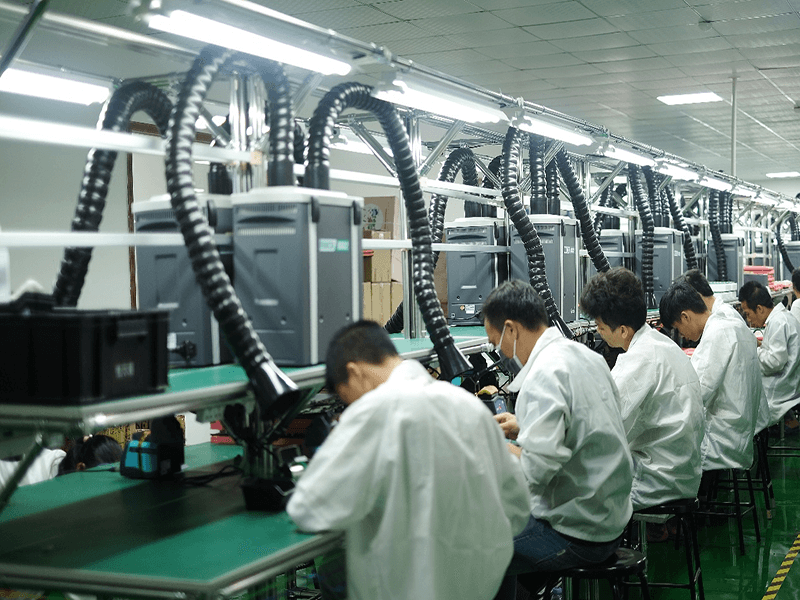
The order then runs through board and material preparation, stencil making, paste printing, placement, first article confirmation, reflow and optical inspection, with insertion, programming and functional verification where they are included. At the end the assemblies are packed in antistatic material and labelled by version and quantity.
Where nothing in the design or the process changes, the next order reuses the confirmed data and tooling, which shortens the import stage considerably. That makes the first enquiry worth doing thoroughly: the information gathered for one quotation becomes the baseline for every order that follows.
The assembly work itself is performed through SMT assembly, with pin-in-hole stages through through-hole assembly, the material side through component procurement, the verification through PCBA testing and the criteria behind the inspection under quality management.
Where the Date Comes From
The date attached to a quotation is built out of material and process, and the two are not equally flexible. If the devices are in stock and the boards are fabricated, a small batch can move through assembly quickly. If one device is on a long lead, no amount of line priority recovers the weeks it takes to arrive, and the assembly date simply moves with it.
That is why an enquiry is more useful when it states whether the material already exists. A customer who holds the components is asking for a purely manufacturing quotation; a customer quoting from a bill of materials is also asking about supply, and the answer will carry a date for the material as well as a date for the build.
Where the schedule is tight, the useful question is which stage is holding it. Boards, stencil, material, fixture and line capacity each respond to different actions, and only some of them respond to money. Asking the question plainly at the enquiry stage produces a realistic date instead of an optimistic one.
FAQ
What is the minimum needed for a quotation? Gerber data, the bill of materials, the coordinates and the assembly drawing, together with the quantity and the date; everything else refines the figure rather than enabling it.
Why does the same board receive different prices? Usually because one quotation assumes a single-sided build, generic material or no test, and the other allows for two passes, specified devices and verification.
Does a small quantity remove the setup cost? No. The stencil, the programme and the first article remain, which is why the unit price of a prototype is higher than that of a production run.