Electrostatic Discharge Safe Packaging for PCB Shipment
An assembled board that leaves the factory in the wrong packaging can arrive electrically damaged without a single mark on it. Electrostatic discharge damage to finished assemblies is usually latent, appearing as leakage or as a marginal input threshold rather than an obvious field failure, which is why packaging is treated as part of the product specification. This article covers the materials, the handling rules and the checks that keep a shipment safe.
How Static Damage Happens to Finished Assemblies
Electrostatic discharge begins when a charged operator or a charged surface touches the first conductor on the board. On a bare board the damage is often cosmetic, but on an assembly the discharge can reach a gate oxide, a thin film resistor or a connector contact and leave a latent defect that passes test and fails in the field.
The discharge path matters as much as the voltage. A board sitting on an insulating foam block is isolated from ground, so a charge on the board cannot equalise and the next contact produces the full discharge. Packaging that provides a controlled, resistive path lets charge equalise slowly instead.
Materials by Surface Resistance Range
Packaging materials are classified by surface resistance. Conductive materials sit below about 1E4 ohms per square, dissipative materials between roughly 1E4 and 1E11, and insulators above that. Conductive and dissipative materials both protect a board, but they behave differently when they touch a live assembly.
Dissipative material is usually preferred for close contact with an assembly, because it drains charge without allowing the rapid current that a conductive surface can produce. Conductive material is used where shielding from an external field matters and where the material will not touch exposed conductors directly.
Surface resistance is measured at a defined humidity, so a material that passes in a dry laboratory can behave differently in a humid warehouse. The measurement condition belongs in the specification alongside the value.
Shielding Bags and Moisture Barrier Bags
A shielding bag has a metallised layer that forms a Faraday cage around the board, so an external field cannot induce a damaging potential inside. The bag must be closed to work, and the closure is usually a fold with a label or a zipper strip rather than a loose twist.
Moisture barrier bags are a different product with a different purpose. They combine a metallised shield with a moisture barrier and are used with desiccant for boards that must arrive dry, such as assemblies carrying moisture sensitive devices or boards with an oxidation sensitive finish.
Pink Poly and Antistatic Foam Limits
Pink antistatic polyethylene prevents charge from building up on the material itself, but it does not shield the contents and it does not drain a charge from the board. It is acceptable as an outer wrap or as a separating layer, and inadequate on its own for a board leaving the building.
Antistatic foam is useful for pin protection, and its limits are similar. The foam stops charge generation but provides no barrier, and some foams shed particles onto the assembly. Where the foam touches gold contacts, a check for residue and for surface resistance is worth doing before it is used in volume.
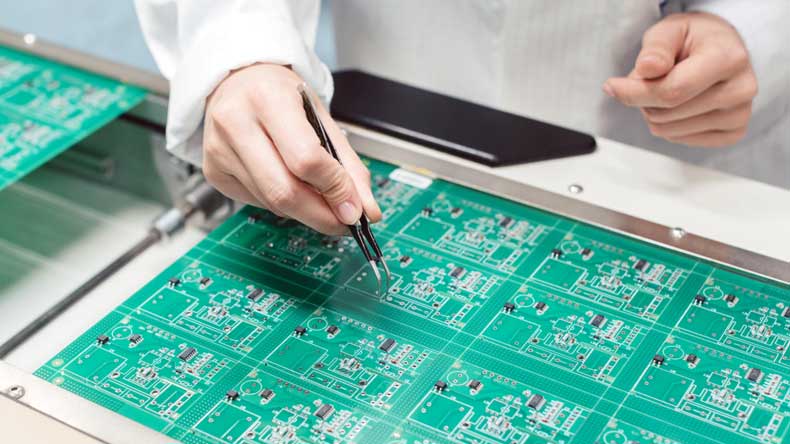
A common mistake is to reuse a shield bag long past its useful life. Metallised layers crease, abrasion removes the coating and the shield becomes a plain plastic bag that still looks correct.
Triboelectric Charging in Transit
Triboelectric charging happens when two materials rub and separate, which is exactly what occurs when boards slide inside a carton during transport. The charge generated depends on the material pair, the contact area and the speed of separation, and it can reach several kilovolts on an insulating surface.
Packing design reduces it. Restraining the board so it cannot move, avoiding insulating films that rub directly against the assembly and using dissipative separators all lower the charge that reaches the board during a long journey.
Card Racks, Trays and Magazine Selection
Racks and magazines are usually made from dissipative plastic or from coated metal. What matters is that every slot is dissipative, that the rack is grounded during handling and that the boards are supported so they cannot touch each other or the frame.
Slot pitch should match the assembly height including any connector that stands above the board. A rack that crushes a connector or forces boards against each other defeats the purpose of the dissipative material, and the damage appears as a mechanical defect rather than a static one.
Desiccant, Humidity and Corrosion Protection
Humidity affects both static behaviour and corrosion. A very dry environment encourages charge generation, while a humid one promotes galvanic corrosion on exposed finishes, so the target is a moderate, controlled condition rather than either extreme.
Where desiccant is used, the quantity has to match the bag volume and the required dry period. A humidity indicator card should be included so that the condition can be checked without opening the bag, and the card has a limited life of its own.
Packaging Assemblies with Batteries or Connectors
Assemblies carrying a battery need additional care, because a short across a battery terminal produces heat rather than a static event. Terminal protection, insulating caps and a rigid separator that prevents crushing are the normal precautions.
Connectors benefit from caps that protect contacts and prevent a discharge path from reaching a pin. Where the assembly has exposed gold contacts, the cap material has to be clean, dissipative and free of sulphur bearing compounds that could tarnish the surface.
Labeling, Handling and Audit Practice
Labels identify the ESD sensitivity, the date the bag was sealed and the humidity condition at packing. Where the board is moisture sensitive, the label also records the bake state, because a bag opened in error has to be repacked and the clock restarted.
ESD audit practice keeps the packaging system honest. Wrist straps, work surfaces and carts are tested at intervals, and the results are recorded. gopcb applies the same expectations to finished goods packing that its customers apply on their own lines, so a packaging specification is part of the order rather than an afterthought.
Incoming packaging material deserves a check as well. Measuring surface resistance on a sample from each lot and confirming that the shield layer is intact catches a supplier substitution before it reaches a customer, and the check takes minutes with a resistance meter.
The final link is the shipping container itself. A carton lined with plain bubble wrap offers no protection at all, while the same carton with a dissipative inner layer and restrained contents meets the intent of the specification without extra cost.
Related reading: our fabrication notes, board quality and design release notes cover the same ground.
FAQ
Is a pink antistatic bag enough to ship a PCB assembly? No. It prevents charge build-up on the bag but provides no shielding and does not drain charge from the board. Use a shielding bag for transport.
How is packaging material verified? By measuring surface resistance on a sample from each lot at the specified humidity, and by inspecting the shield layer for creases and abrasion before reuse.
Does humidity matter inside the bag? Yes. Very dry conditions encourage static generation, while humidity accelerates corrosion on exposed finishes. Desiccant quantity and a humidity indicator card keep the condition visible.