Halogen-Free PCB: PCB Design, PCB Manufacturing, Materials & Applications
Modern electronics are increasingly moving toward more sustainable materials and manufacturing processes. As environmental regulations become more stringent and manufacturers pay greater attention to material composition, the PCB industry is also developing alternatives that reduce the intentional use of halogenated flame-retardant systems.
One important example is the Halogen-Free PCB.
Halogen-free printed circuit boards are manufactured using laminate systems formulated to meet defined limits for halogen content, particularly bromine (Br) and chlorine (Cl). Instead of relying on conventional halogenated flame-retardant systems, many halogen-free laminates use phosphorus-, nitrogen-, or mineral-based flame-retardant technologies.
However, “halogen-free” does not mean that a PCB contains absolutely no halogen atoms. It generally refers to compliance with specified concentration limits. It is also important to distinguish halogen-free requirements from RoHS compliance. RoHS restricts specific hazardous substances, while halogen-free PCB specifications primarily address halogen content.
This guide explains what a halogen-free PCB is, its characteristics and advantages, common applications, materials, manufacturing considerations, differences from conventional FR-4, and how to select an appropriate manufacturing partner.
What Is a Halogen-Free PCB?
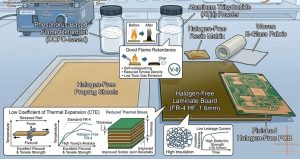
A Halogen-Free PCB is a printed circuit board manufactured using laminate and associated materials whose halogen concentrations remain below specified industry limits.
Traditional FR-4 laminates may use brominated epoxy resin systems to achieve flame-retardant performance. Tetrabromobisphenol A (TBBPA), for example, has historically been used in some epoxy resin systems.
Halogen-free laminates instead use alternative flame-retardant technologies, commonly involving phosphorus- and/or nitrogen-containing chemistries or inorganic fillers.
The objective is to achieve the required flame resistance and electrical performance while reducing the intentional use of brominated and chlorinated flame-retardant systems.
Common Halogen-Free Definition
A commonly referenced industry criterion for halogen-free laminate materials is:
- Chlorine (Cl) ≤ 900 ppm
- Bromine (Br) ≤ 900 ppm
- Total halogens ≤ 1,500 ppm
The exact specification should always be verified against the applicable material standard, customer requirement, and laminate manufacturer’s datasheet.
Therefore, a halogen-free PCB should not simply be described as a board containing “zero halogens.” Instead, it should be understood as a PCB manufactured using materials that satisfy defined halogen-content limits.
Why Are Halogen-Free PCBs Important?
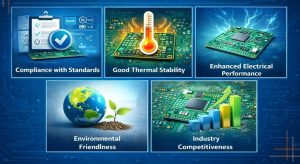
Halogen-containing materials have been widely used because halogenated flame-retardant systems can provide effective fire resistance. However, concerns about the environmental and occupational effects of certain substances released during combustion or improper disposal have encouraged the development of alternative material systems.
Reduced Use of Halogenated Flame Retardants
Halogen-free laminates reduce reliance on brominated and chlorinated flame-retardant systems.
Some halogen-free flame-retardant technologies promote char formation or otherwise interfere with combustion, allowing the laminate to meet required flammability performance without relying on conventional brominated flame retardants.
Environmental Considerations
Environmental performance has become increasingly important throughout the electronics supply chain.
OEMs and electronics manufacturers may specify halogen-free materials as part of their product sustainability requirements, corporate environmental policies, customer specifications, or regulatory strategies.
Important: Halogen-Free Is Not the Same as RoHS
RoHS and halogen-free requirements should not be treated as identical.
RoHS restricts specific hazardous substances in electrical and electronic equipment, including substances such as lead, mercury, cadmium, hexavalent chromium, and certain restricted flame retardants and plasticizers.
A PCB can be RoHS compliant without being halogen-free, and a material should not be labeled halogen-free merely because it is RoHS compliant.
For this reason, engineers should verify both requirements independently when developing a product.
Key Properties of Halogen-Free PCBs
The performance of a halogen-free PCB depends heavily on the specific laminate formulation. Different manufacturers and material families can have significantly different electrical, thermal, mechanical, and processing characteristics.
1. Electrical Insulation
Halogen-free laminates can provide the electrical insulation required for multilayer PCB structures.
Important properties include:
- Dielectric constant (Dk)
- Dissipation factor (Df)
- Volume resistivity
- Dielectric strength
- Insulation resistance
For high-speed designs, Dk and Df should be evaluated at the actual operating frequency and using appropriate test methods.
2. Flame Retardancy
A key requirement of PCB laminates is controlled flammability.
Halogen-free materials can use alternative flame-retardant systems based on technologies such as:
- Phosphorus compounds
- Nitrogen-containing systems
- Mineral fillers
- Hybrid flame-retardant formulations
Some materials can achieve UL 94 V-0 performance, but this must be verified from the individual laminate’s certification and datasheet rather than assumed for every halogen-free PCB.
3. Thermal Performance
Many halogen-free laminates are designed for demanding lead-free assembly processes and may offer relatively high Tg and good thermal stability.
However, halogen-free status itself does not automatically guarantee superior thermal performance.
Engineers should evaluate:
- Tg
- Td
- CTE
- Thermal stress resistance
- T260/T288 performance where specified
- Decomposition characteristics
- Reflow capability
4. Mechanical Strength
A PCB laminate must provide sufficient mechanical strength to withstand manufacturing, assembly, handling, and operation.
Important characteristics include:
- Flexural strength
- Peel strength
- Dimensional stability
- Interlaminar adhesion
- Resistance to delamination
- Moisture absorption
The appropriate properties depend on the PCB structure and manufacturing process.
5. Low Thermal Expansion
The coefficient of thermal expansion (CTE) is important because PCB materials expand and contract as temperature changes.
A controlled CTE can help improve:
- Plated-through-hole reliability
- Microvia reliability
- Solder-joint reliability
- Dimensional stability
- Thermal-cycle performance
The Z-axis CTE is particularly important for multilayer PCB reliability because repeated thermal cycling can place mechanical stress on plated vias.
Advantages of Halogen-Free PCBs
1. Reduced Reliance on Halogenated Materials
The primary benefit is the reduced intentional use of brominated and chlorinated flame-retardant systems.
This can support product sustainability objectives and customer-specific environmental requirements.
2. Suitable for Lead-Free Assembly
Many modern halogen-free laminates are engineered for lead-free soldering and high-temperature assembly processes.
However, the actual assembly capability should be confirmed from the laminate’s processing recommendations.
3. Good Thermal Reliability
Many halogen-free laminate families offer relatively high Tg and good resistance to thermal stress.
This can be useful for multilayer boards exposed to repeated soldering or thermal cycling.
4. High-Speed Electrical Performance
Some advanced halogen-free materials offer stable dielectric properties and relatively low loss.
This makes certain halogen-free laminate systems suitable for:
- High-speed digital circuits
- Networking equipment
- Data-processing hardware
- Automotive electronics
- Communication systems
However, not every halogen-free laminate is a high-frequency material. High-speed applications still require careful Dk, Df, stackup, impedance, and loss analysis.
5. Mechanical Reliability
High-quality halogen-free laminates can provide suitable dimensional stability, adhesion, and mechanical strength for multilayer PCB applications.
6. Support for Sustainability Goals
Companies may choose halogen-free materials to support internal sustainability targets, customer requirements, product environmental declarations, or supply-chain material policies.
The environmental benefits should nevertheless be evaluated across the complete product lifecycle rather than based solely on the absence of halogenated flame retardants.
Applications of Halogen-Free PCBs
Halogen-free PCB materials are used across a wide range of electronic products.
1. Automotive Electronics
Automotive electronics increasingly use sophisticated control, sensing, communication, and computing systems.
Potential applications include:
- ADAS electronics
- Infotainment
- Body-control modules
- Battery-management systems
- Power electronics
- Vehicle networking
- Sensor modules
Automotive PCB materials must satisfy the electrical, thermal, mechanical, and reliability requirements of the specific vehicle application.
2. Industrial Control
Industrial equipment may operate continuously under demanding electrical and environmental conditions.
Halogen-free multilayer boards can be considered for:
- Industrial controllers
- PLC systems
- Motor-control equipment
- Power-management systems
- Automation equipment
- Industrial networking
For high-power applications, thermal performance and electrical safety should be evaluated independently from halogen content.
3. Consumer Electronics
Consumer products are an important application area for environmentally specified PCB materials.
Examples include:
- Smartphones
- Tablets
- Computers
- Home appliances
- Networking equipment
- Smart-home devices
- Wearable electronics
Compact products often require high-density multilayer construction, making material selection an important part of PCB Design.
4. Medical Electronics
Medical electronics can use halogen-free PCB materials where they meet the electrical, thermal, mechanical, environmental, and regulatory requirements of the equipment.
Potential applications include:
- Patient monitoring systems
- Diagnostic equipment
- Laboratory instruments
- Wearable medical electronics
- Medical imaging electronics
The use of a halogen-free material alone does not make a PCB “medical grade.” Medical applications require system-specific compliance, quality controls, and reliability considerations.
5. Telecommunications and Networking
High-speed communication equipment can use advanced laminate systems with controlled dielectric properties.
Applications may include:
- Network switches
- Routers
- Base-station equipment
- Data communication systems
- High-speed computing hardware
For these applications, signal integrity and insertion loss may be more important than halogen-free classification alone.
Halogen-Free PCB vs Standard FR-4 PCB
Halogen-free PCB and conventional FR-4 PCB should not be treated as completely separate PCB categories.
FR-4 describes a broad family of glass-reinforced epoxy laminates, while “halogen-free” describes a material composition criterion. Therefore, a halogen-free PCB can still be considered part of the broader FR-4-family category if it uses an appropriate glass-reinforced epoxy construction.
The actual differences depend on the specific laminate formulations.
| Property | Halogen-Free PCB | Conventional FR-4 PCB |
|---|---|---|
| Resin system | Halogen-free flame-retardant formulation | May use brominated flame-retardant chemistry |
| Halogen content | Designed to meet specified halogen limits | Depends on material formulation |
| Flame retardancy | Achieved using alternative flame-retardant systems | Often achieved using brominated chemistry |
| Tg | Often medium-to-high Tg, depending on grade | Can range from standard to high Tg |
| Thermal performance | Depends on specific laminate | Depends on specific laminate |
| Electrical performance | Depends on Dk/Df and resin formulation | Depends on Dk/Df and resin formulation |
| Environmental specification | Suitable when halogen-free is required | May or may not meet halogen-free requirements |
| RoHS | Can be RoHS compliant | Can also be RoHS compliant |
| Cost | Often higher than commodity materials | Often lower for standard grades |
| Processing | May require process optimization | Widely established processing window |
Important Technical Difference
It is inaccurate to state that every conventional FR-4 PCB contains brominated resin or that every halogen-free PCB has superior thermal performance.
The correct comparison is between the specific laminate datasheets.
Two materials may both be classified as FR-4 but have significantly different:
- Tg
- Dk
- Df
- CTE
- Td
- Moisture absorption
- Peel strength
- Thermal reliability
- Flammability performance
Therefore, material selection should be based on the actual design requirements.
When Should You Choose a Halogen-Free PCB?
A halogen-free PCB may be appropriate when one or more of the following requirements apply:
Environmental Material Requirements
If the OEM, customer, or product specification requires halogen-free materials, the laminate and associated materials should be selected accordingly.
Global Supply-Chain Requirements
Companies selling electronics across multiple markets may adopt stricter material specifications to simplify product qualification and supply-chain management.
High-Temperature Assembly
If the PCB must withstand demanding lead-free reflow profiles or repeated thermal exposure, an appropriate high-Tg halogen-free laminate may provide useful performance.
High-Speed Electronics
Some halogen-free laminates provide suitable dielectric properties for high-speed circuits.
However, engineers should select the material based on actual electrical performance rather than assuming that all halogen-free materials are suitable for high-frequency applications.
Sustainability Programs
Manufacturers with defined environmental objectives may specify halogen-free materials as one part of a broader sustainable product strategy.
Materials Used in Halogen-Free PCB Manufacturing
Halogens can be present in PCB resin systems, flame retardants, additives, and other materials. Therefore, achieving a halogen-free specification requires careful control of the complete material system.
Halogen-Free Prepreg and Laminate
Halogen-free laminates generally use alternative resin and flame-retardant systems.
Examples of commercially available material families include products from major laminate manufacturers such as Panasonic, Isola, EMC, and other suppliers.
Specific product names and availability can change, so engineers should always verify current manufacturer datasheets and certificates before specifying a material.
Phosphorus-Based Flame Retardants
Phosphorus-containing compounds are widely used in halogen-free resin systems.
Depending on the formulation, they can promote char formation and interfere with combustion processes.
Nitrogen-Based Flame Retardants
Nitrogen-containing compounds can also be incorporated into flame-retardant systems.
They may work together with phosphorus-based chemistry to achieve the required fire performance.
Mineral Flame Retardants
Inorganic materials such as aluminum hydroxide or magnesium hydroxide can be used in some flame-retardant systems.
Their suitability depends on the resin system, processing temperature, loading level, and required electrical properties.
Copper Foil
Copper foil remains the primary conductive material used in most halogen-free PCBs.
The choice of copper thickness depends on current-carrying requirements, impedance, thermal management, mechanical considerations, and manufacturing capability.
Solder Mask and Other Materials
A halogen-free PCB specification may also include requirements for solder mask, adhesives, coatings, and other materials.
If a project has strict halogen restrictions, the complete material BOM should be reviewed rather than checking only the laminate.
Halogen-Free PCB Manufacturing Process
The basic PCB Manufacturing process for halogen-free boards is similar to that used for conventional multilayer PCBs.
However, the selected laminate can have different processing characteristics, requiring appropriate manufacturing parameters.
1. Market and Material Requirement Analysis
Before selecting materials, determine whether the product actually requires halogen-free construction.
Consider:
- Customer specifications
- Target markets
- Environmental policies
- Regulatory requirements
- Electrical requirements
- Thermal requirements
- Mechanical requirements
- Cost targets
2. Material Selection
Select a laminate based on:
- Halogen content
- Tg
- Td
- Dk
- Df
- CTE
- Moisture absorption
- Thermal reliability
- Mechanical properties
- Processing requirements
Material certificates and manufacturer datasheets should be retained as part of the product documentation.
3. Prototype Development
Before mass production, prototype boards can be manufactured using the selected material.
Prototype testing should verify both electrical performance and manufacturing compatibility.
4. Manufacturing Process Optimization
The manufacturer’s process parameters may need adjustment based on the selected laminate.
Potentially relevant parameters include:
- Lamination temperature
- Lamination pressure
- Heating profile
- Drilling parameters
- Desmear process
- Plating parameters
- Reflow profile
It is not accurate to assume that all halogen-free laminates require a slower drilling speed or are inherently more brittle. Drilling performance depends on the specific material construction and manufacturer’s processing recommendations.
5. PCB Fabrication
The board is fabricated using standard processes such as:
- Inner-layer imaging
- Etching
- Layer inspection
- Lamination
- Drilling
- Desmear
- Copper plating
- Outer-layer imaging
- Etching
- Solder-mask application
- Surface finishing
- Electrical testing
- Final inspection
6. PCB Assembly
If the project includes assembly, SMT and THT processes must be compatible with the selected laminate and components.
Lead-free reflow profiles should be verified against component and laminate requirements.
7. Testing and Validation
Testing can include:
- Electrical continuity
- Isolation testing
- AOI
- X-ray inspection
- Dimensional inspection
- Thermal testing
- Reliability testing
- Flammability verification where applicable
The exact testing program should be determined according to the product requirements.
Challenges of Halogen-Free PCB Manufacturing
Material Cost
Halogen-free laminate systems can cost more than commodity PCB materials because of resin chemistry, performance requirements, and material qualification.
Processing Differences
Some halogen-free laminates may have different drilling, lamination, moisture, or reflow characteristics.
Manufacturing parameters should therefore be established according to the selected material rather than copied directly from a standard FR-4 process.
Material Availability
Not every PCB laminate supplier stocks every halogen-free grade.
Long-term projects should consider supply continuity and approved alternative materials.
Electrical Performance
Halogen-free status does not automatically indicate low loss or high-speed performance.
For high-speed applications, Dk, Df, resin content, glass style, copper roughness, stackup, and transmission-line geometry all need to be considered.
Cost Optimization
Replacing a conventional laminate with a premium halogen-free material without evaluating the actual requirements may unnecessarily increase cost.
The material should be selected based on the complete product specification.
How to Choose a Halogen-Free PCB Manufacturer
Not every PCB manufacturer has the same experience with specialized laminate materials. When selecting a supplier, consider the following factors.
1. Verify Halogen-Free Material Capability
Ask the manufacturer which halogen-free laminate families they regularly process and whether they can provide relevant material documentation.
2. Evaluate Manufacturing Equipment
Confirm that the supplier has appropriate capabilities for:
- Multilayer PCB production
- Controlled lamination
- Fine-line fabrication
- HDI where required
- Laser drilling
- Surface finishing
- SMT assembly
3. Review Process Knowledge
Manufacturing engineers should understand how the selected laminate behaves during drilling, lamination, plating, solder-mask processing, and assembly.
4. Verify Quality Documentation
Depending on the project, documentation may include:
- Material certificates
- RoHS documentation
- Halogen test reports
- UL documentation
- Process records
- Inspection reports
- Traceability records
5. Evaluate DFM Support
A qualified manufacturer should review the PCB design before production and identify potential issues involving:
- Trace width
- Spacing
- Hole sizes
- Layer registration
- Copper thickness
- Thermal design
- Component placement
- Assembly requirements
6. Consider Long-Term Supply
For commercial products with long lifecycles, material availability and approved second-source strategies should be considered early.
Kingda Halogen-Free PCB Manufacturing Support
Kingda can support projects requiring halogen-free PCB materials and manufacturing processes according to the technical requirements of the application.
Depending on the project, the manufacturing process can incorporate multilayer construction, specialized laminate selection, SMT/THT assembly, controlled impedance, HDI structures, electrical testing, inspection, and DFM review.
For a halogen-free project, the engineering team should define the required halogen thresholds, laminate family, electrical performance, thermal requirements, target certifications, production volume, and applicable environmental specifications before production.
This allows the PCB material and manufacturing process to be selected based on measurable technical requirements rather than simply using “halogen-free” as a general product label.
Conclusion
Halogen-Free PCB technology provides an important material option for electronics manufacturers seeking to reduce their reliance on halogenated flame-retardant systems.
However, halogen-free does not automatically mean zero halogen, RoHS compliance, higher thermal performance, or better electrical performance. These are separate technical characteristics that must be evaluated independently.
The most important considerations when selecting a halogen-free PCB include halogen content, flame-retardant technology, Tg, Td, CTE, dielectric properties, mechanical strength, moisture resistance, manufacturing compatibility, reliability, and total cost.
For PCB Design, engineers should select the laminate according to the actual electrical, thermal, mechanical, and environmental requirements. For PCB Manufacturing, the selected material should be supported by appropriate lamination, drilling, plating, assembly, inspection, and testing processes.
As environmental specifications become increasingly important across automotive, industrial, consumer, medical, telecommunications, and other electronics markets, halogen-free materials will remain an important option in modern PCB development.