High-End Board Supply: Reports, Materials and Scheduling Risk
Supplying a high-end board is a different business from supplying an ordinary one, and the difference shows up in three places: the materials, the measurements and the schedule. The materials are specialised and less freely available, the measurements are what prove that the design’s electrical requirements have been met, and the schedule is long because each process has a floor and they occur in sequence.
When demand for this class of board is strong, all three tighten at once. The purpose of asking the right questions is not to obtain reassurance but to establish which parts of the chain the supplier controls and which they are exposed to.
Materials and What Their Availability Implies
Boards of this class are built on laminates chosen for dielectric behaviour and thermal performance, and those grades are produced in smaller volumes than the standard ones. Copper foils and reinforcement materials used in the fastest designs are similarly constrained.
Two consequences follow. The first is cost, which is a commercial matter the customer can plan for. The second is availability, which is a schedule matter and is less visible in a quotation.
The laminate supply question is therefore worth asking early: which grades are held in stock, which are ordered per project, and what the replacement time is for each. A supplier who knows the answer is describing their exposure, and a customer who hears it can decide whether to accept a longer date, approve an equivalent material or secure the material themselves.
Substitution on this class of board is a design decision rather than a purchasing one. A laminate that differs in dielectric constant changes the impedance of the traces above it, so any replacement has to be assessed against the stack-up rather than against the price.
Structure and the Processes It Requires
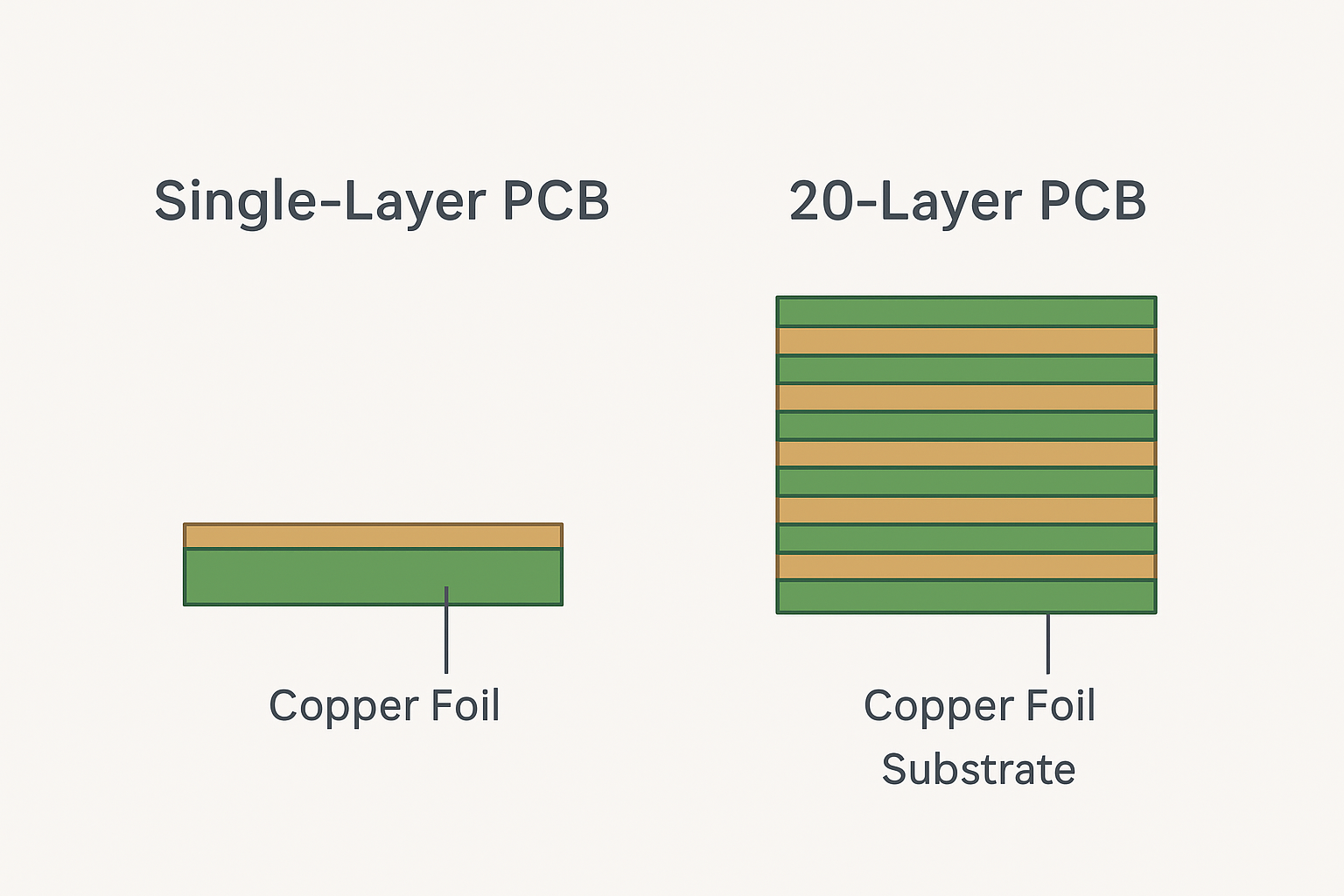
The number of layers is the headline figure, but the structures inside the board are what determine whether a given fabricator can build it. A via that passes through every layer is a simpler proposition than one that terminates at an inner layer, and a stack that requires several lamination cycles is a longer and less forgiving sequence than one that requires two.
Those structures — buried and blind vias, vias placed within pads, and back-drilling used to remove unused portions of a through via — are each supported by processes that have to exist in house. Asking which of them are routine, rather than which are possible, is the question that establishes capability.
Measurements and the Quality Report
On an ordinary board, most of the evidence of quality is visual. On a dense high-speed board, much of it is numerical, and the report that accompanies the delivery is the way the customer verifies that the electrical intention was realised.
The measurements that matter are the impedance of the controlled traces, taken from coupons built into the panel, the results of the electrical test applied to every board, the plating thickness in the holes and, where the design is demanding, a cross-section that shows the inner-layer geometry and the registration.
A useful quality report states what was measured, on how many samples and against which limits, and it identifies the panel or lot. A document that reports only that the boards passed is not a report; it is a statement, and it cannot be compared with the next delivery.
The same file is what makes a repeat order possible. Where the measurements from the first batch are available, the second can be compared against them, and a drift in the process becomes visible before it becomes a problem in the customer’s product.

Lead Time and the Order of Operations
The schedule of a deep stack is a sequence, and each step depends on the one before it. Material is obtained, the inner layers are imaged and etched, the layers are pressed in cycles that take their own time, the board is drilled and plated, the outer layers are formed, and then finishing, testing and inspection follow.
Prioritising an order shortens the waiting between those steps, but it does not remove them. That is why an urgent date on a deep stack is quoted at a premium, and why a promise that is much shorter than the process itself deserves a question about how it will be achieved.
There is also a cumulative effect. Where several orders on the same line are urgent at once, the priority of each declines, and the honest answer to an enquiry is a range rather than a specific day. A supplier who gives a range and explains which item is driving it is more useful than one who gives a precise date derived from a standard.
Capacity, Continuity and the Second Batch
A first delivery proves that the board can be built; it does not prove that the second one will match it. On this class of board, continuity is a question of whether the same process, the same material and the same equipment will be used again, and whether the measurements taken from the first batch are retained for comparison.
That is worth establishing before the order rather than after. A supplier who records the material lot, the lamination parameters and the impedance results is describing a process that can be repeated, and the customer can then treat the second delivery as a confirmation rather than an investigation. Where those records do not exist, the second batch is a new attempt to achieve something that was previously achieved by chance or by the attention of a particular engineer.
Capacity belongs in the same conversation. A plant with demand ahead of its capability will prioritise the customers whose schedules are already committed, and a customer who has a production plan for the coming year is better served by establishing the arrangement than by re-tendering each order. The questions that matter are how far ahead the capacity is committed, whether a repeat order can be reserved, and what the arrangement is when the requirement changes.
What the Customer Should Ask
The questions that produce useful answers are about scope and evidence. What layer count is routine rather than occasional? Which internal structures are produced in house? Which laminate grades are stocked, and what happens when one is unavailable? Which measurements accompany a delivery, and on how many samples? What is the realistic span for this stack, and what would change it?
It is also worth asking what happens when a board fails one of those measurements, since the answer describes how the process is controlled rather than merely how it is documented. Where the requirement is not clear to the customer, the stack-up is the document through which it can be discussed, and it belongs to the designer rather than to purchasing. The assembly that follows the board is covered by SMT assembly, with verification through PCBA testing and the controls under quality management.
FAQ
Why does a high-end board take so long? Because the processes occur in sequence and each has a minimum duration, and heat and pressure cannot be applied to the layers more quickly than the material allows.
Can a laminate be substituted to save time? Only after the electrical consequence has been assessed against the stack-up, since the dielectric properties affect the impedance.
What should accompany a delivery? Measurements rather than assurances: impedance from coupons, electrical test results, plating data and, where relevant, a cross-section.