Twenty to Forty Boards per Robot: Sizing the Humanoid PCB Market
Industry analysis published in September 2026 reported that shipments of humanoid robots in China exceeded forty thousand units in the first half of the year, accounting for ninety-seven percent of the global total. The same analysis, drawing on a humanoid robot industry report released at the 2026 World Robot Conference, noted that a single robot may contain between twenty and forty printed circuit boards. Sizing the humanoid robot PCB market therefore means counting boards per unit rather than units alone.
That figure is the one that matters for the electronics supply chain. Robot unit numbers are still small by consumer standards, but the board content per unit is high, and the boards are diverse. A platform may include compute boards, sensor interface boards, joint controller boards, power distribution boards, battery management boards and communication boards, each with its own fabrication requirements.
Multiplying two modest numbers produces a substantial requirement. Forty thousand robots times twenty to forty boards is between eight hundred thousand and 1.6 million boards in six months, in a category that barely existed in volume three years ago.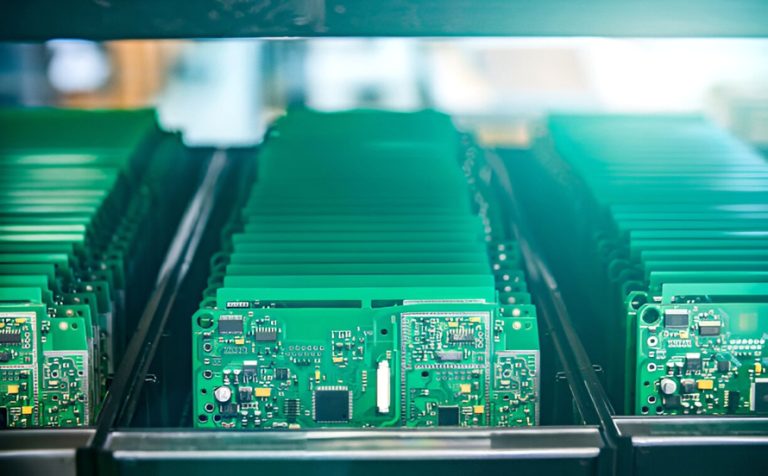
Why Robots Need So Many Boards
The count reflects distributed architecture. Rather than centralising all electronics in one enclosure, humanoid platforms place control close to the actuator, which reduces cable length and improves response. Each joint or joint group therefore has its own driver board, and a robot with thirty degrees of freedom may have a dozen or more joint controllers.
Sensing adds more. Cameras, force sensors, inertial measurement units and tactile arrays all require interface electronics, and those interfaces are usually distributed rather than centralised because the analogue signals are sensitive to noise and distance.
Power adds the rest. A robot needs a battery management system, a distribution board and often local regulation near high-current loads. Each of those is a separate assembly with its own thermal and current requirements, and together they account for a significant share of the board count.
There is a serviceability dimension to the board count as well. A robot with distributed controllers can be repaired by replacing a single joint board rather than scrapping a central unit, which reduces lifetime cost and simplifies field service. That advantage is one of the reasons the distributed architecture persists even though it increases the number of boards, and it means the boards should be designed for replacement rather than permanently integrated.
Finally, the board count changes how a programme evaluates suppliers. Instead of qualifying one manufacturer for one board, a robot company may need a partner who can produce a family of boards with different technologies and hold consistent quality across all of them. That is a broader qualification, and it favours manufacturers with experience across multiple product types rather than specialists in one.
A Portfolio of Very Different Boards
The boards in a humanoid robot are not variations on a single design. A compute board resembles a compact server board, with high layer count, fine features and controlled impedance. A joint controller is a power board with heavy copper, thermal vias and current sensing. A sensor interface board is a mixed-signal design where noise performance dominates. A power distribution board is largely about current capacity and protection.
That spread means a robot programme requires a manufacturer able to run several process regimes under one quality system. It also means the failure modes differ by board type: the compute board fails on signal integrity, the joint controller on thermal fatigue, the sensor board on noise, and the distribution board on current handling.
Test strategy has to reflect that diversity. A single functional test approach will not cover the range, and the fixtures and procedures for each board type must be developed separately. For a programme ramping toward thousands of units, that test development is a substantial engineering effort in its own right, and it belongs in the planning from the beginning rather than after the design is released.
Where the Volume Actually Lands
High-volume boards are the simple, repeated ones: joint controllers and sensor interfaces, which appear many times per robot. Those are where panelisation, automated assembly and test economics matter most, and where a design that can be produced on a standard line delivers the greatest cost benefit.
Low-volume boards are the complex ones: the compute board and perhaps a central power board, which appear once per robot. Those carry the technical risk and the manufacturing difficulty, but their volume does not justify dedicated tooling.
Recognising this split is useful for planning. A programme should decide which boards it will design for manufacturability at volume and which it will accept as low-volume, high-complexity items. Applying volume-oriented thinking to a board that ships once per robot wastes engineering effort; applying prototype thinking to a board that ships thirty times per robot wastes money.
Connector strategy becomes important at this board count. Every board needs at least one connection, and each connection is a potential failure point and a cost. Standardising connectors across joint controllers reduces inventory and assembly errors, but it constrains the current and signal requirements each board can carry. That trade is usually settled early in the platform design and is difficult to change later.
Why Reliability Requirements Are Rising
Early humanoid platforms were evaluated in demonstrations and research settings where a failure was an inconvenience. Robots entering factories, warehouses and homes face operating hours measured in thousands and users who are not engineers. That changes the reliability requirement for every board in the machine.
Thermal cycling, vibration and impact all affect distributed boards more than centralised ones, because joint controllers experience the motion directly. Solder fatigue at connectors and large components becomes a design consideration rather than a theoretical one, and the mechanical layout of the board has to accommodate it.
Traceability follows. A fleet of robots in service will produce failures that need to be attributed to production lots, which requires records linking each board to its build. Manufacturers serving this market need a quality management approach closer to automotive practice than to consumer electronics, even while the volumes remain modest. That is a demanding industrial electronics standard to meet at a young industry’s volumes.
Cost Structure of Robot Electronics
With twenty to forty boards per unit, the cost of the board set is a meaningful fraction of the bill of materials even if individual boards are inexpensive. That creates pressure in two directions: simplify the architecture to reduce board count, and reduce the cost of each repeated board.
Simplifying architecture means consolidating functions, which increases the complexity of the remaining boards and concentrates risk. Reducing per-board cost means standardising across joints, accepting some over-specification in exchange for volume efficiency. Most cost-sensitive platforms do both, and the result is a smaller number of more capable boards.
The choice affects manufacturing as well. Fewer, more complex boards are harder to produce but easier to plan, while many simple boards are easier to produce but require more coordination. For a manufacturer, the second pattern is generally more comfortable because it fits existing board capabilities and can be scheduled predictably.
Manufacturers should also consider how boards are identified and handled. With many similar-looking joint controllers on one line, physical marking and traceability are the difference between controlled production and repeated mix-ups. Marking that survives assembly and testing, and a record that links each board to its position in the machine, are practical requirements rather than formalities.
The board count also has implications for how a robot company organises its engineering. Developing twenty to forty distinct boards requires a team structure and a documentation discipline that a single-board product never needs, and it multiplies the number of suppliers and specifications to manage. Some companies respond by standardising aggressively across platforms, reusing boards between robot generations. That reuse reduces engineering load and improves volume for each board type, and it is one of the clearest signs that a robotics company has moved from prototyping to product development.
Procurement strategy follows the same logic. With many boards per unit, the risk of a shortage in any one of them is multiplied, and a missing joint controller stops an entire robot just as effectively as a missing processor. Classifying boards by lead time and by the availability of alternatives, and holding buffer only where the risk justifies it, is the practical response.
What Suppliers Should Prepare For
Manufacturers intending to serve humanoid robot programmes should expect a mixed portfolio rather than a single product. The capability requirements span dense multilayer and high-density interconnect boards, heavy copper power boards, mixed-signal sensor interfaces and simple control boards, all needing functional test and traceability.
They should also expect design iteration during production, because robot platforms evolve quickly. A process that can absorb changes without invalidating tooling and fixtures is more valuable in this market than one optimised for a completely frozen design.
Finally, they should expect volumes to grow unevenly. Some boards will scale quickly with unit shipments while others remain low volume because they appear once per robot. Planning production around that uneven growth, with a clear view of which boards are on the critical path, is the practical challenge. Manufacturers who can help a customer see that structure, rather than only quoting individual boards, are the ones likely to hold the relationship as the category scales.