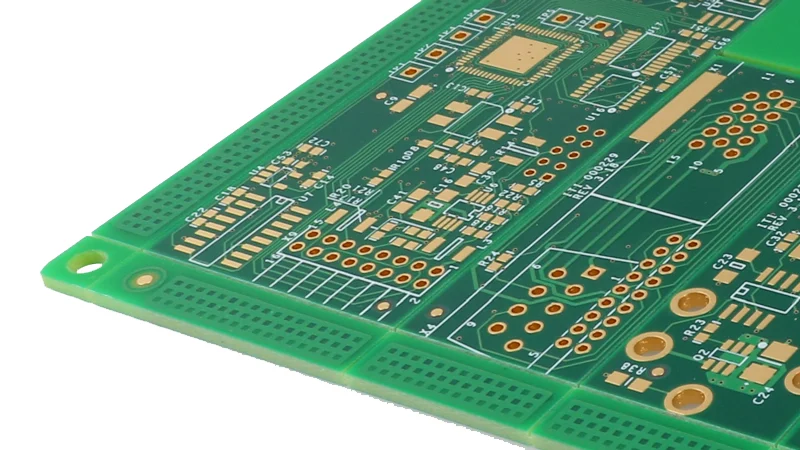
Inner Layer Registration: Control and Measurement
<h2 Why Registration Is the Hardest Tolerance
Every layer of a multilayer board is imaged separately and then bonded together in a press, and the alignment between them is the result of a chain of errors that starts with the artwork and ends with the cooling cycle. Each layer is exposed through a film or a laser, the cores are stacked with prepreg between them, and the whole assembly is pressed at temperature and pressure. The resin flows, the glass fabric moves, the copper and the laminate expand differently, and when the stack cools it does not return exactly to where it started. The residual misalignment is registration error, and because it cannot be corrected after lamination, it has to be designed around and controlled in the process.
<h2 How the Error Accumulates
Artwork or laser imaging contributes its own positional error, and the film itself changes size with temperature and humidity. The tooling that locates the layers introduces an error that depends on the pin fit and the machine. During the press cycle, the layers shift as the resin flows, and the amount depends on the prepreg resin content, the heating rate and the pressure profile. Different materials shrink differently on cooling, and a stack built with laminates from different suppliers or with a mix of thicknesses will move more than one built from a single consistent set. Finally, the drill has to find the pads it was designed to hit, and the drill position adds its own contribution on top of the lamination shift.
<h2 What It Costs When It Goes Wrong
The obvious consequence is a reduced annular ring, which is the copper remaining around a hole after the drill has eaten into the pad. If registration shifts far enough, the pad can be breached, creating an open or a marginal connection that passes test and fails later. Less obvious is the effect on impedance: a shifted inner layer changes the relationship between a trace and its reference plane, which changes the impedance of that trace. A third consequence is a broken connection at an inner layer interface when the pad has been displaced relative to the via, which shows up in a cross section as a partial or missing connection rather than as an open.
<h2 How It Is Measured
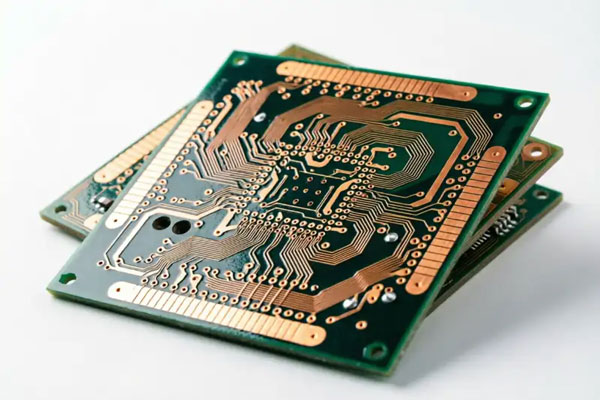
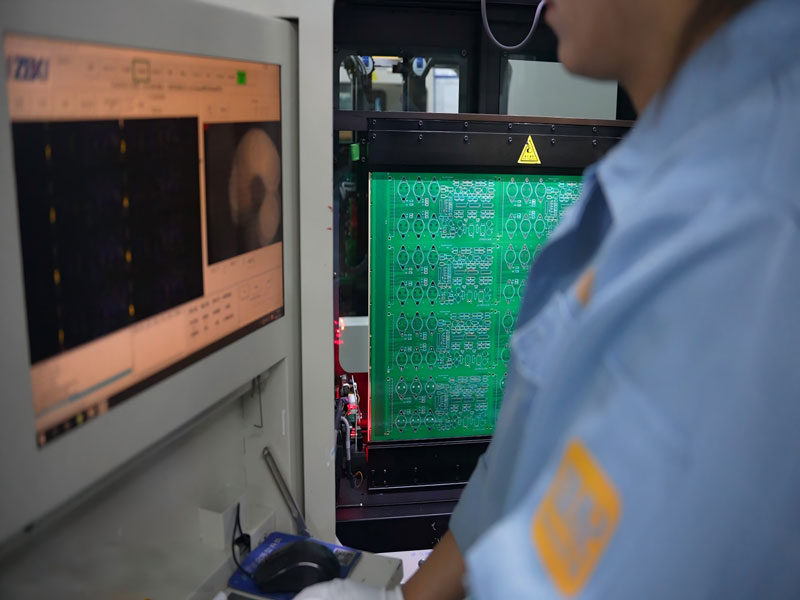
Registration is measured on a coupon designed for the purpose, with targets on each layer that can be read after lamination. The classic coupon has a set of concentric ring targets and a scale that shows how far the layers have moved relative to the design location, and the measurement is normally performed at more than one position on the panel, because lamination shift is not uniform: it is usually worse at the edges than at the centre. Modern shops often use an automated optical measurement instead of a visual coupon, but the principle is the same. The result is compared with the allowance built into the design, and the design allowance is what protects the annular ring when the actual shift is at the limit.
<h2 Controls That Hold the Registration
The most effective controls are material consistency, press profile discipline and tooling condition. Using laminates and prepregs with the same construction and preferably the same supplier keeps the shrinkage behaviour consistent between orders, which is why a change of material can move registration even when nothing else changed. The press profile controls resin flow, and a profile that has been validated should not be adjusted without checking the shift afterwards. Tooling pins, plates and the condition of the locating holes matter because a loose fit allows movement before the resin has hardened. Imaging scale compensation is the final control: the artwork for each layer can be scaled slightly to compensate for the known shrinkage of that layer, which is standard practice on fine pitch multilayer work.
<h2 Designing Around the Limit
Registration is a process property, so the design has to provide the margin. That means an annular ring sized for the class plus the registration allowance, not the class minimum alone, and it means avoiding pad and via geometries that leave no room for a shift. On fine pitch inner layers, moving a via or reducing the number of layers may be a better answer than tightening the tolerance, because the process cannot be tightened indefinitely. Where the design has to push the limit, the coupon data should be reviewed per lot rather than accepted as a declaration, since it is the only evidence that the allowance was sufficient on that particular panel.
FAQ
What is layer registration? The alignment between the layers of a multilayer board after lamination, measured as the positional error relative to the design location.
Why does misregistration matter? It reduces the annular ring, can breach a pad, changes the impedance of traces referenced to the shifted layer and can produce a partial connection at an inner layer interface.
What causes it? Imaging error, tooling fit, resin flow during pressing, differential shrinkage on cooling and the drill position, all accumulating into a single result.
Where is registration worst? Usually at the panel edges rather than the centre, which is why coupons are measured at more than one position.
How is the risk reduced? Consistent materials, a validated press profile, maintained tooling, artwork scale compensation and a design annular ring that includes an allowance for the shift.
Conclusion
Registration is the sum of every positional error in the process, and it cannot be corrected once the stack is laminated. Hold the materials and the press profile consistent, keep the tooling fit tight, compensate the artwork for known shrinkage, and design an annular ring that includes a realistic allowance rather than the class minimum. The construction and tolerance limits available are part of PCB capabilities, the annular ring and via planning belongs in PCB design and layout, and the lamination process that determines the result is described in PCB manufacturing. A prototype PCB assembly build with registration coupon data confirms the stack before volume in 2026.