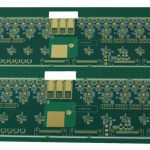
Legend Ink Selection and Silkscreen Quality Control
The legend is the printed information layer that tells an assembler where a component goes, which way round it fits and what the board is. It is not a structural layer and it is often treated as an afterthought, yet a legend that is illegible, misplaced or missing is one of the most common causes of an assembly error and one of the easiest things for a customer to reject. Legend ink is chosen once for a product family and then rarely revisited, which is exactly why it deserves a proper decision at the start of a project.
What the Legend Has to Do
The legend has to identify components, show orientation, carry the reference designators and the part number, and do all of that without interfering with any pad, via or test point. It also has to survive the soldering process, the cleaning chemistry and the handling that follows. It also has to stay legible after the mask has been cured, the finish applied and the board placed in a reflow oven twice.
Those requirements pull in different directions. Small text saves space but becomes illegible after printing, and a thick ink layer gives good contrast but can flow onto a pad edge during curing. A workable legend is the result of choosing an ink and a print setup that satisfy both constraints at the same time. Getting that balance right is a printing question rather than a chemical one, and it is settled by a first article check rather than by a specification sheet.
Ink Types and Their Behaviour
Two families dominate. Epoxy based legends are the traditional screen printed inks, with excellent chemical resistance and a heavy, opaque deposit. Ultra violet curable inks are printed by the same equipment but are cured with light, which allows a thinner deposit and a faster process. Both are applied with silkscreen printing equipment, so the condition of the screen or the stencil is as important as the ink itself.
Thermal cure inks are more forgiving of a partly shadowed area, while light cure inks need the correct wavelength and intensity to reach the full depth of the film. The ink has to be matched to the surface it sits on as well, because a legend printed over a smooth solder mask behaves differently from one printed over a textured surface. Ink that adheres well to a cured mask may not adhere to a mask that was over cured, so the two processes should be developed together rather than separately.

Print Resolution and Minimum Text
Resolution is limited by the mesh or the stencil, the ink rheology and the surface underneath. The practical minimum line width and the minimum character height are stated by the fabricator, and text below that limit will print as a smear regardless of how good the artwork is. The screen mesh, the squeegee pressure and the snap off distance all set the practical limit, and the limit should be published to the designer rather than discovered at inspection.
Character shape matters as much as size. A font with thick uniform strokes and generous spacing stays readable at a smaller height than a decorative font, and a solid font printed in a single pass is more legible than an outline font that relies on two thin lines to define a letter. Character spacing matters as well, because two letters that touch each other on the print become a single ambiguous shape on the finished board.
Registration to the Pads
The legend has to be registered to the copper, not to the board edge, and the registration tolerance is usually looser than the mask tolerance. That looseness is what allows the ink to encroach on a pad opening and cause a soldering defect that looks like a mask problem. Clipping the legend in the fabrication file keeps the pads clear, but the text that is removed may be exactly the reference designator an operator needed.
Designers can reduce the risk by keeping legend features clear of the pad opening by a defined distance and by avoiding legend over any surface mount pad. Where space is tight, the reference designator can be placed on the opposite side of the component rather than beside it. Keeping a defined keep out around every pad opening is a simple design rule that removes an entire class of assembly complaint.

Cure and Adhesion
The legend is cured after printing, and the cure has to be complete enough for the ink to resist the flux, the cleaning chemistry and the mechanical handling of assembly. An under cured legend stays soft, smears under a finger and can be washed off in an aqueous cleaner.
Over curing causes the opposite problem. A brittle ink cracks along the edge of a pad, flakes during depaneling and loses contrast as the surface dulls. The cure profile should be verified with a travelling thermocouple on a production panel rather than trusted to the oven display. Registering the print and the cure together as one process, rather than as two independent steps, is what makes the legend reliable over a long run.
Colour and Contrast
White legend on green mask is the traditional combination, and it remains the easiest to read under the lighting used on most assembly lines. Black, yellow and other colours are available, and each has a different opacity and a different tendency to show the surface beneath it. The approved colour should be agreed on a physical sample, because a screen rendering of a colour is not a reliable guide to the printed result.
Contrast is what actually matters. A white legend over a very light mask colour has poor contrast even though the print quality is perfect, while a black legend over white mask is exceptionally readable in a camera inspection system. Our surface finish guide describes how the mask and the legend interact during soldering. Where an inspection camera is used, the contrast between the ink and the mask affects the read rate, so the choice has a measurable effect on the line.
Legend Over Pads and Vias
Printing legend over a pad is a defect because it stops the solder wetting, and printing it over a via can trap flux or solvent in the hole. Both situations are usually avoidable at the design stage by moving the text rather than by asking the fabricator to clip it. A via that must remain open should be left clear, because legend printed over it can be pushed into the hole during cure and trap solvent.
Where the density leaves no room, the fabricator can clip the legend automatically, but the result is unpredictable and the customer may not accept it. It is far better to remove the conflicting text in the design file and to accept a smaller or abbreviated reference designator. An abbreviated designator is still useful to an operator, whereas text that has been clipped into an unreadable fragment is not.
Defects and Inspection
The common legend defects are missing text, blurred or smeared characters, ink on pads, legend printed off position and a colour that does not match the approved sample. Each of them is judged against a sample or against a written standard, because the judgement is partly subjective. Giving the operator a boundary sample of the worst acceptable print removes most of the variation between shifts.
Automatic optical inspection can check for missing and misplaced legend, but it cannot easily judge legibility, so a human check against the approved sample remains part of the process. Our quality documentation describes how these results are classified at gopcb.
Process Control Points
The controls are the ink lot and its viscosity, the screen or stencil condition, the print parameters, the cure profile and the registration measurement. Every one of those is repeatable, and every one of them can drift during a long production run. Squeegee wear and ink drying on the screen are the two most common causes of a slow drift in print quality.
The best defence is a first article check against the approved sample followed by periodic checks through the run. Our fabrication notes guide lists the data that should accompany an order, and the legend specification belongs in that list alongside the stack up and the finish. Treating the legend as a specified requirement rather than as decoration is what stops it from becoming a late change order.
FAQ
What is the minimum legible text height? It depends on the print process and the ink, but most fabricators quote a practical limit and will reject artwork below it. A uniform, solid font remains readable at a smaller size than a decorative one.
Can legend be printed over a pad? It should not be, because the ink stops the solder wetting and can flake into the joint. The text should be moved or abbreviated at the design stage instead.
Why does white legend turn yellow after assembly? Heat exposure during reflow or an incomplete cure can discolour the ink. A verified cure profile and a stable ink lot keep the colour inside the approved range.