Manual vs. Automated PCBA Cleaning: Methods, Benefits, and Best Practices
Choosing the right PCBA cleaning method is an important part of maintaining the quality, reliability, and long-term performance of electronic assemblies. Depending on production volume, PCB complexity, contamination type, equipment investment, and quality requirements, manufacturers may choose between manual cleaning and automated cleaning processes.
Manual cleaning provides operators with direct control over the cleaning process and is often suitable for prototypes, repair work, rework, and low-volume production. Automated cleaning, on the other hand, provides greater consistency, repeatability, and process efficiency, making it particularly suitable for medium- to high-volume PCB assembly production.
Regardless of the method selected, effective cleaning is essential because flux residues, solder paste residues, dust, oils, and other contaminants can affect electrical performance and long-term reliability. A well-controlled cleaning process can reduce contamination-related failures, improve product quality, and extend the service life of PCBA products.
Key Takeaways
- Manual PCBA cleaning offers excellent process flexibility and direct operator control, making it suitable for prototypes, rework, repairs, and small production batches.
- Automated PCBA cleaning provides consistent and repeatable results and is more appropriate for medium- and high-volume production.
- The correct cleaning method depends on PCB design complexity, production volume, contamination type, component sensitivity, cleaning requirements, and overall manufacturing cost.
- After cleaning, PCBs should be properly dried and inspected to verify that residues and moisture have been effectively removed.
- Selecting the appropriate cleaning chemistry, equipment, and process parameters is essential for preventing component damage and maintaining assembly reliability.
- A comprehensive cleaning process should include cleaning, rinsing when required, drying, inspection, and functional or reliability testing.
Why Is PCBA Cleaning Important?
During the PCB assembly process, various contaminants may remain on the board after soldering and component placement. If these contaminants are not properly removed, they can negatively affect electrical performance, mechanical reliability, and the long-term durability of the assembly.
Flux Residues and Reliability
Flux is widely used during soldering to improve solderability and remove oxides from metal surfaces. Although some modern flux formulations are designed to leave minimal or no-clean residues, residues may still remain on the PCB surface depending on the soldering process, flux chemistry, thermal profile, and application conditions.
Potential contaminants include:
- Flux residues
- Solder paste residues
- Dust and fibers
- Fingerprints and skin oils
- Ionic contamination
- Cleaning-agent residues
- Manufacturing debris
- Environmental particles
Some residues can absorb moisture from the surrounding environment. Under suitable conditions, ionic contamination combined with moisture and electrical bias may contribute to electrochemical migration, leakage current, corrosion, or other reliability problems.
For high-reliability electronics, cleaning should therefore be considered as part of the overall manufacturing quality-control process rather than simply an aesthetic procedure.
Common PCBA Contaminants
Different contaminants require different cleaning approaches.
Flux residues are among the most common contaminants following soldering. Depending on the flux chemistry, they may be removed using compatible aqueous or solvent-based cleaning processes.
Dust and fibers can accumulate around components, connectors, and other mechanical structures. Although they may not always create immediate electrical problems, excessive contamination can affect assembly cleanliness and thermal management.
Fingerprints and oils can introduce organic contamination during manual handling. Proper gloves and ESD-safe handling procedures can help prevent these contaminants from reaching the PCB surface.
Ionic contaminants are particularly important for high-reliability applications because they may contribute to leakage currents, corrosion, and electrochemical migration when moisture and electrical bias are present.
For this reason, effective PCB cleaning should be followed by appropriate inspection and, where required, cleanliness testing.
PCBA Cleaning Methods: Manual vs. Automated
There are two broad approaches to PCBA cleaning: manual cleaning and automated cleaning.
The most appropriate method depends on the product requirements rather than simply the size of the PCB.
Manual PCBA Cleaning
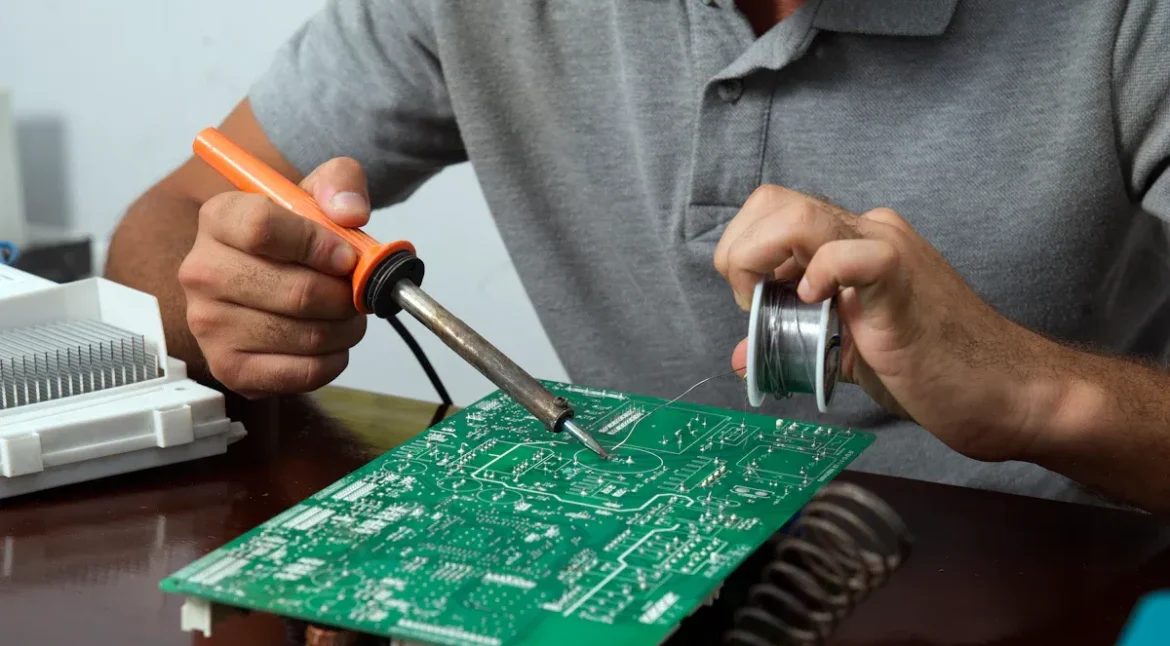
Manual cleaning uses cleaning agents, brushes, wipes, sprays, or other hand-operated tools to remove contaminants from the PCB surface.
It is commonly used for:
- Prototype PCBs
- Engineering samples
- Small production batches
- PCB rework
- Repair and maintenance
- Localized contamination removal
- Assemblies that require selective cleaning
One of the main advantages of manual cleaning is flexibility. Operators can visually inspect the board and concentrate on areas where contamination is most severe.
However, manual cleaning relies heavily on operator skill and consistency. Small gaps beneath components, between fine-pitch leads, or around densely populated areas may be difficult to clean thoroughly.
Automated PCBA Cleaning
Automated cleaning uses dedicated equipment to clean PCB assemblies according to controlled process parameters.
Depending on the application, automated systems may use:
- Aqueous cleaning
- Semi-aqueous cleaning
- Solvent-based cleaning
- Spray cleaning
- Immersion cleaning
- Ultrasonic cleaning
- Multi-stage cleaning and rinsing systems
Automated systems can provide controlled cleaning time, temperature, pressure, chemical concentration, and drying conditions. This makes them particularly valuable for high-volume production where process repeatability is critical.
For complex assemblies with dense component placement, automated cleaning can also provide more consistent access to difficult-to-reach areas than manual cleaning.
How to Choose the Right PCBA Cleaning Method
Selecting a cleaning method requires consideration of several factors.
1. Production Volume
Production volume is one of the most important factors.
For prototypes, repairs, and small batches, manual cleaning can often be more economical because it requires limited equipment investment.
For high-volume manufacturing, automated cleaning can significantly reduce labor requirements and provide better process consistency.
2. PCB Design Complexity
PCB layout and component density also influence cleaning requirements.
Simple boards with relatively large component spacing may be easier to clean manually.
Complex assemblies containing fine-pitch components, BGAs, connectors, shields, and densely populated areas may benefit from a controlled automated cleaning process.
3. Type of Contamination
Different contaminants require different cleaning chemistries.
For example, a cleaning process designed for removing water-soluble flux may not be optimal for removing certain no-clean or resin-based flux residues.
Before selecting a cleaning agent, manufacturers should consider:
- Flux chemistry
- Solder paste formulation
- Component materials
- PCB surface finish
- Adhesives and coatings
- Cleaning equipment compatibility
- Environmental and safety requirements
4. Component Sensitivity
Not every PCB assembly can tolerate the same cleaning conditions.
Sensitive components, MEMS devices, switches, relays, connectors, sensors, and certain coatings may require special consideration.
Cleaning pressure, temperature, chemical concentration, exposure time, and drying conditions should be validated against component and assembly specifications.
5. Total Cost of Ownership
Manual cleaning generally requires less initial investment, while automated systems require equipment, installation, utilities, maintenance, and operator training.
However, for high production volumes, automated cleaning may reduce the cost per board through improved throughput, lower labor requirements, and reduced process variation.
Manual PCBA Cleaning Process
A typical manual cleaning process may include the following steps.
Step 1: Prepare the Work Area
Use a clean, well-ventilated work area and follow appropriate ESD protection procedures.
Operators should wear suitable gloves to prevent fingerprints and oils from contaminating the PCB.
Step 2: Apply the Cleaning Agent
Apply a compatible PCB cleaning solution to the contaminated area.
Isopropyl alcohol (IPA) is commonly used for certain cleaning applications, while specialized PCB cleaning formulations may provide better performance for specific flux residues.
The cleaning agent should always be verified for compatibility with the PCB materials, components, coatings, labels, and adhesives.
Step 3: Agitate the Contamination
Use an appropriate ESD-safe or chemically compatible brush to gently agitate the contaminated areas.
Pay particular attention to:
- Component leads
- Fine-pitch components
- Connector areas
- Around solder joints
- BGA regions where accessible
- Areas containing visible flux residue
Excessive mechanical force should be avoided because it may damage components or solder joints.
Step 4: Rinse When Required
If the selected cleaning chemistry requires rinsing, use an appropriate rinse medium.
For aqueous processes, deionized water may be used when specified by the cleaning process.
The exact water quality requirements should be defined according to the cleaning chemistry and cleanliness standard rather than assuming that all applications require the same rinse conditions.
Step 5: Dry the PCB
Remove residual moisture using clean, dry air or an appropriate drying system.
The PCB should be completely dry before electrical testing, packaging, or further processing.
Step 6: Inspect the Assembly
Inspect the PCB under appropriate lighting or magnification.
Look for:
- Visible flux residues
- Water marks
- Cleaning-agent residues
- Particles
- Corrosion
- Damaged components
- Moisture trapped beneath components
For critical applications, additional cleanliness testing may be required.
Step 7: Store the Clean PCB Properly
After cleaning and inspection, store the PCBA in a clean, dry, protected environment to prevent recontamination.
Tools and Materials for Manual PCB Cleaning
Common tools include:
- Cleaning tray
- Compatible PCB cleaning solution
- IPA or specialized PCB cleaning chemistry
- ESD-safe brushes
- Lint-free wipes
- Protective gloves
- Deionized water when required
- Clean compressed air or air gun
- Magnification equipment
- Clean storage containers or bags
The selection of tools should be based on the PCB design and the requirements of the cleaning chemistry.
Advantages of Manual PCBA Cleaning
Manual cleaning offers several benefits:
- Lower initial equipment investment
- High process flexibility
- Suitable for prototypes and low-volume production
- Effective for localized contamination
- Easy to perform during repair and rework
- Allows direct operator inspection
- Easy to adapt to different PCB designs
Manual cleaning can therefore be a practical solution when production volume is limited or when only specific areas require cleaning.
Limitations of Manual PCBA Cleaning
Despite its flexibility, manual cleaning has several limitations.
- Lower throughput
- Higher labor requirements
- Greater dependence on operator skill
- Potential variation between operators
- Difficult access to densely populated areas
- More challenging to maintain consistent results in high-volume production
For complex PCB assemblies, insufficient cleaning in hidden or restricted areas may create quality and reliability risks.
Automated PCBA Cleaning
Automated cleaning is designed to improve process consistency and production efficiency.
Depending on the equipment and application, automated systems may combine cleaning, rinsing, and drying into a controlled production cycle.
Types of Automated PCB Cleaning
Aqueous Cleaning
Aqueous cleaning uses water-based cleaning chemistry to remove contaminants.
It is commonly used for removing many types of flux residues and process contaminants.
A typical process may include:
- Cleaning
- Rinsing
- Final rinsing
- Drying
Water quality and cleaning-agent concentration should be controlled throughout the process.
Semi-Aqueous Cleaning
Semi-aqueous processes combine water with specialized cleaning agents or solvents.
They can be useful when contamination is more difficult to remove than typical water-soluble residues.
Solvent-Based Cleaning
Solvent cleaning uses chemical solvents selected for specific contamination types.
This approach can provide effective removal of certain organic residues, but compatibility, worker safety, ventilation, environmental regulations, and material compatibility must be carefully considered.
Ultrasonic Cleaning
Ultrasonic cleaning uses high-frequency acoustic energy transmitted through a liquid cleaning medium.
The resulting cavitation can help remove contaminants from difficult-to-reach areas.
However, ultrasonic cleaning should not be treated as universally suitable for every PCBA. Certain components, crystals, MEMS devices, ceramic components, or mechanically sensitive structures may require restrictions or alternative cleaning methods.
Always validate the ultrasonic process against the component manufacturer’s recommendations.
Automated PCBA Cleaning Process
A typical automated cleaning process includes several controlled stages.
Step 1: Prepare the Cleaning System
Check the equipment, cleaning solution, water quality, filters, nozzles, and other process components.
Step 2: Load the PCB Assembly
Place the PCBAs into the cleaning system according to the equipment manufacturer’s loading requirements.
Boards should be positioned to ensure appropriate cleaning-agent coverage and drainage.
Step 3: Configure Process Parameters
Depending on the equipment, parameters may include:
- Cleaning temperature
- Cleaning time
- Spray pressure
- Chemical concentration
- Conveyor speed
- Rinse flow
- Drying temperature
- Air pressure
These parameters should be validated rather than selected solely based on general recommendations.
Step 4: Perform the Cleaning Cycle
The machine applies the selected cleaning chemistry according to the programmed process.
For complex assemblies, multiple cleaning stages may be required.
Step 5: Rinse the PCB
When required, the PCBA is rinsed to remove remaining cleaning chemistry and loosened contaminants.
Deionized water may be used in suitable aqueous processes.
Step 6: Dry the Assembly
The system uses controlled air, vacuum, heat, or other drying technologies to remove moisture.
Complete drying is particularly important before electrical testing and packaging.
Step 7: Inspect and Verify Cleanliness
After cleaning, inspect the assembly for visible contamination and potential process defects.
For high-reliability products, ionic contamination testing or other cleanliness verification methods may also be appropriate.
Advantages of Automated PCBA Cleaning
Automated cleaning provides several important benefits:
- High production throughput
- Repeatable cleaning results
- Lower dependence on manual labor
- Better process control
- Suitable for complex PCB assemblies
- Improved production consistency
- Easier process documentation and monitoring
- Better scalability for mass production
For manufacturers producing large quantities of PCB assemblies, automated cleaning can provide significant operational advantages.
Limitations of Automated PCBA Cleaning
Automated cleaning also involves several challenges:
- Higher initial equipment investment
- Equipment maintenance requirements
- Higher process setup complexity
- Operator training requirements
- Utility and facility requirements
- Chemical handling and environmental considerations
- Potential production disruption if equipment fails
Manufacturers should therefore evaluate both production requirements and total operating costs before investing in an automated system.
Manual vs. Automated PCBA Cleaning: Comparison
| Factor | Manual Cleaning | Automated Cleaning |
|---|---|---|
| Production volume | Low to medium | Medium to high |
| Initial investment | Low | High |
| Labor requirement | High | Lower |
| Process consistency | Operator-dependent | Highly repeatable |
| Throughput | Lower | Higher |
| Complex PCB assemblies | More challenging | Generally more suitable |
| Localized cleaning | Excellent | May require special setup |
| Process control | Primarily manual | Automated and programmable |
| Maintenance | Relatively simple | Requires scheduled maintenance |
| Best application | Prototypes, repairs, rework, small batches | Mass production and complex assemblies |
Cleaning Quality and Inspection
Cleaning alone does not guarantee a reliable PCBA.
A complete PCB assembly cleaning process should include appropriate verification.
Depending on product requirements, manufacturers may use:
- Visual inspection
- Microscope inspection
- UV inspection for specific residues
- Ionic contamination testing
- Surface insulation resistance testing
- Electrical testing
- Functional testing
- Reliability testing
The inspection method should be selected according to the product’s risk level and applicable industry requirements.
For high-reliability electronics, cleanliness verification can be particularly important because contamination may not always be visible to the naked eye.
Best Practices for PCBA Cleaning
To achieve consistent results, manufacturers should establish a controlled cleaning procedure.
1. Select the Cleaning Chemistry Carefully
Do not assume that one cleaning agent works for every type of residue.
The cleaning chemistry should be compatible with the flux, solder paste, PCB materials, component packages, conformal coatings, adhesives, and other assembly materials.
2. Control Cleaning Parameters
Temperature, time, pressure, chemical concentration, and drying conditions can significantly affect cleaning performance.
These parameters should be documented and monitored.
3. Avoid Excessive Mechanical Force
When manually cleaning, excessive brushing or scraping can damage solder joints, component markings, coatings, or sensitive components.
4. Prevent Recontamination
Operators should use clean gloves, tools, wipes, and storage containers.
A PCB that has already been cleaned should not be placed on a contaminated work surface.
5. Ensure Complete Drying
Residual moisture can cause problems during electrical testing, storage, and operation.
Make sure the PCBA is completely dry before proceeding to the next manufacturing stage.
6. Validate the Cleaning Process
For new PCB designs, new cleaning agents, or new equipment, process validation should be performed before full-scale production.
7. Maintain Cleaning Equipment
Automated cleaning systems should be regularly inspected and maintained.
Filters, nozzles, pumps, water quality, chemical concentration, and drying systems should be monitored according to the equipment manufacturer’s maintenance requirements.
How Kingda Supports High-Quality PCB Assembly
For manufacturers seeking reliable electronic manufacturing solutions, cleaning should be integrated into the broader PCB assembly quality-control system.
At Kingda, a controlled manufacturing approach can help ensure that PCB assemblies are produced with consistent process management from component placement and soldering through inspection, cleaning, testing, and final delivery.
The appropriate cleaning method should be selected according to PCB design, component characteristics, production volume, contamination type, and reliability requirements.
Whether a project requires manual cleaning for prototypes and rework or automated cleaning for high-volume production, the objective remains the same: remove unwanted contaminants without damaging the PCB assembly and maintain stable product reliability.
Frequently Asked Questions About PCBA Cleaning
What is the best cleaning agent for manual PCBA cleaning?
Isopropyl alcohol (IPA) is commonly used for certain manual PCB cleaning applications. However, specialized PCB cleaning agents may provide better results for particular flux chemistries.
The cleaning agent should always be verified for compatibility with the PCB substrate, components, coatings, adhesives, labels, and other materials.
How often should a PCBA be cleaned?
Cleaning frequency depends on the soldering process, flux type, product requirements, and cleanliness specifications.
For assemblies where residue removal is required, cleaning is typically performed after soldering and before subsequent inspection, testing, or protective processing.
Not every assembly necessarily requires the same cleaning process, especially when qualified no-clean materials are used.
Can tap water be used to clean a PCBA?
Tap water is generally not recommended for the final rinse of high-reliability PCB assemblies because it contains dissolved minerals and ions that may leave residues.
Where an aqueous cleaning process requires a controlled final rinse, appropriately specified deionized or purified water is commonly used.
The required water quality should be defined according to the cleaning process and cleanliness requirements.
Is automated cleaning safe for every PCB design?
No.
Automated cleaning is suitable for many PCB assemblies, but the cleaning process must be compatible with the components and materials used on the board.
Sensitive components, MEMS devices, crystals, switches, connectors, batteries, coatings, and mechanically fragile structures may require special cleaning conditions.
Always verify the cleaning requirements with the relevant component and material manufacturers.
Which is better: manual or automated PCBA cleaning?
Neither method is universally better.
Manual cleaning is generally more suitable for prototypes, repairs, rework, localized contamination, and low-volume production.
Automated cleaning is generally more suitable for high-volume production, complex assemblies, and applications requiring consistent and repeatable process control.
The best solution is the one that provides the required cleanliness level while protecting components, meeting production requirements, and maintaining acceptable total cost.
Conclusion
Effective PCBA cleaning is an important part of producing reliable electronic assemblies.
Manual cleaning provides flexibility, low initial investment, and direct operator control, making it useful for prototypes, repairs, rework, and small production batches.
Automated cleaning provides higher throughput, repeatability, and process consistency, making it a strong choice for medium- and high-volume PCB assembly production.
When selecting a cleaning method, manufacturers should evaluate production volume, PCB complexity, contamination type, component sensitivity, cleaning chemistry, equipment investment, process control, and cleanliness requirements.
Most importantly, cleaning should not be considered an isolated operation. It should be integrated with inspection, testing, process validation, equipment maintenance, and overall quality management.
With the right cleaning process and proper quality controls, manufacturers can reduce contamination-related failures, improve PCBA reliability, and achieve more consistent production results.