What Actually Drives PCB Cost
Cost Is Set in the Design
Most of the cost of a board is decided before a purchase order exists, and it is decided by the design rather than by the negotiation. Area, layer count, material, tolerances, finish and the amount of testing all follow from the layout and the specification, and each of them moves the price in a way that is predictable once the drivers are understood. The reason cost conversations often go badly is that they happen at the quotation stage, when the design is fixed and the only lever left is volume.
Area, Layer Count and Panels
Price generally scales with area and with layer count, because both consume panel capacity and process steps. The relationship is not linear: doubling the layer count more than doubles the work, since each pair of layers adds a lamination and the registration and inspection around it. What often matters more than the nominal area is the number of boards that fit on a panel, so a small change to the outline that improves the nesting can reduce the price even though the board has not changed electrically. Where the volume is high, panel utilisation is one of the few levers that pays without touching performance.
Material Selection
The laminate is a large share of the material cost and an even larger share of the schedule risk. A standard FR-4 in a common thickness is the baseline; a high glass transition temperature, a low loss material, a heavy copper build or a metal core board each raises the price, sometimes by a multiple. The decision should follow the requirement rather than the reverse: a low loss material is justified by the loss budget, a high Tg by the thermal cycle, a heavy copper by the current. Choosing a premium laminate for a design that does not need it is one of the most common ways to overspend on a board.
Tolerances and Special Processes
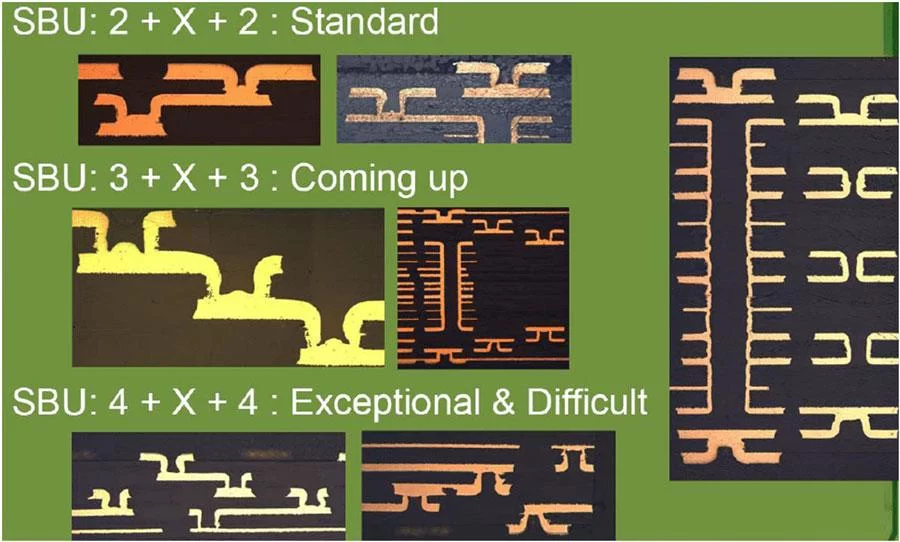
Tight tolerances cost money because they reduce yield. A smaller hole, a narrower conductor, tighter spacing, a controlled impedance, a filled via or a via in pad each add a process step or reduce the window, and the price reflects the boards that are lost as well as the extra work. Plating and finish have a similar effect: a hard gold on a connector edge is a separate operation, and an unusual finish may be a special order. The useful question for each tolerance is what it actually protects, because a specification that is tighter than the function requires buys nothing but scrap.
Yield, Volume and Setup
The cost of a board is partly the cost of the boards that were not shipped. A design with a marginal process window will lose a percentage of every panel, and that loss is built into the price. Volume works in the opposite direction, because the setup, the tooling and the front end engineering are spread over more units; this is why the price of the tenth board is much lower than the price of the first. The non recurring costs, such as the stencil, the test fixture and the programming, are also amortised, so a repeat order is cheaper than the first even when nothing else changes.
Assembly and Testing Costs
The assembly cost is driven by the number of placements, the mix of packages and the inspection that follows. A board with many small parts is slower to place than one with few large parts, and a fine pitch device or a BGA adds an inspection step and often an X-ray. Testing follows the same logic: an in circuit test with a fixture is a large fixed cost that only pays at volume, while a functional test needs a test specification and a fixture and a place in the flow. Where the volume is low, a simpler test strategy is usually the cheaper choice, provided the coverage is adequate.
Where the Savings Are
The largest savings are structural rather than commercial. Reducing the board area, avoiding a layer that is not needed, choosing a stocked material, relaxing a tolerance that protects nothing and improving the panel utilisation all reduce cost without reducing quality. Buying more than the build needs to reach a price break often increases the total cost once storage, obsolescence and cash are counted. The disciplined approach is to know which driver dominates a particular board, then change that driver rather than argue about the total.
Total Cost, Not Unit Price
The quoted unit price is only one term in the cost of a board. Freight, expediting, duty, the cost of inventory, the cost of scrap and rework, and the cost of a line stoppage all belong to the same budget. A cheaper supplier whose boards arrive with a wider spread of quality may cost more once the assembly yield is counted, and a higher price that removes a week of schedule may be the cheaper choice when a product launch is at stake. Comparing quotations on the total cost, with the assumptions written down, is what prevents a saving from becoming a surprise.
FAQ
What drives PCB cost most? Area, layer count, material and yield, with volume deciding how the fixed costs are spread.
Is a higher price always better quality? No. A price reflects the specification and the yield, not the quality of the workmanship.
Why is the first board so expensive? Setup, tooling and front end engineering are non recurring costs carried by the first units.
How can I reduce cost without changing performance? Improve panel utilisation, use stocked materials and drop tolerances that the function does not require.
Are price breaks always worth taking? Only if the extra units will be used; storage, obsolescence and cash can cost more than the saving.
Conclusion
Cost is designed in, so the levers are area, layers, material, tolerance and yield rather than the negotiation alone. Know the dominant driver and change it. Fabrication economics belong to PCB manufacturing, the assembly cost sits in PCB assembly, and the specification that fixes most of the price is written during PCB design and layout. What the factory can build economically is described under PCB capabilities in 2026.