SMT Capacity: Daily and Monthly Output
Once a product moves into volume, the scale of the assembly operation stops being a background detail and becomes the thing that decides whether orders are delivered and whether a busy season can be absorbed. Our SMT factory occupies fifteen thousand square metres and runs thirty six SMT lines, which allows a project to move from a prototype through a pilot batch and into volume without changing supplier in the middle.
Equipment and What It Can Place
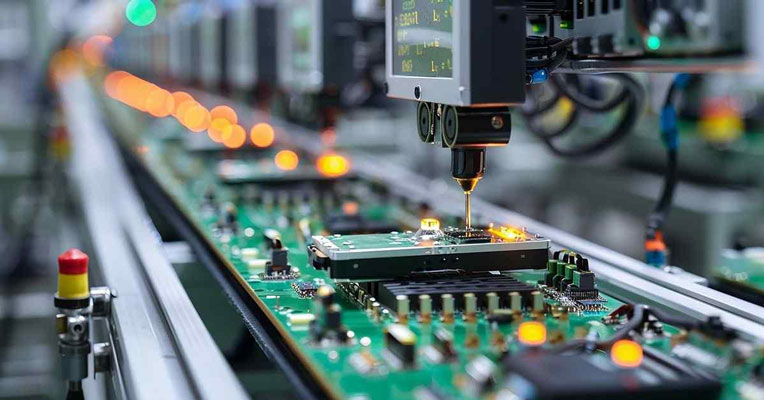
The flow is automated from printing through placement and reflow to inspection. The printers are fully automatic, the placement machines are multi function and cover everything from the smallest chip components to large connectors, the reflow ovens are computer controlled, and the inspection equipment covers paste measurement, optical inspection and X-ray.
The smallest component placed is 01005, which measures roughly nought point four by nought point two millimetres, and ball grid arrays are placed down to a pitch of nought point three millimetres. The quality system holds ISO 9001, IATF 16949 and ISO 14001 certification, and four inspection stages are in place: paste inspection, optical inspection, X-ray and a first article check on a dedicated instrument.
<img src="https://www.gopcba.com/wp-content/uploads/2026/08/automotive-pcb-assembly-china-automotive-grade-requirements-01.webp" alt="SMT production line running a volume order” />
What the SMT Capacity Means in Practice
The placement speed of a single line depends on the mix of parts, the complexity of the board and how often the line is changed over. On a standard board with few part types and a large quantity, one high speed line places in the region of several hundred thousand placements in a day. Multiplying that across thirty six lines gives a daily output that covers medium and large orders, and running the same figure over a working month covers the monthly requirement of consumer, industrial, medical and automotive programmes.
Stating a single number would be misleading, because the monthly output of the factory is not the monthly output available to one product. What matters to a customer is the capacity that can be allocated to their order and the date on which it can be delivered, and both follow from the quantity, the part mix and the position of the order in the schedule.
The order types illustrate the shape of it. A prototype of one to ten boards, carrying a few thousand placements, is delivered one to two days after the material is complete, on a sample line arranged for quick changeover. A pilot batch of fifty to five hundred boards, carrying tens of thousands to a few hundred thousand placements, takes three to five days on a line set up for small batches. A medium production order of five hundred to three thousand boards takes five to seven days using several lines in parallel. An order above three thousand boards is planned individually, and it is scheduled on dedicated lines with an engineer assigned to it.
Quality Through a Volume Order
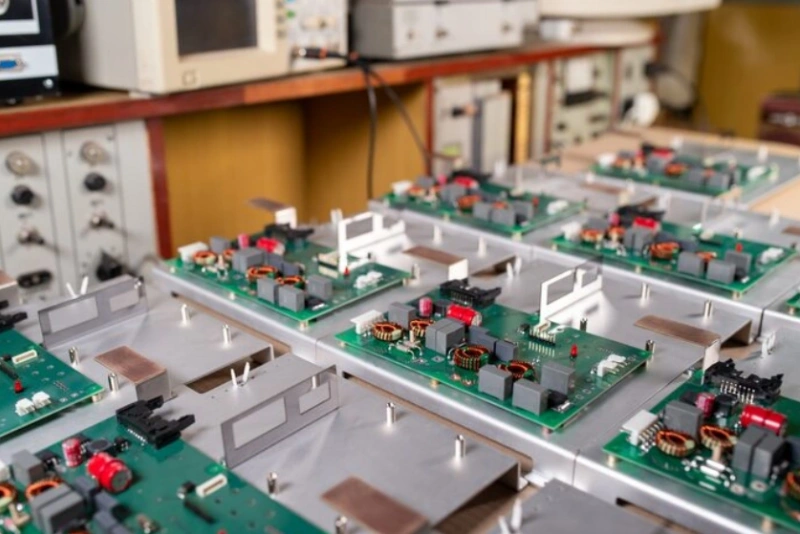
Volume does not reduce the inspection. Paste thickness and area are measured after printing so that the source of the soldering is controlled. Optical inspection runs both before and after reflow, catching missing parts, offset and bridging, and X-ray covers the joints under a ball grid array or a quad flat no lead device.
The first article is measured in full when the line is changed over, which is what prevents a batch level error at the moment when a batch level error is most expensive. Volume orders are built to the IPC-A-610 acceptability standard, a quality engineer follows each batch, and the records run from incoming inspection through the first article, the in process checks and the outgoing inspection. The yield on a conventional board with sound material and a sound bare board is normally above ninety nine percent, and it is tracked rather than assumed.
Working as a Volume Partner
A customer can supply material or have the factory buy it. On a turnkey order the customer provides the bill of materials and the board data and the rest is handled: purchasing, stencil making, placement, through hole work, testing and assembly. A long term volume relationship is priced differently from a one-off order, and material for a regular customer can be held in stock so that the purchasing lead time is removed from the schedule.
The process engineers follow the yield data during production rather than only at the end. A stage that is producing more defects than it should is adjusted while the order is running, which improves the first pass yield and reduces the cost of repair rather than reporting the problem after the shipment has left.
Our high volume assembly lines run this kind of work, component procurement handles the material and the stocking arrangement, and the whole flow is recorded under quality management.
Planning the Schedule Around the Capacity
`r`n
Capacity is only useful if it can be planned against. The quantities above assume that the material is complete and that the board data does not change, and they assume the order has been given a slot. In practice the useful conversation is about the date on which the material will be ready, because everything after that point is a matter of arithmetic on the line.
`r`n
A customer with a seasonal peak is better served by a conversation in advance than by a request in the middle of it. Where a programme is expected to grow, the part types and the panel design are reviewed at the start, since a board that changes every quarter forces a stencil, a fixture and a programme to be redone each time, and those are the hours that a line cannot spend producing.
`r`n
The same reasoning applies to the material. Holding a stock of the parts that consume the most purchasing lead time removes the largest single variable from the schedule, and it is why a long term arrangement with a customer can deliver dates that a one-off order cannot.
`r`n
What a New Customer Should Prepare
`r`n
A first volume order is quoted from the bill of materials and the board data, and the more complete those are the more reliable the answer. The bill of materials should carry the full part number rather than a generic description, the quantities should allow for the loading and changeover losses, and the board data should include the panel if a panel has been defined.
`r`n
It also helps to state which parts may be substituted and within what limits. A substitution that is approved in advance can be applied when a lead time slips, while one that has to be confirmed by message in the middle of a run stops the line at the point where stopping is most expensive.
`r`n
Where the order includes testing, the test specification and the acceptance criteria belong with the order rather than after it. A test that is defined in advance can be fixtured and programmed in parallel with the assembly, which keeps it off the critical path.
FAQ
What does a placement cost per point? The figure falls as the quantity rises and rises with the complexity of the parts, particularly for ball grid arrays and unusual components. A quotation follows from the bill of materials and the board data.
Is there a minimum order? No. A few boards and a few tens of thousands of boards are both accepted, and the unit cost improves with volume because the engineering and changeover are spread further.
What if the material is incomplete? On a turnkey order the lead times are assessed in advance and alternatives are proposed for parts that are short. On a customer supplied order, sending the complete material avoids the cost of building the order in more than one pass.