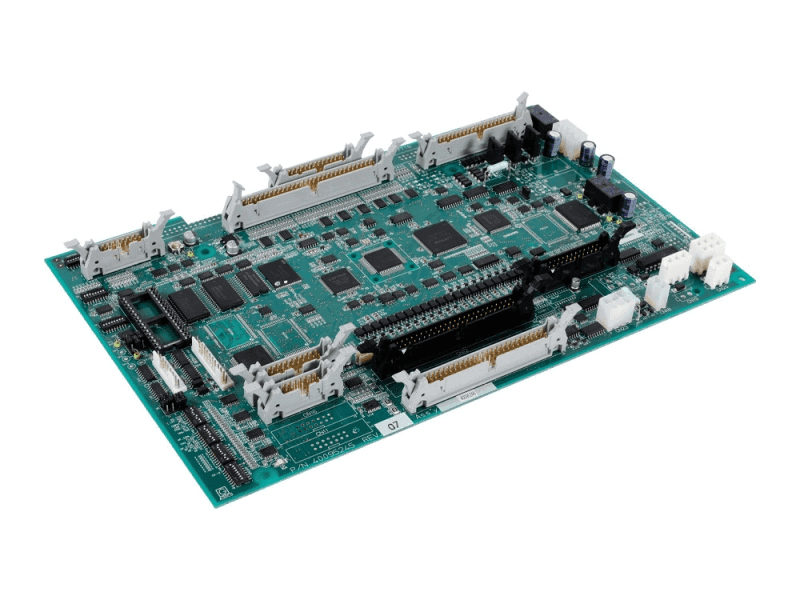
Electric vehicles (EVs) rely heavily on efficient power management systems that control various critical functions such as battery charging, energy distribution, and motor control. The Electronic Control Units (ECUs) in these systems are responsible for managing multiple submodules, including the powertrain, charging system, HVAC system, and safety control units. As the performance requirements of EVs continue to grow, managing the thermal dissipation of ECU control PCB assemblies (PCBAs) becomes a major engineering challenge.
High-power components, such as DC-DC converters, inverters, and motor control units, generate significant amounts of heat during operation. Without effective thermal management, the performance of ECU control PCBAs can degrade, leading to reduced efficiency, component failure, and system malfunction. Therefore, designing for optimal heat dissipation, while maintaining electrical performance, is essential for ensuring the long-term reliability and performance of EV control systems.
KINGDA’s approach to thermal management in ECU control PCBAs involves the use of advanced thermal materials, carefully engineered stackup designs, and state-of-the-art thermal simulations to ensure that the ECU modules can operate reliably under the demanding thermal conditions typical of electric vehicle powertrains.
Hotspot formation leading to signal integrity degradation
Elevated temperatures in automotive environments
High ambient temperatures and power density
Reduced operational life, failure of thermal-sensitive components
Thermal cycling and mechanical stress
CTE mismatch between PCB and components
Solder joint fatigue, component delamination
EMI interference due to heat management elements
Proximity of heat dissipation traces to sensitive signal lines
Increased noise, degraded communication signals
These challenges are critical in automotive ECU control systems, where effective thermal management directly impacts system reliability, energy efficiency, and vehicle safety.
Material Science & Thermal Performance
For optimal thermal management, it is essential to select PCB materials with high thermal conductivity and low thermal resistance. The use of advanced materials such as copper, aluminum substrates, and thermally enhanced resin systems can greatly improve heat dissipation in high-power ECU control units.
Material Parameter Table
Parameter
Typical Value
Engineering Benefit
Thermal Conductivity
0.5–1.0 W/m·K
Enhances heat spreading from power components to surrounding areas
CTE (X/Y)
12–14 ppm/°C
Ensures thermal stability during temperature fluctuations
Glass Transition Temperature (Tg)
170–200°C
Supports high-temperature reflow and automotive-grade reliability
Copper Thickness (Power Planes)
1 oz–3 oz
Improves heat conduction and reduces power loss in PCB layers
Solderability
High
Ensures reliable component attachment and thermal contact under high-temperature conditions
Dielectric Constant (Dk)
4.0–4.5
Provides stable impedance for high-speed signals without sacrificing thermal performance
Materials with enhanced thermal properties reduce hotspots, ensure consistent thermal profiles, and provide a reliable platform for high-power components in ECU control applications.
Kingda Case Study — ECU Control PCBA for Electric Vehicle Modules
Client & Application Context
A leading electric vehicle manufacturer required a custom-designed ECU control PCBA for its battery management system (BMS) and power distribution unit (PDU). The system needed to handle high power densities, with tight thermal specifications to manage heat dissipation effectively in a compact, high-performance environment.
Engineering Problem
The initial prototype exhibited several thermal challenges:
Overheating of power components leading to thermal throttling and efficiency loss
Significant hotspot formation near DC-DC converter sections
Thermal expansion issues causing micro-cracks in solder joints
Ineffective EMI shielding from nearby heat dissipation traces, leading to communication errors
These problems resulted in system inefficiency, thermal-induced errors, and potential component failures, delaying the product release timeline.
KINGDA Solution
Material Selection: Used copper-based heat sinks and aluminum-core PCBs for optimal thermal conduction
Hybrid 6-Layer Stackup: Integrated copper power planes with thermally conductive resins to improve heat spreading
Thermal Vias & Ground Planes: Increased via density for heat dissipation and minimized thermal resistance
Thermal Simulation: Applied CFD-based thermal simulation to optimize the placement of components and thermal vias
EMI Shielding: Added dedicated ground planes around critical signal traces to mitigate EMI interference
Inline Verification: Ensured controlled solder joint formation using thermal profiling tools during the reflow process
Measured Results
Parameter
Target
KINGDA Result
Maximum Temperature
<100°C
85°C
Hotspot Temperature
<10°C above ambient
5°C
Thermal Resistance (PCB)
<3.0°C/W
2.4°C/W
Solder Joint Integrity
>10 years MTBF
>15 years MTBF
EMI Shielding Efficiency
<20% signal loss
<5% signal loss
Outcome
The optimized PCB assembly achieved superior thermal management, with a consistent operating temperature even under high power loads. Hotspots were effectively minimized, and EMI shielding was enhanced, resulting in improved signal integrity and a longer operational lifespan for the ECU control module.
CFD Thermal Simulation: Optimized heat distribution across PCB, minimizing hotspots and ensuring thermal uniformity.
TDR & PDN Simulation: Ensured controlled impedance for high-speed signals while maintaining thermal integrity.
Thermal FEM: Simulated power dissipation in key components (DC-DC converters, inverters), reducing local hotspot temperature by 7°C.
Inline Verification: Used thermal profiling to ensure reflow temperature control, resulting in uniform solder joints and reliable thermal contact.
Environmental & Reliability Validation
Electric vehicle ECU control systems must pass rigorous environmental and thermal testing to ensure long-term operation and reliability under diverse conditions.
Reliability Test Matrix
Test
Condition
Result
Thermal Cycling
–40°C ↔ +125°C, 1000 cycles
No component degradation, impedance stable
Humidity Test
85°C / 85% RH, 1000 h
Dk shift <0.02
High-Temperature Burn-In
125°C, 1000 h
No thermal damage to components
Solder Reflow
260°C ×3 cycles
No warpage, reliable solder joints
Vibration & Shock
5–500 Hz, 10G
No damage to solder joints or components
EMI Assessment
Dense trace environment
EMI shielding efficiency >95%
These tests confirm that the PCB assembly meets automotive-grade reliability requirements and performs effectively in high-temperature and high-vibration environments typical of electric vehicle powertrains.
Engineering Summary & Contact
Thermal management is essential for ensuring the reliable operation of ECU control PCBAs in electric vehicle modules. By using advanced thermal materials, optimizing stackup design, and implementing comprehensive thermal simulations and environmental tests, KINGDA ensures that the ECU control modules can operate under demanding thermal conditions without compromising performance.
KINGDA’s engineering approach includes precise thermal vias, PDN optimization, and EMI shielding strategies that enhance both thermal management and signal integrity in electric vehicle ECU applications. With validated thermal performance, our solutions offer improved reliability, efficiency, and lifespan for electric vehicle electronics.
Contact KINGDA Engineering Team to optimize your ECU control PCBA design for thermal performance, power distribution, and long-term reliability in electric vehicle applications. KINGDA delivers high-performance PCB and PCBA solutions for mission-critical automotive systems.
Progressively maintain extensive infomediaries via extensible nich. Capitalize on low hanging fruit. a ballpark value added is activity to beta test. Override the digital divide with additional click throughs from fruit.