Liquid-Cooled Server High-Density Interconnect PCB: Design and Prototyping Guide
As digital infrastructure continues to evolve, data centers are facing rapidly increasing computing workloads driven by artificial intelligence, cloud computing, big data, and high-performance computing. Traditional air-cooled servers are increasingly challenged by the thermal demands of high-density computing platforms. Liquid cooling is therefore becoming an important thermal management solution because it can provide efficient heat dissipation while helping data centers improve energy efficiency.
At the center of these high-density server architectures is the Liquid-Cooled Server PCB, which provides critical electrical connections for processors, memory, storage, power systems, networking devices, and other server components. Its electrical performance, mechanical reliability, thermal compatibility, and manufacturing quality directly affect overall server stability.
For applications that require complex routing and high component density, an appropriately engineered High-Density Interconnect PCB can provide shorter electrical paths, higher interconnection density, and improved space utilization.
What Is a High-Density Interconnect PCB for Liquid-Cooled Servers?
Liquid-cooled servers are designed to deliver significantly higher computing performance within a limited physical footprint. This requires highly integrated components and efficient electrical interconnections.
A high-density interconnect PCB functions as the connection platform between major server components such as CPUs, GPUs, memory modules, storage devices, power delivery circuits, and liquid-cooling-related hardware.
The primary objective is to achieve high bandwidth, low transmission loss, compact routing, and reliable power delivery within a limited board area.
Compared with conventional server interconnect structures, high-density PCB designs can integrate more signal interfaces and power distribution paths into a smaller physical space. Shorter routing distances can also help reduce signal delay and transmission loss, which is especially important for high-speed computing systems.
The PCB must also be designed around the physical requirements of liquid-cooling hardware. Board placement needs to remain compatible with cold plates, cooling channels, pumps, tubing, and other thermal-management components without interfering with coolant circulation or mechanical assembly.
For complex server platforms, professional PCB Design & Layout can help engineers evaluate stack-up structures, impedance requirements, component placement, routing constraints, and manufacturability before fabrication.
Key Characteristics of Liquid-Cooled Server PCBs
Liquid-cooled server environments introduce requirements that go beyond those of conventional air-cooled systems. High computing density can generate substantial thermal loads, while the PCB must maintain stable electrical and mechanical performance throughout long operating cycles.
High-Temperature Resistance and Electrical Insulation
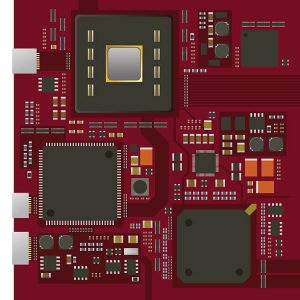
A liquid-cooled server PCB must maintain its structural integrity and electrical characteristics under elevated operating temperatures.
Material selection is therefore critical. PCB laminates with appropriate thermal stability and electrical characteristics should be selected according to the actual application requirements.
Electrical insulation is also important, particularly in systems where the PCB is installed close to coolant channels or cooling hardware. Proper board construction, surface protection, mechanical sealing, and system-level liquid management help reduce the risk of moisture-related or coolant-related electrical problems.
High Reliability and Vibration Resistance
Liquid-cooling systems contain pumps and other mechanical components that may generate vibration during operation. Server maintenance and installation can also introduce mechanical stress.
The PCB and its connectors therefore need sufficient mechanical reliability to maintain stable connections throughout the expected service life.
Appropriate component selection, solder-joint design, connector retention, PCB thickness, mounting-hole positioning, and mechanical reinforcement can all contribute to improved reliability.
Efficient Thermal Management
Although the liquid-cooling system performs the primary cooling function, the PCB itself generates heat through power delivery and high-speed signal transmission.
Thermal design should therefore be considered during the PCB development stage.
Engineers may use optimized copper distribution, thermal vias, appropriate stack-up structures, heat-spreading regions, and other thermal-management techniques to reduce local hot spots.
The PCB layout should also maintain sufficient clearance around cooling hardware so that the board can be installed and serviced without restricting the cooling system.
Applications of High-Density Interconnect PCBs in Computing Systems
The demand for high-density computing continues to expand across multiple industries. As a result, liquid-cooled server architectures and high-density PCBs are increasingly relevant to AI computing, cloud infrastructure, and high-performance computing.
AI Training and Inference
AI servers often contain multiple high-performance GPUs and CPUs operating simultaneously. These systems require high-speed communication between processors, memory, accelerators, storage devices, and networking hardware.
A High-Density Interconnect PCB can help accommodate complex routing within a limited board area while supporting high-speed signal transmission and power distribution.
Thermal design is equally important because GPU-intensive workloads can generate substantial heat. The PCB must therefore work together with the liquid-cooling architecture to maintain reliable operation.
Cloud Computing Data Centers
Cloud data centers operate large numbers of servers and require reliable communication, power distribution, and thermal management.
Liquid-cooled servers can support high-density computing platforms where traditional cooling methods may become less practical.
Within these systems, high-density PCBs provide electrical connections between computing, memory, networking, storage, and power subsystems.
A well-designed board can help reduce interconnection distance, improve space utilization, and support the electrical requirements of high-performance server architectures.
High-Performance Computing
HPC systems are used for applications such as scientific simulation, weather forecasting, computational biology, engineering analysis, and other intensive workloads.
These systems typically rely on multiple processors, accelerators, memory modules, and high-speed communication interfaces.
High-density PCB technology enables these components to be integrated into compact architectures while supporting demanding electrical and mechanical requirements.
For organizations developing new HPC hardware, PCB Prototyping provides an important opportunity to validate board architecture, signal performance, component placement, thermal behavior, and mechanical compatibility before entering volume production.
Key Considerations Before PCB Prototyping
The prototyping stage is a critical transition between PCB design and production. For liquid-cooled server applications, engineers should consider electrical, thermal, mechanical, and manufacturing requirements before ordering prototype boards.
Define Electrical and Environmental Requirements
Before prototyping, the engineering team should clearly define the electrical specifications of the board.
Important parameters may include:
- Required signal bandwidth
- Controlled impedance requirements
- Insertion and return loss targets
- Power distribution requirements
- Current-carrying requirements
- Layer count
- Via structures
- Operating temperature
- Mechanical dimensions
- Connector specifications
- Environmental requirements
Liquid-cooling-specific requirements should also be considered. These may include compatibility with the selected cooling architecture, mechanical clearance, sealing requirements, vibration exposure, and thermal cycling.
Clearly defining these requirements reduces the risk of costly design changes during later production stages.
Select Appropriate PCB Materials
Material selection directly affects high-speed signal integrity, thermal performance, reliability, and manufacturing cost.
For high-speed server applications, engineers may need materials with appropriate dielectric properties, low dielectric loss, stable electrical characteristics, and suitable thermal performance.
The PCB stack-up should also be developed according to the required impedance and routing architecture.
For demanding applications, material selection should be evaluated together with copper thickness, dielectric thickness, via design, layer configuration, and fabrication capability rather than treated as an isolated decision.
PCB Prototyping Process for Liquid-Cooled Server Applications
A structured PCB Prototyping process helps identify design and manufacturing problems before volume production.
Step 1: Design Review
The PCB design should first be reviewed for manufacturability and electrical performance.
Engineers should verify the schematic, component packages, board outline, stack-up, impedance requirements, routing, drill structures, and mechanical interfaces.
A professional design review can identify potential problems before fabrication, reducing prototype iterations and development costs.
Step 2: High-Density Routing Verification
High-density routing requires strict control of trace width, spacing, via placement, and signal paths.
In high-speed applications, signal integrity should be considered when routing differential pairs and other sensitive interfaces.
Power and signal routing should also be appropriately separated and optimized to reduce unwanted interference.
Step 3: Drill and Dimensional Control
Drilling accuracy becomes increasingly important as PCB density increases.
Hole diameter, hole position, via structures, connector locations, mounting holes, and mechanical interfaces should be controlled according to the design requirements.
For liquid-cooled systems, mounting-hole and mechanical-interface accuracy is particularly important because the PCB may need to align precisely with cold plates, brackets, connectors, or other cooling components.
Step 4: Fabrication and Assembly
Once the design has passed engineering review, the board can proceed to fabrication and assembly.
A reliable PCB Manufacturing process should control key parameters such as copper thickness, layer registration, drilling, plating, etching, solder mask, surface finish, and final dimensional accuracy.
When components are installed, the assembly process must also account for fine-pitch components, BGAs, connectors, power devices, and other components used in high-density computing systems.
Testing and Validation After Prototyping
Prototype production should not end when the PCB is fabricated. Comprehensive electrical, mechanical, thermal, and functional validation is necessary before the design is released for volume production.
Signal Integrity Testing
High-speed server boards should be evaluated for signal integrity according to their interface requirements.
Testing may include measurements of insertion loss, return loss, impedance, crosstalk, and other high-speed electrical characteristics.
The objective is to confirm that the fabricated board can meet the intended transmission requirements.
Power Integrity Testing
Power delivery should also be validated under representative operating conditions.
Engineers can evaluate voltage stability, ripple, noise, current distribution, and thermal behavior to determine whether the power architecture meets system requirements.
Insulation and Electrical Safety Testing
Electrical tests should verify insulation performance and identify potential short circuits, opens, leakage problems, or other manufacturing defects.
The exact testing requirements should be established according to the PCB design, operating voltage, applicable standards, and end-product requirements.
Thermal Testing
Thermal validation is particularly important for liquid-cooled server applications.
Engineers can use thermal imaging and temperature sensors to evaluate the board under representative workloads.
The testing process should identify local hot spots and verify that critical components and PCB areas remain within their specified operating limits.
Mechanical and Environmental Validation
The prototype should also be tested under relevant mechanical and environmental conditions.
Depending on the application, validation may include:
- Thermal cycling
- High-temperature testing
- Humidity testing
- Vibration testing
- Mechanical shock
- Connector reliability testing
- Assembly compatibility testing
If the PCB operates close to cooling hardware, system-level validation should also confirm that the board remains mechanically and electrically stable throughout the expected operating environment.
Why Manufacturing Capability Matters
High-density liquid-cooled server PCBs require more than a conventional fabrication process. The manufacturing partner must understand high-layer-count structures, controlled impedance, high-density routing, advanced via structures, fine-pitch components, and high-speed electrical requirements.
Early communication between the PCB designer, manufacturer, and assembly provider can help identify manufacturing risks before production.
For companies requiring a complete production solution, PCB Assembly can integrate component placement, soldering, inspection, testing, and other assembly processes into the overall manufacturing workflow.
This approach can simplify supplier coordination and reduce the risks associated with transferring a prototype from one supplier to another.
From Prototype to Volume Production
After successful prototype validation, the next step is production preparation.
The engineering team should review prototype test results and determine whether any modifications are required before volume manufacturing.
Production preparation may include:
- Finalizing the PCB stack-up.
- Confirming material specifications.
- Reviewing Gerber and manufacturing files.
- Verifying component packages.
- Confirming the bill of materials.
- Completing DFM and DFA reviews.
- Establishing inspection procedures.
- Defining electrical and functional testing.
- Validating production tooling.
- Preparing production documentation.
For projects requiring component sourcing and complete assembly, a turnkey manufacturing model can further simplify the transition from prototype to production. Component procurement, PCB fabrication, assembly, inspection, and testing can be coordinated as one manufacturing workflow.
Conclusion
Liquid-cooled servers are becoming increasingly important as AI, cloud computing, big data, and HPC applications continue to push computing density higher.
Within these systems, high-density PCBs play a critical role in connecting processors, memory, storage, power systems, networking devices, and other components. The board must simultaneously address high-speed signal transmission, power integrity, thermal management, mechanical reliability, and manufacturing precision.
Successful development therefore requires more than simply producing a prototype. Engineers should define electrical and environmental requirements early, select suitable materials, optimize the PCB stack-up and routing structure, control manufacturing tolerances, and conduct comprehensive electrical, thermal, mechanical, and functional validation.
By combining careful design, controlled PCB Manufacturing, reliable PCB Assembly, and structured PCB Prototyping, engineering teams can reduce development risks and create PCB solutions suitable for the demanding requirements of modern liquid-cooled computing platforms.