Four Wire Low Resistance Test: PCB Kelvin Measurement Guide
Why Precision Resistance Testing Matters in PCB Manufacturing
Accuracy and reliability are everything in modern electronics manufacturing. In high current power boards, automotive electronics and industrial controls, even a tiny resistance deviation can reduce performance or cause a system failure, which is why electrical testing is a critical quality gate. Among the advanced techniques used in production, the four wire low resistance test, also known as the Kelvin test, delivers the micro-ohm level accuracy that ordinary two wire methods cannot reach.
This guide explains the principle of four wire low resistance testing, the equipment it uses, its applications in PCB manufacturing, its advantages over two wire measurement and the 2026 cost reference for adding it to your quality plan.
gopcb applies Kelvin measurement inside its PCBA testing service to catch connection defects before boards ship.
What Is the Four Wire Low Resistance Test?
The four wire low resistance test, or Kelvin measurement, is a high precision method for measuring very low resistance values in the milliohm or micro-ohm range. Its defining feature is the use of four wires: two wires force a known test current through the circuit and two wires measure the voltage drop across it.
By separating the current path from the voltage measurement path, the method eliminates the influence of lead resistance and contact resistance. The voltage sensing loop carries almost no current, so the reading reflects the true resistance of the device under test instead of the sum of the device plus the probes and cables.
Why PCB Manufacturing Needs Low Resistance Measurement
Low resistance appears at the most critical points of a board: power traces, ground networks, solder joints and connector interfaces. If any of these locations develops abnormal resistance, the product suffers higher voltage drop, excessive heating, more power loss and reduced system stability.
High precision resistance measurement detects cold solder and weak joints, identifies damaged traces, confirms conductivity consistency across the batch and improves long term reliability. A single marginal solder joint on a battery sensing net can produce false readings for years, so catching it during production is worth far more than the test cost.
How the Four Wire Method Works
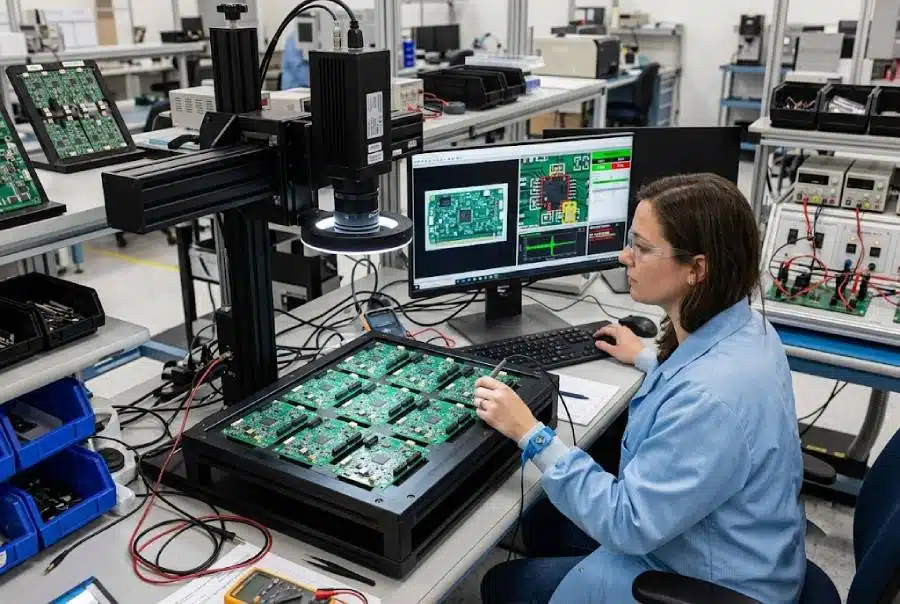
The four wire resistance method is simple in concept. The two outer wires apply a constant current to the circuit under test, the two inner wires measure the voltage drop, and Ohm’s law gives the resistance from the ratio of voltage to current. Because the voltage measurement loop draws almost no current, the resistance of the test leads and probe contacts does not distort the result.
This arrangement makes milliohm and micro-ohm measurement practical in a production environment where two wire readings would be swamped by a few milliohms of contact resistance. The measurement is fast, repeatable and easy to automate with a Kelvin fixture and a micro-ohmmeter.
Four Wire vs Two Wire Testing
Two wire testing is simple and cheap but carries a fundamental error: the same wires carry the current and measure the voltage, so lead and contact resistance add directly to the reading. That makes it unsuitable for low resistance values. Four wire testing separates the functions, removes lead resistance influence and delivers extremely high accuracy, which makes it ideal for milliohm range measurements at a slightly higher cost per test point.
The conclusion for PCB manufacturing is clear. When the target resistance drops below about one ohm, especially into the milliohm range, the four wire method is far superior to the traditional two wire approach.
Equipment Used for Kelvin Testing
Production four wire testing depends on a few key pieces of equipment. Kelvin probes and fixtures provide precise, stable contact with four independent tips per test point. A micro-ohmmeter measures the very low resistance values, and automatic test equipment runs the sequence at high speed for volume output. Custom test fixtures adapt the system to different board structures and test point layouts.
Automated systems keep the result consistent and repeatable across large batches, which matters because a resistance reading is only useful when the same measurement gives the same answer every time on the same design.
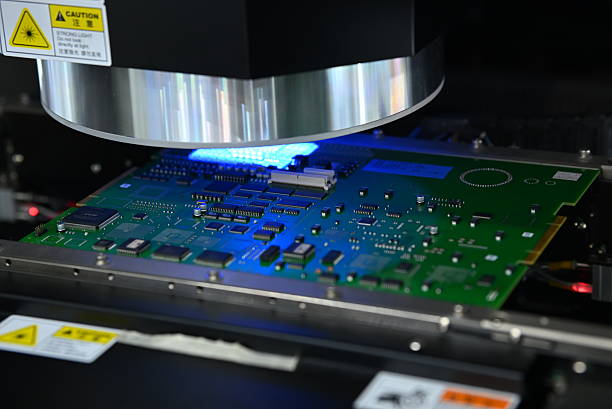
Resistance testing also protects the power delivery chain. Many boards combine high current zones with sensitive sensing circuits, and a small resistance increase in the sense path causes the controller to measure the wrong voltage or current. Adding four wire test points during PCB design and layout makes the production test faster and more accurate, because the fixture can reach clean Kelvin pads instead of probing component leads.
Applications in PCB and PCBA Production
SMT solder joint detection verifies joint quality and finds cold solder or weak contact. Through hole connection testing confirms that plated holes are reliable and conductive. High current trace testing validates the conductivity of power paths, and automotive and industrial electronics use the technique for systems where a connection failure is not acceptable. Aerospace and medical electronics rely on it to keep critical equipment safe and stable over its service life.
The same measurement also supports design validation. When a new power stack-up or copper weight is introduced, four wire data on sample boards confirms that the planned trace resistance matches the simulation, which prevents a costly surprise in volume production.
Advantages of the Four Wire Test
High measurement accuracy for very small resistances is the first benefit. The method removes lead and contact errors, which raises the overall quality control level of the PCB line. Boards that pass a Kelvin test carry verified connection quality, so product reliability and service life improve, and high end applications can be served with confidence. The slightly higher cost per point is repaid by fewer field failures and lower warranty expense.
Common Problems and Solutions
Contact resistance interference is solved with high quality Kelvin probes and stable contact pressure. Probe position errors are handled with automated fixtures that place every tip at the same location. Environmental factors such as temperature and oxidation are controlled by testing in a stable environment and by keeping surfaces clean, because even a thin oxide layer can shift a milliohm reading.
Standards and Cost Reference
PCB low resistance testing follows IPC manufacturing and inspection standards, internal quality control systems and industry certification rules for automotive, medical and aerospace programs. These references keep test data consistent and comparable between suppliers.
The 2026 market reference is about 10 to 50 USD per board for sample testing, 0.05 to 0.15 USD per test point in volume production and 100 to 500 USD for a custom test fixture. Although four wire testing costs a little more than basic continuity checks, the precision and reliability it adds give excellent value for high end products. A complete turnkey PCB assembly program can include the Kelvin test in the standard flow so cost stays predictable.
FAQ
Is four wire testing the same as Kelvin testing? Yes, the two names describe the same measurement method.
Why is the four wire method more accurate? It removes the influence of lead resistance and contact resistance from the reading.
When should four wire low resistance testing be used? Whenever the target resistance is below about one ohm, especially at milliohm levels.
Which industries require this test? Automotive, aerospace, medical devices and power systems are the main high reliability users.
Can four wire testing find solder defects? Yes, it reliably detects cold solder, weak joints and damaged conductive paths.
Get a PCB Testing Quote
The four wire low resistance test is an essential technique in modern electronics manufacturing. It removes lead errors, measures extremely low resistance accurately and raises the quality and reliability of the finished PCB. With automated inline testing, AI defect recognition and growing demand from electric vehicles, Kelvin measurement is becoming the standard for connection verification. gopcb combines advanced test equipment, a strict quality system and competitive 2026 pricing to deliver high reliability boards. Send your files for a free DFM review and a PCB manufacturing quotation with four wire low resistance testing today.