



PCB Prototype vs Standard PCB Manufacturing: Which Fits Your Project in 2026
Why the Prototype vs Standard Manufacturing Choice Matters
Choosing the right PCB manufacturing path affects your development speed, unit cost and time to market. At the start of a project you need small runs that come back fast so you can test a circuit and fix problems. Once the design is verified you need volume production that is stable, repeatable and cheap per board. These are two different services, and mixing them up costs time and money. This guide compares PCB prototype service and standard PCB manufacturing so you can pick the right one for your project.
What Is a PCB Prototype Service?
A PCB prototype service is a low volume run used during product development to verify the design works. It focuses on correctness and speed rather than on minimizing unit cost. Prototype service normally covers a handful to about one hundred boards, with lead times as short as 24 to 72 hours. Design flexibility is high because you can make changes and order another sample set quickly.
The main role of a prototype is functional verification. Engineers use it for research and development, minimum viable product builds, functional testing and debugging, and engineering validation stages. Because the goal is to prove the circuit, the supplier optimizes for fast turn, easy modification and repeatable quality on a small quantity.
What Is Standard PCB Manufacturing Service?
Standard PCB manufacturing is a production service used once the design is frozen. It is built for medium to high volume, from a few hundred boards up to millions, where the priority is cost per board and consistent delivery. The process is highly automated and repeatable, and it runs under a strict quality system such as IPC standards. Standard production suits consumer electronics, automotive systems, industrial controls and medical devices.
Because the tooling and setup are spread across a large quantity, the unit price drops significantly. The tradeoff is a longer lead time of about two to four weeks and higher initial engineering or tooling costs. Design flexibility is limited once the production tooling is set, so the layout needs to be final before you place a large order.

Key Differences Between Prototype and Standard Production
Quantity. Prototype is small batch while standard production is large batch. Lead time. Prototype ships in about one to five days, while production runs take two to four weeks. Cost structure. Prototype has a higher price per board, while standard production has a low unit price but requires upfront investment. Flexibility. Prototype supports frequent design changes, while production is essentially fixed. Process. Prototype emphasizes fast turnaround, while production leans on high automation and optimized flow. Quality control. Prototype focuses on functional test, while production adds full inspection such as AOI and ICT.
2026 PCB Price Comparison
As a reference, a 2 layer prototype run of 5 to 10 boards typically costs about 30 to 80 US dollars, while a 4 layer prototype of the same quantity runs about 80 to 200 US dollars. A 24 hour rush service usually adds 20 to 50 percent. Standard production is different: at 1000 pieces, a 2 layer board can drop to about 0.5 to 1.5 US dollars per board, and a 4 layer board to 1.5 to 5 US dollars per board. Tooling and non-recurring engineering fees for production often run from 100 to over 500 US dollars, and SMT assembly is quoted separately from the BOM.
To lower the cost of a production board, optimize the layer count and size, use standard FR4 material, run a design for manufacturing review, and order in higher volume to spread the setup cost.
When to Choose PCB Prototype Service
Choose a prototype service when the design is not yet final and you expect multiple iterations, when you need to verify circuit function quickly, when the project schedule is tight, or when you are working on an early prototype or proof of concept. For startups and R&D teams, fast prototyping is the key to lowering development risk because it lets you find problems early at a low total cost.
When to Choose Standard PCB Manufacturing
Choose standard manufacturing once the design is fully validated and frozen, when you need large scale production, when per unit cost matters most, or when the product is about to launch and must ship in volume. At this stage the engineering is done and the focus shifts to yield, consistency and cost.
Moving From Prototype to Volume Production
The transition between the two services is where projects often stumble. Common challenges include a design that does not match the production process, inconsistency in quality between sample boards and volume boards, and an unstable component supply chain. A good design for manufacturing review solves many of these before they happen.
Optimize line width and spacing for manufacturability, use a sensible panel layout to cut waste and cost, and standardize component placement so the board is easy to assemble and test. Working with a one stop manufacturer lets you hand off the same data, keep one quality standard and expand capacity quickly when demand grows.
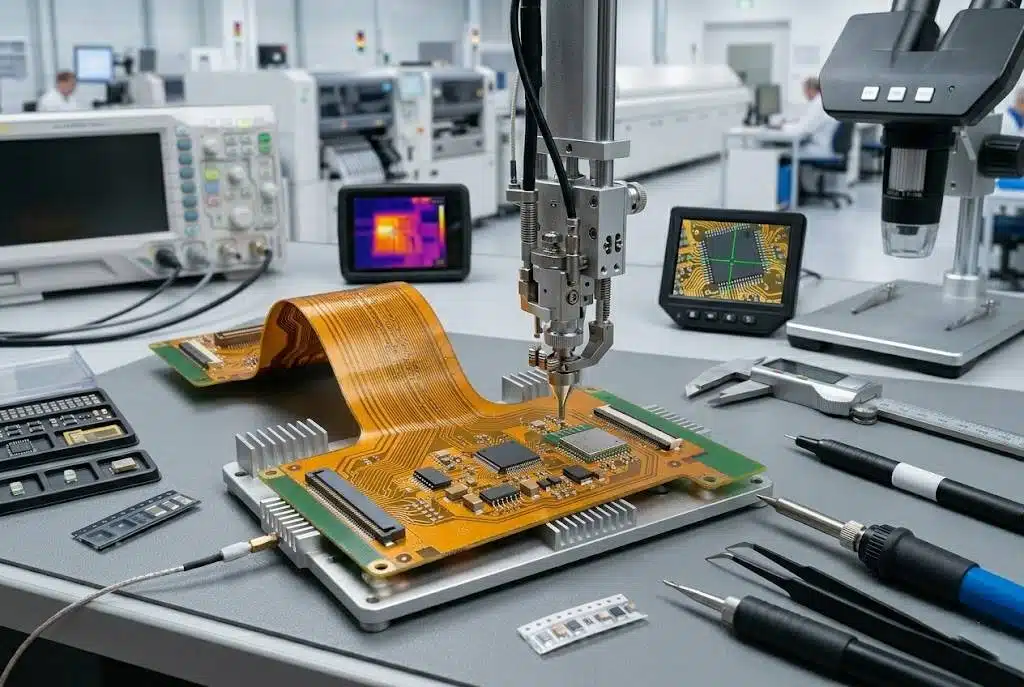
A prototype board and a production board should share the same stack up, material, finish and copper weight whenever possible. If the prototype uses a different laminate or surface finish, the production board may behave differently in the field. Confirm the specifications stay constant across the two orders so the samples you test are the boards you ship.
Key Factors Before Choosing a PCB Service
Evaluate your project deadline first, then your cost structure and volume. Confirm the quality and certification requirements such as ISO and IPC, and compare the technical capability and service level of each supplier. A supplier that understands both prototyping and volume production can move you effortlessly from a small sample run into a stable high volume build.
Documentation also matters. A clear set of files with the layer stack, drill table, impedance requirements and panel layout speeds the transition and avoids miscommunication. A documented feedback loop between your team and the factory keeps every revision tracked, so the volume build matches the approved prototype. Ask the supplier for a design for manufacturing report before you place the production order.
Why Choose a One Stop PCB Supplier
One stop service covers everything from prototype to volume production. It gives you fast delivery with 24 to 72 hour prototyping, competitive pricing for different project sizes, and advanced capability across multilayer, HDI, high frequency and flexible boards. A strict quality system following IPC Class 2 and Class 3 ensures consistency. By combining fast prototyping with volume manufacturing, the right partner shortens your time to market and lowers your overall cost.
Start with PCB prototype service to validate the design, then hand off to PCB manufacturing for volume. Review PCB design and manufacturing best practices to keep the layout production ready before you commit to tooling.
FAQ
Can a PCB prototype be used directly for mass production? Yes, but it usually lacks the cost advantage and is not recommended for large scale runs.
How long does a PCB prototype take? Typically 24 to 72 hours, though complex boards can take longer.
What quantity counts as standard PCB production? Generally 500 boards or more is considered volume production.
Why is PCB prototyping more expensive per board? Because the quantity is small and the delivery is fast, so the unit cost is higher.
How do I get an accurate PCB quote? Send the Gerber files, BOM list, quantity and process requirements to the manufacturer.
