
Fine Line Production in PCB Fabrication: Resist, Exposure and Etching
Component packages have moved toward ball grid arrays and finer pitches, and the consequence for the board is a steady reduction in conductor width and spacing combined with an increase in layer count. Width and spacing save area; layers save space. The direction is clear, with two to three mil lines now mainstream in advanced work and smaller features following. What is less obvious is how much of that can be produced on ordinary equipment with better process control, and where the real limits lie.
Do You Need New Equipment?
The usual assumption is that each step up in density requires an investment in new machinery, and that a high-quality board is simply the output of high-quality equipment. The investment is real, but it is not the only route. Capital equipment is expensive, and buying it before the process is understood means learning on the new machine, with the trial production and data collection paid for twice. A more economical sequence is to establish what the existing line can achieve with careful process development, and then to decide from the measured result and the market requirement whether an investment is justified. That makes the question a process question rather than a purchasing question, and the answer depends on the resist, the exposure, the development and the etching.
Acid Etching Versus Pattern Plating
The two common approaches to forming conductors are etching after plating, and pattern plating followed by alkaline etching. Each has a different set of advantages. The etch route produces very uniform conductors, which favours impedance control, and it generates less pollution; its weakness is that a single defect in a hole can scrap the panel. The alkaline route is easier to control but produces less uniform conductors and a greater environmental load. The choice therefore depends on which failure mode and which constraint matters more for the product, and it changes the rules that apply to the rest of the process.
Dry Film and Development
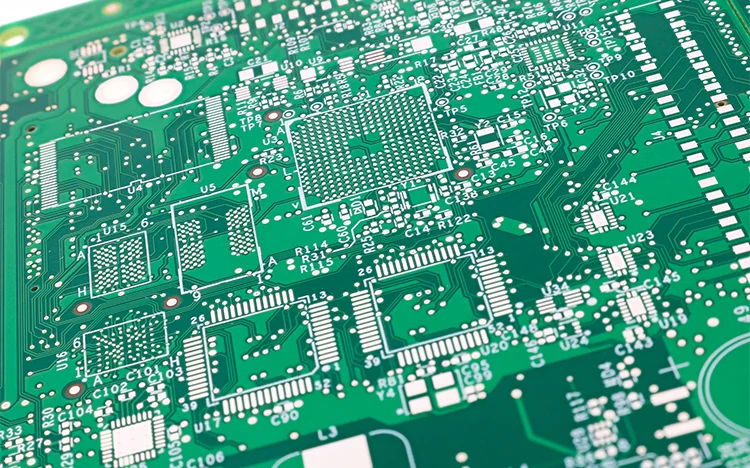
The resist is the starting point, because the pattern cannot be finer than the film can resolve. Different dry films have different resolution, but most can image a two mil line and space after exposure, and the resolution of an ordinary exposure unit is generally sufficient at that dimension, so lines at or above this scale usually present no problem. Development conditions matter much less at four mil and above: nozzle shape, pressure and chemistry concentration have little effect. Below about three mil, the nozzle becomes the critical variable. A fan nozzle operated at roughly three bar is needed to develop the pattern cleanly, because the jet has to reach the bottom of a very narrow space; a conical nozzle with lower pressure struggles at these dimensions. The direction in which the panel is fed also affects both resolution and the profile of the resist sidewall.
Exposure Energy and Cleanliness
Exposure energy has a strong influence on the result, but the working range of most films is wide. On a twenty-one step gauge the useful window is around step seven to nine, and on a twenty-five step gauge around step twelve to eighteen. Lower energy generally improves resolution, but it also makes the pattern more vulnerable to dust and debris, which cause opens after acid etching and shorts after alkaline etching. The practical exposure setting is therefore chosen together with the cleanliness of the darkroom rather than in isolation, because an energy that works in a clean environment will produce defects in a dusty one. This is the reason two shops with identical equipment can achieve different minimum features.
Exposure Equipment
Exposure units differ in their light source and cooling, and their nominal resolution figures are similar. In practice, both the air-cooled area source and the water-cooled point source types can produce three mil lines and spaces without any special adjustment. With reduced energy and careful operation, dimensions approaching one and a half mil can be resolved, though at that scale the influence of dust and debris becomes dominant and the yield is sensitive to handling. Interestingly, the difference between exposing through a film surface and through a glass surface is not significant, which means the choice of artwork material does not by itself set the limit.
The Mushroom Effect in Alkaline Etching
Pattern plating builds copper and then tin or tin-lead over the resist pattern, and the deposit tends to spread laterally as it grows, producing a mushroom-shaped cross-section. The effect exists in every plated board; the question is whether it is significant. Above four mil lines it is small enough to ignore. At two mil the situation changes: the plated metal overhangs the resist, the film is trapped underneath it, and stripping becomes very difficult. Three partial remedies exist. Pulse plating produces a more uniform deposit. A thicker dry film, around fifty to fifty-five micrometres instead of the usual thirty-five to thirty-eight, resists the overhang better and works well with acid etching, though it costs more. Lower plating current reduces the lateral growth. None of them is complete, and in practice a combination is used. The stripping step needs attention for the same reason: because the alkaline solution attacks tin-lead noticeably at two mil dimensions, the plated tin-lead can be made thicker and the concentration of the stripping solution reduced to compensate. The underlying plating behaviour is described in this article on electroplating additives.
Etching Practice for Fine Lines
Etching speed varies with line width and line shape, and the achievable result depends on the etchant and the nozzle. Where the design does not require a particular copper thickness, using 0.25 ounce foil, or etching back part of a 0.5 ounce base copper and plating a thinner copper layer with a thicker tin-lead layer, all help the alkaline route. Nozzle selection is important here as well: a fan nozzle is required, while a conical nozzle generally limits the process to about four mil. Acid etching has similar sensitivity to line width and shape, and it offers a real advantage in fine line production because it avoids the mushroom effect and produces less undercut, so the impedance change after etching is smaller. Its disadvantage is handling: the film that masks the holes and the surface is easily damaged or scratched during transport and the preceding steps, so the process demands care. Here too the fan nozzle clearly outperforms the conical type. Defects that survive into the plated structure are described in this article on copper plating defects and prevention.
Where the Yield Is Actually Lost
The parameters that most affect yield are the lamination speed and temperature, the cleanliness of the panel surface and the cleanliness of the artwork film. For acid etching, the lamination parameters and the flatness of the panel are especially important; for alkaline etching, cleanliness at the exposure step dominates. The practical conclusion is that ordinary equipment can produce three mil lines and spaces, provided the process is developed for it, and that below three mil the alkaline route is generally the more capable choice unless the base copper is reduced substantially. The result, however, depends heavily on the environment and on the skill of the operators, which is why the same specification can produce very different yields at two sites. Keeping the pad and feature geometry within what the process can hold is what makes the difference, and the standards for those features are described in this article on PCB pad design standards, while the data preparation that supports fine features is covered in this article on HDI board CAM methods.
FAQ
Can three mil lines be produced on standard equipment? Yes, with fan nozzles, controlled exposure energy and a clean environment. Most ordinary exposure units reach three mil without special adjustment.
Why does a fan nozzle matter at fine dimensions? Because the jet has to reach the bottom of a narrow space to develop the pattern. A fan nozzle at around three bar does this; a conical nozzle with lower pressure does not.
What is the mushroom effect? The lateral spreading of plated metal over the resist, which traps the dry film and makes stripping difficult. It becomes significant at about two mil lines and can only be reduced, not eliminated.