Repairing Water Damaged Circuit Boards
A board that has been wet is not necessarily a board that is dead, and the difference between a recoverable assembly and a scrapped one usually comes down to what happens in the first hour. Water alone is rarely the damage. The damage comes from what the water carried and from the corrosion that continues after the water has gone.
Water and What It Dissolves
Pure water is a poor conductor. The problem is the ions it picks up: salts from the environment, flux residues left on the assembly, and the corrosion products themselves, which are often more conductive than the original contaminant.
That is why a board that was wet with clean water behaves differently from one that was wet with seawater, and why a board that had flux residue on it can fail even after a freshwater exposure. The residue dissolves, spreads, and leaves a conductive path between features that were never meant to be connected. Our PCBA soldering requirements article describes the residues that originate in the assembly process.
Immediate Actions That Matter
The first action is to remove power and keep it removed. Energising a wet board is what turns a recoverable assembly into a destroyed one, because the conductive paths created by the water carry currents into places the design never intended.
The second is to remove the contamination before it can spread. Clean water rinsing removes salts; leaving the board to air dry without rinsing concentrates them. The third is to dry the assembly properly rather than quickly, because moisture trapped inside components and under coatings is what fails later. Our medical electronics notes describe the cleaning and coating regime used where this risk is managed deliberately.
<img src="https://www.gopcba.com/wp-content/uploads/2026/06/Thermal-Management-1.jpg" alt="circuit board with corrosion after water damage” />
Assessing the Damage
Assessment starts with the visible. Corrosion appears as discoloration on copper, a dull or white deposit on solder joints, and a green tint where copper salts have formed. Connectors are the first parts to suffer, because their surfaces are exposed and their contacts are fine.
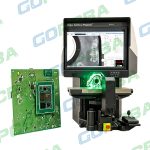
Component damage is harder to see. Electrolytic capacitors may have vented or lost capacitance, connectors may have corroded internally, and fine pitch devices may have corrosion under the package that no optical inspection can reach. Where the product justifies it, X-ray inspection is the only way to see beneath a ball grid array. Our PCB electrical test coverage article describes what each inspection method can reach.
Cleaning Methods
Effective cleaning needs the right chemistry as well as the right agitation. Water alone will not remove ionic residues that have dried onto the surface, and a solvent that does not dissolve the specific contaminant will simply move it around.
Ultrasonic cleaning is effective for removing material from beneath components and in tight spaces, provided the frequency and the power are chosen to suit the assembly. Excessive ultrasonic energy can damage wire bonds inside components and can crack small ceramic parts, so it is not a method to apply indiscriminately. Where the assembly carries parts that cannot tolerate it, a spray wash with a directed jet is the gentler alternative.
Drying and What It Takes
Drying is not a matter of time at room temperature. Moisture trapped inside a plastic package or under a conformal coating will not leave at ambient conditions within any useful period, and the assembly will fail when it is heated during operation or during subsequent rework.
A controlled bake follows the same logic as the pre assembly bake that moisture sensitive components receive. The temperature and duration depend on the components present and on whether there are parts that cannot tolerate heat, such as batteries or certain plastics. Our prototyping notes describe the same moisture management from the design side.
Rework and Replacement
Where corrosion has reached a joint, reworking that joint is usually necessary. The old solder carries the contamination and the corrosion products, so removing it and replacing it with fresh alloy removes the problem along with the material.
Connectors and sockets are frequently replaced rather than cleaned, because their contact surfaces are plated and the plating is what has been damaged. Where a track has corroded through, a repair link may be acceptable for a prototype and is usually not acceptable for a product that will see service.
When to Stop
Some boards should not be repaired. Where corrosion has reached internal layers, where a ball grid array has corroded beneath it, or where the board is part of a product whose failure would be dangerous, replacement is the responsible answer.
The judgement should be made on evidence rather than on optimism. A board that passes a functional test after cleaning may still have a partially corroded connection that will fail in a few months, and the cost of that failure is usually greater than the cost of the replacement. Our reliability notes describe how such latent defects behave over a service life.
Preventing the Problem
Where a product is likely to see moisture, the design and the process should address it before it happens. Conformal coating is the standard answer, and it must be applied to a clean surface, because coating over residue traps the contamination in place.
Connectors and any surface that must make contact need to be excluded from the coating, and the coating must reach everywhere else, including beneath components. Designing for that coverage is a layout decision as much as a process one. Our routing techniques article covers the design practices that make coating effective.
What the Cleaning Step Cannot Fix
Cleaning removes contamination from surfaces it can reach. It does not restore plating that has been consumed, and it does not repair a joint whose alloy has been converted into corrosion product.
Where corrosion has changed the material rather than merely deposited on it, the only reliable remedy is replacement. Recognising that boundary is what prevents a board from being returned to service in a condition that will fail again, and it is the reason a repaired assembly should be inspected rather than merely tested. Our PCB quality article describes the inspection methods that reveal what a functional test cannot.
Where the assembly is valuable, a repaired board should be treated as a repaired board rather than as a new one. That means recording what was replaced, keeping it under observation and accepting that its remaining service life is shorter than that of an untouched unit.
FAQ
Is a board that was wet with clean water safe to use? Often, after cleaning and drying. The risk is the residues already on the board dissolving and spreading, not the water itself.
Can a board be dried in an oven at home? It can be dried, but the temperature may damage components or plastic parts. A controlled bake at a temperature the assembly can tolerate is the safer approach.
Why do boards fail weeks after they get wet? Because corrosion continues after the water has gone, and because residue left in place keeps absorbing moisture from the air.
Does ultrasonic cleaning always help? It is effective at removing contamination from hidden areas, and it can damage sensitive components if the energy is too high. The setting matters.
What is the most common mistake after water exposure? Applying power to see whether the board still works. That is what converts a cleanable board into a destroyed one.