



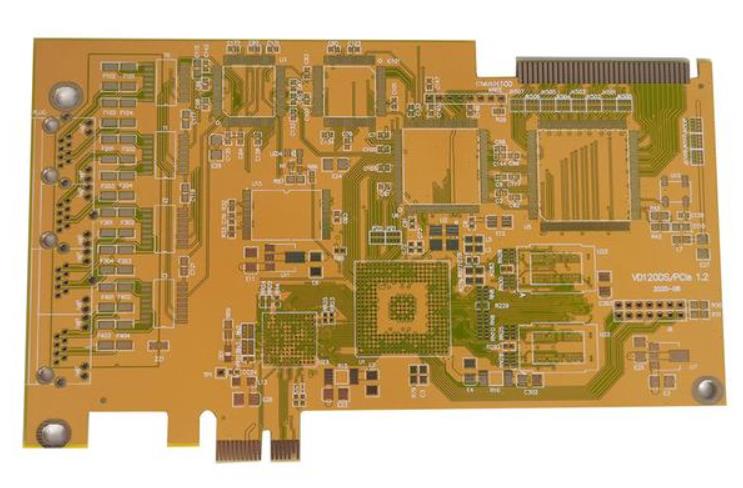
High Tg PCB: Advantages, Applications, and Materials
Thermal performance decides how long a circuit board survives, and the threshold that describes it is the glass transition temperature. A high Tg PCB is one built on laminate whose glass transition sits well above the standard range, which lets the board keep its rigidity and its dimensions through thermal loads that would soften an ordinary material. That single property changes what the board can be used for.
What Tg means
Tg is the temperature at which the base material changes from a rigid, glassy state into a softer, rubbery one. Below it, the laminate behaves as a stiff structural material with a stable dielectric constant. Above it, the material expands much more quickly with temperature, mechanical stiffness drops, and the dimensional stability of the board is no longer guaranteed.
A standard PCB laminate has a glass transition temperature between roughly 130 and 140 degrees Celsius. A high Tg PCB uses material rated at 170 degrees Celsius or higher, and some grades reach well beyond that. The number is not a limit on operating temperature; it is the point at which the material behaviour changes, and decent margin above the process and operating peaks is what keeps that change out of the design window.
The advantages
Enhanced thermal stability is the first benefit. The board tolerates higher temperatures without the material degrading, which matters during lead-free reflow and during operation in a hot enclosure. Improved mechanical strength follows from the same property: a laminate that stays rigid keeps its shape under mechanical stress.
The coefficient of thermal expansion is lower, which reduces the mismatch between the laminate and the copper. That mismatch is what drives delamination, pad lifting, and warping, so reducing it improves yield at assembly as well as reliability in service. Electrical performance also benefits, since a stable dielectric supports more consistent signal behaviour in high-frequency designs, and the combination is what makes the material suitable for harsh environments where temperature swings are part of normal operation.

The question is not whether a board will see high temperature, but how close to the glass transition the laminate is expected to operate.
Where high Tg boards are used
Automotive electronics is the largest user base: engine control units, power management modules, and sensors operate in an environment where the ambient temperature and the internal dissipation are both high. Aerospace and defence applications add radar, avionics, and satellite communication, where reliability cannot be restored once the product is deployed.
Industrial equipment follows, including power converters, high-power LED systems, and motor controllers, all of which combine continuous thermal load with long service requirements. Telecommunications uses high Tg material in 5G base stations, network infrastructure, and RF applications, and medical imaging and diagnostic equipment completes the list, where a board failure has consequences beyond the product itself.
Material options
High Tg FR-4 is the workhorse: widely available, cost-effective, and sufficient for most thermally demanding but electrically ordinary designs. Polyimide goes further, offering excellent thermal stability together with mechanical strength, and it is the usual choice where the operating temperature or the mechanical requirement exceeds what FR-4 can provide.
Where the signal itself is the constraint, laminates engineered for high-frequency and RF work combine thermal capability with a low and stable dielectric constant. Metal-core constructions answer a different problem, providing a path for heat to leave the board through the substrate rather than only through the copper, and they appear where dissipation is the dominant requirement.
High Tg compared with standard laminate
The differences are systematic rather than marginal. A standard board has a glass transition temperature around 130 to 140 degrees Celsius, moderate mechanical strength, and standard electrical behaviour at a lower cost. A high Tg board occupies the 170 to 260 degree range, with high thermal stability, excellent mechanical strength, and enhanced electrical performance, at a cost that is higher but not prohibitive.
The consequence is a difference in application rather than in quality. A high Tg board is not a better version of a standard board; it is a board specified for an environment where a standard one would change behaviour mid-life. Choosing it for a product that never approaches the standard temperature window adds cost without adding benefit. The specification should follow the temperature the laminate will actually see, plus the margin that the assembly process itself requires.
Design considerations
Thermal design comes first. Heat spreaders, thermal vias under power devices, and adequate spacing between hot components and temperature-sensitive ones all reduce the temperature the laminate actually sees, which is the variable that matters. A material with a higher glass transition temperature buys margin, but it does not replace a thermal path.
Stackup decisions follow the thermal and electrical requirements together. Layer arrangement, copper distribution, and the placement of reference planes determine both the signal behaviour and the ability of the board to move heat away from the components. Manufacturing limits close the loop: the material, the layer count, and the finish all have to be within the capability of the shop that will build the board, which is why a design review before release is cheaper than a redesign afterwards. The electrical side of that trade-off is covered in our guide to multilayer advantages in high-speed designs.
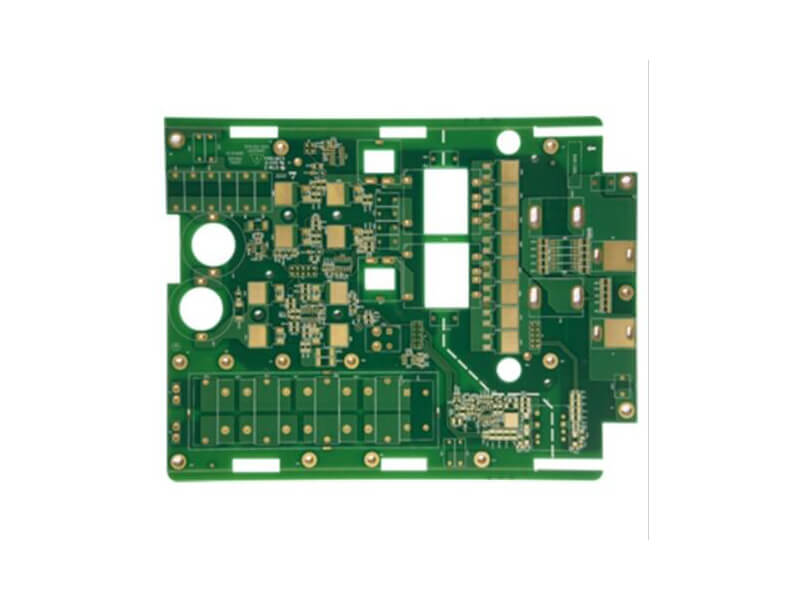
A higher glass transition temperature does not reduce the heat a component produces. It only decides how much of that heat the laminate can absorb before its dimensions move.
Manufacturing flow and its challenges
The process follows the standard sequence with tighter control: material selection, stackup design, etching and drilling with attention to the stress the material carries, copper plating for conductivity and durability, solder mask and surface finish for protection, and finally a thermal stress test that confirms the board survives the conditions it was specified for. The reflow profile that the board must survive is itself part of the specification, and the differences between alloys are covered in our guide to lead-free versus leaded solder.
Four challenges appear repeatedly. Material availability can vary by grade, so the supply channel matters. Cost sits above standard laminate, which is why the specification should be justified by the application. The process is less forgiving, since drilling and etching parameters developed for standard material do not transfer unchanged. And thermal expansion still exists, so the stackup and the material have to be chosen together rather than one after the other. The stackup rules that keep expansion under control are set out in multilayer design rules.
FAQ
Do I need a high Tg board for lead-free assembly? Not automatically, but the higher reflow temperature makes the margin smaller. If the board is thick, has heavy copper, or carries large thermal mass, the higher glass transition temperature is usually worth specifying.
Does a higher Tg improve signal integrity by itself? Only indirectly. A material with a stable dielectric constant helps, but the impedance of a trace is set by geometry and by the uniformity of the dielectric, not by the glass transition temperature alone.
How much more does high Tg material cost? The laminate premium is modest compared with the rest of a finished board, and the effect on the total price is usually smaller than a change in layer count or surface finish. The larger cost is usually the tighter process control the material demands, including a more careful press profile and closer control of drilling and etching parameters.


1 Comment
Wind Power PCBA: Architecture and Reliability Design
[…] bay is often sealed and passively cooled. It is the same thermal and material reasoning that makes high-Tg laminates worthwhile on power […]