What Makes a 6-Layer Flexible PCB Cost More
A 6-layer flexible PCB sits at the point where flexible circuits stop being simple and start being an engineering project. Two-layer flex is a well-understood product with stable pricing, but once the count rises to six, the material, the lamination sequence, the registration requirements and the yield all change at once. That is why quotes for the same nominal board can differ by a factor of two.
This article explains what actually drives the cost of a 6-layer flexible PCB, which of those drivers the designer controls, and how to compare quotations that appear to describe the same thing.
What the Six Layers Are For
Additional layers in a flexible circuit are usually bought for one of three reasons: a shielding layer to control impedance and reduce emissions, a ground plane to give high-speed signals a defined return path, or extra routing capacity in a flex that has to carry a dense interface through a narrow bend area.
Each of those reasons has a different cost profile. A shielding layer adds material and a lamination step but little routing complexity. A ground plane requires vias and stitching. Extra signal layers multiply the drilling and registration work, which is where the price rises fastest. Deciding which of the three the design actually needs, before ordering, is the single largest cost lever available.
<img src="https://www.gopcba.com/wp-content/uploads/2026/08/low-volume-pcb-aoi-xray-testing-early-defect-detection.jpg.webp" alt="Six layer flexible circuit with polyimide coverlay” />
Polyimide and Adhesiveless Builds
The base material for a flexible circuit is polyimide, which tolerates soldering temperatures and holds its dimensions through processing. Polyimide costs many times more than FR-4 per unit area, and the price rises with the grade: standard material, high-temperature grades and dimensionally stable grades are progressively more expensive.
The adhesive system matters as much as the film. Adhesive-based construction uses an acrylic or epoxy layer between the copper and the polyimide, which is cheaper and more forgiving to process but thicker and less stable dimensionally. Adhesiveless construction bonds copper directly to polyimide, giving a thinner stack, better bend performance and tighter registration, at a higher material cost. For six layers, where the stack is already thick, the thinner adhesiveless build often pays for itself by improving flexibility and yield.
Layer Count and Lamination Cycles
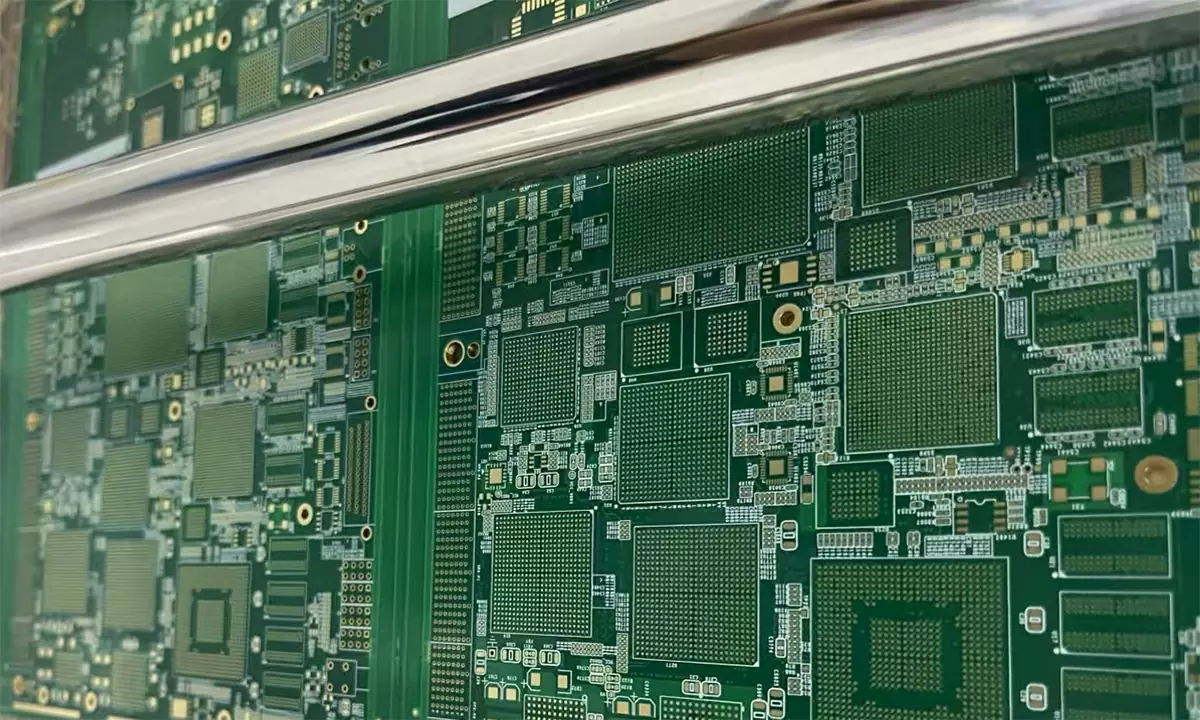
Flexible circuits are laminated in pairs, and a six-layer board requires more press cycles than a four-layer one, with a coverlay lamination on top of that. Each cycle adds handling, adds a registration step and adds a chance of a defect, so the cost rises faster than the layer count alone would suggest.
The lamination sequence also constrains the design. If the stack requires sequential lamination to create buried vias, the panel passes through the press more than once and the cost climbs accordingly. Designs that keep to through vias and a single lamination cycle are markedly cheaper, and that constraint should be considered while the layer assignment is still flexible.
Panel Utilization and Order Quantity
Flexible circuits are made on panels like rigid boards, and the panel is the unit of fixed cost. A small flex design tiles many parts onto a panel, which spreads the setup cost over more units and lowers the unit price. A large or irregular flex outline tiles poorly and can leave most of the panel unused.
Quantity works in the same direction but with a floor. Because setup dominates at low volumes, the unit price falls steeply from a handful of pieces to a few hundred, then flattens. Ordering at the point where the curve flattens gives the best value, and the saving from moving slightly above the immediate requirement is often larger than the cost of the extra boards.
Tooling, Testing and Yield
Tooling for a flexible circuit includes the drill programme, the coverlay artwork and any forming or stiffener fixtures. Testing is a larger share of the cost than on a rigid board, because flexible circuits are usually 100 percent electrically tested and often inspected optically, and because a flexible circuit that fails cannot be reworked as easily as a rigid one.
Yield is the hidden variable in every quote. A fabricator with a well-controlled flex line will quote a lower unit price than one that is learning, because the quoted price has to cover the scrap. When two quotes differ sharply, the difference is usually an assumption about yield rather than a difference in material specification.
Volume also changes the test economics. At low quantities a fabricator may test every part on a flying probe, which is slow but needs no fixture. At higher quantities a dedicated fixture becomes worthwhile, and the cost per board falls even though the fixture itself is expensive. That is one reason the unit price curve flattens rather than continuing to fall.
Design Choices That Reduce Cost
Several design decisions lower the price without lowering quality. Keeping the layer count to the minimum the routing requires is the first. Avoiding buried vias and sequential lamination is the second, and it is worth reworking the layer assignment to achieve. Using a single stiffener material and a common stiffener thickness across the board reduces setup, and keeping the outline rectangular improves panel utilization.
The bend area deserves particular attention. A generous flexible circuit outline with a wide bend radius tolerates more process variation than a tight one, so it yields better. Where the design combines rigid and flexible sections, the construction rules for a rigid-flex board should be applied from the start rather than retrofitted.
Comparing Quotes Properly
Two quotations are only comparable if they describe the same construction. The items that must match are the base material grade, the adhesive system, the copper type and thickness, the coverlay material and thickness, the surface finish, the stiffener material and the test coverage. A quote that omits any of them is not a cheaper offer; it is a different product.
Ask for the stack drawing with the quote. It takes a minute to read and it prevents the situation where the prototype passes and the production order arrives with a different dielectric thickness. The same discipline applies when moving from a single-layer or two-layer flex to a six-layer one, as the comparison of flexible board constructions makes clear.
FAQ
Why is a 6-layer flexible PCB so much more expensive than a 4-layer one? The extra layers add material, an additional press cycle, more drilling and tighter registration, and they reduce yield because each step can introduce a defect. The result is a price that rises faster than the layer count, typically by more than fifty percent for the same outline.
Does a thicker copper foil increase the cost? Yes, and it also reduces the achievable trace width and the minimum bend radius. Extra copper weight is justified when the flex carries significant current or when it must survive many flex cycles, but it should not be specified by default.
Can the unit price be reduced after the design is fixed? The remaining levers are quantity and panel layout. Reviewing the panelization with the fabricator, adjusting the quantity to fill panels evenly and confirming that the outline tiles efficiently are the practical options once the construction is settled. If the product family includes a second flex that shares the same outline and layer count, ordering both together often reduces the unit price for each, because the setup is charged once.