PCB Color: Green, Black and Blue and What the Choice Affects
The color of a circuit board is one of the few specifications a customer notices immediately and one of the last that engineers think about. It is not merely cosmetic: the solder mask pigment changes how the resist cures, how well automated inspection can see a defect, and how much heat the surface absorbs under a strong light source.
Where PCB Color Comes From
Board color is the color of the solder mask, not of the laminate. The base material is a translucent yellow-green in its natural state, and the familiar appearance of a finished board comes from the pigmented resist printed over the copper. Change the pigment and the board changes color without any electrical change at all.
Silkscreen is a second, independent choice. White legend over a dark mask offers the highest contrast, while white legend on a white mask is nearly invisible and forces a different marking strategy.
Why Green Became the Default
Green became standard for reasons that were partly technical and partly historical. The pigment chemistry was well understood, the resin system was stable in production, and the contrast between white legend, the bare solder pads and the green surface made visual inspection straightforward with the equipment of the time.
Cost reinforced the choice. Green mask was produced in larger volumes than any other color, so it remained the cheapest and the most consistently available, and that remains largely true today.
Green Solder Mask and Inspection Contrast
Inspection is the strongest argument for green. Automated optical inspection systems illuminate the board and look for anomalies, and the highest contrast is obtained when the mask and the copper differ strongly in brightness. Green mask with a bright solder finish gives that contrast naturally.
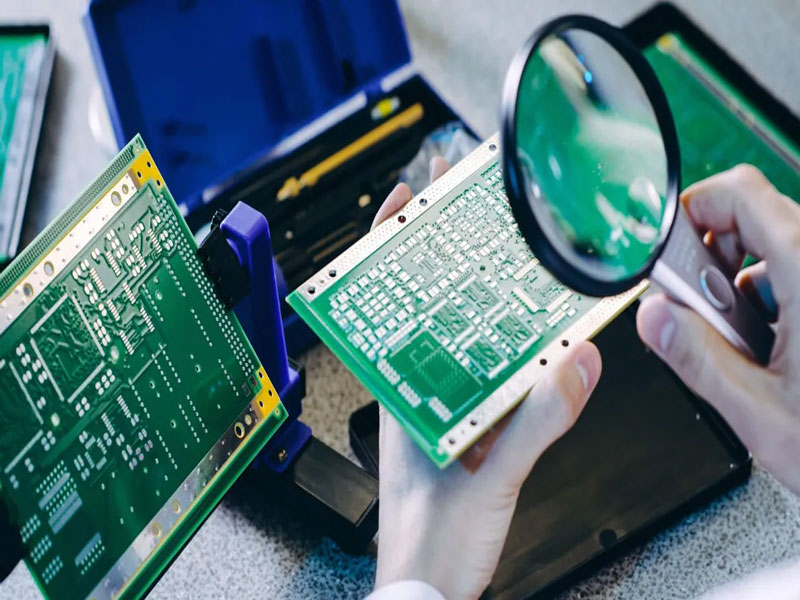
The same applies to human inspection under a microscope. A trained operator scanning a green board sees an area of exposed copper as an obvious anomaly, while the same defect on a dark mask requires more attention and more time.
Black PCB: Appearance and Inspection Cost
Black boards are chosen for appearance, and the aesthetic result is undeniable. The manufacturing consequence is that contrast disappears. Black mask reflects very little light, so automated inspection needs different lighting and often a different algorithm, and manual inspection becomes slower.
There is a second effect. Black absorbs radiant heat, so a board under a strong inspection lamp or in direct sunlight runs warmer than a green or blue equivalent. For a low-power consumer product that is irrelevant; for a dense assembly near its thermal limit it is one more contribution to consider.
Blue, Red, White and Matte Finishes
Blue and red masks sit between green and black on contrast, and both are widely available at modest cost. Blue has become common on development and hobby boards, while red appears frequently on automotive and industrial products as a brand choice.
White mask is the most difficult case, because any contamination, flux residue or discoloration becomes visible and the legend must usually be printed in a contrasting color. Matte finishes reduce glare under inspection lighting, which helps with dark masks and is a common reason to specify them.
Pigment Chemistry and Cure Behaviour
Pigments are not inert with respect to the curing chemistry. Different pigments absorb light at different wavelengths, and the exposure step in a photoimageable mask depends on the resist absorbing the exposing energy. A formulation that cures comfortably in green may need a longer exposure or a higher dose in black or white.
Formulators compensate by adjusting the photoinitiator package, but the result is that each color has its own process window. Switching color late in a project is therefore a process change as well as a cosmetic one, and see the discussion of solder mask ink and thixotropy for how the printing parameters interact with the formulation.
Heat Absorption and Thermal Behaviour
Absorption of radiant energy depends on the surface color, and a black board will be measurably warmer than a green one under the same illumination. In most products the difference is small compared with the heat generated by the circuit itself, but in a sealed enclosure with no airflow the contribution is not zero.
Reflectivity also matters for optical sensing. A product that uses an optical sensor mounted close to the board can be disturbed by stray reflections from a glossy mask, and a matte finish is the usual remedy.
Color and Lead-Free Processing
Lead-free reflow exposes the mask to higher temperatures, and dark pigments tend to show thermal discoloration more than light ones. Yellowing that would be invisible on a green board becomes noticeable on a white or pale mask, which is a cosmetic issue rather than a functional one but can still fail an incoming inspection.
Black mask also hides the faint yellowing that indicates the early stage of mask degradation, which means a problem visible on a green board may go unnoticed until it is advanced on a black one.
Choosing a Color for the Product
Choose green when manufacturing efficiency, inspection contrast and cost matter most, which covers most production electronics. Choose blue or red when the product has a brand identity to maintain. Choose black when appearance is a genuine selling point and the inspection impact is acceptable. Choose white only when the design can tolerate the handling discipline it requires.
Whatever the choice, confirm that the fabricator runs that color routinely rather than occasionally, because a rarely used pigment is a process risk. Where the assembly must also survive moisture or contamination, the mask color is independent of the conformal coating decision, and both should be recorded among the quality characteristics of the build.
How Color Affects Marking and Assembly
Marking strategy follows the mask color. A laser-marked legend behaves differently on a dark surface than on a light one, and the contrast between a laser mark and the surrounding mask depends on how the pigment reacts to the beam rather than on the pigment color alone. Some dark masks mark cleanly, while others produce a low contrast result that fails a readability check.
Assembly is affected indirectly. Component placement equipment locates fiducials optically, and a low-contrast fiducial on a black or white mask requires the vision system to be retrained. That is a one-time engineering effort, but it is real, and it belongs in the project schedule rather than in the surprise column.
Repair follows the same logic. A technician working under magnification finds a lifted pad or a solder bridge faster on a board with high optical contrast, which is one more reason high-volume production settles on green by default.
FAQ
Does PCB color affect electrical performance? Not directly. The mask is a dielectric coating over the copper, and its color is a pigment choice with no meaningful effect on the circuit. Where a difference appears, it comes from process variation in mask thickness rather than from the pigment itself.
Why do some prototypes arrive blue or red? It is usually a branding or departmental convention, and it also makes a prototype visually distinguishable from a production board. There is no technical advantage to either color.
Is black mask harder to manufacture? It is harder to inspect, and the exposure window may be narrower because the pigment absorbs light differently. A fabricator that runs black routinely will have no difficulty, while one that runs it rarely may need extra process development.