Black Oil-Resistant PCB: Materials, Coatings and Applications
A black oil-resistant PCB is a board whose solder mask has been selected and processed to survive contact with oils, fuels and lubricants while maintaining electrical performance. The colour is a consequence of the pigment system, and the resistance comes from the resin chemistry and the cure.
The requirement appears in automotive, industrial machinery, outdoor equipment and power tools, where oil mist, lubricant spray and fuel vapour are part of the operating environment. An ordinary solder mask may resist these for weeks and then soften, blister or lose adhesion.
Why Oil Resistance Matters
Oil and lubricant attack a polymer coating in two ways. They can be absorbed, which swells the film and reduces its adhesion, and they can dissolve unreacted components of the resin, leaving a soft surface that no longer insulates reliably.
Once the coating softens, contamination reaches the copper and the surface insulation resistance falls. The result is a leakage path that changes with temperature and humidity, which is difficult to diagnose in the field.

Solder Mask Chemistry
Standard photoimageable solder mask is an epoxy-based system with fillers and pigments, cured thermally or with UV followed by a thermal bake. Its chemical resistance depends on the degree of cure and on the crosslink density of the resin.
A more resistant formulation uses a different resin backbone, often with a higher aromatic content, which resists swelling by non-polar liquids. The trade-off is usually a narrower development window and a higher cure temperature.
Black pigment is carbon-based in most formulations. Carbon black changes the exposure behaviour of the film, because it absorbs light, so imaging a black mask requires higher exposure energy and often a more careful process than a green mask. This is a processing cost, not an electrical one.
Surface Energy and Wetting
Resistance to a liquid depends partly on surface energy. A coating with low surface energy repels oil and prevents it from spreading across the surface, which limits the contact area and the time available for absorption.
Surface energy is increased by contamination and by incomplete cure. Residue left after development, fingerprints and flux from assembly all raise the surface energy locally and give the oil a path in.
Cleanliness before assembly therefore matters as much as the coating specification. A high-performance mask applied to a contaminated surface fails at the contamination rather than at the coating.
Adhesion and Cure
Adhesion is what keeps the coating in contact with the laminate. It depends on surface preparation before application, on the cure profile, and on the coefficient of thermal expansion of the mask relative to the board.
Overcuring makes the mask brittle, and a brittle mask cracks at the edges of pads where the copper topography creates stress concentrations. Under-curing leaves reactive groups that the oil can attack.
The cure window is therefore the parameter to control. Cure is verified by measuring hardness, adhesion or the degree of conversion rather than by assuming the oven profile is stable.
Coating Options Beyond Solder Mask
Where solder mask alone is not sufficient, a conformal coating is added. Acrylic coatings are easy to apply and easy to remove but have limited oil resistance; polyurethane and silicone coatings resist oils and solvents better and are the usual choice for automotive and industrial electronics.
Parylene, deposited as a vapour, gives a thin, pinhole-free coating with excellent barrier properties and no liquid application step. It is more expensive and requires specialized equipment, so it is used where the environment justifies it.
Coating and solder mask work together. The mask defines the electrical insulation on the board surface, and the coating seals the assembly including components, joints and mask edges.
Testing Oil Resistance
Resistance is verified by immersion tests in reference fluids, followed by adhesion checks and insulation resistance measurement. Test duration and temperature define the severity, and a short test at room temperature says little about long-term behaviour.
Adhesion is checked by tape test or cross-hatch before and after immersion. A mask that passes the tape test before immersion and fails afterward has been attacked by the fluid, even if the surface looks unchanged.
Insulation resistance measurement completes the picture. Surface resistance is measured between adjacent conductors, often at elevated humidity, because absorbed fluid and humidity act together.
Design Rules for Harsh Environments
Keep conductor spacing generous. Wider gaps reduce the field strength between conductors and give contamination more distance to bridge, which raises the insulation resistance even after the coating has degraded.
Avoid sharp copper edges and pointed features, which concentrate field and provide a starting point for coating defects. Rounded pad shapes and smooth transitions improve coating coverage and reduce stress concentration.
Keep black mask off sensitive measurement areas where possible. Where a coating must be inspected optically, contrast between the coating and the board helps, and a black surface provides none.
Storage, Handling and Repair
An oil-resistant board is not automatically resistant to every fluid it will meet. Cleaning solvents, hydraulic fluid and brake fluid each act differently, and the specification should list the fluids the board must withstand rather than describing the requirement in general terms.
Repair creates a weak point. Solder rework burns or removes the coating locally, and the repair must be recoated with a compatible material. A repaired area that is left uncoated becomes the first place oil reaches the copper.
Laminate and Copper Under the Mask
The laminate also participates in oil resistance. A high glass transition laminate absorbs less moisture and holds its dimensions better through thermal cycling, which keeps the mask from being stressed by the substrate beneath it.
Copper surface condition matters before the mask is applied. Oxidized or contaminated copper produces a mask interface that fails at the copper edge, which is exactly where oil first reaches the conductor once a pinhole forms.
Verifying the Finished Assembly
Verification should match the application rather than the catalogue. A board for an engine compartment and a board for a workshop machine need different fluids, different durations and different acceptance limits.
Write the test into the specification with the fluid, temperature and duration, and require the adhesion check after immersion. Without that sequence, a passing result only proves that the coating survived the immersion, not that it still protects the circuit.
Applications
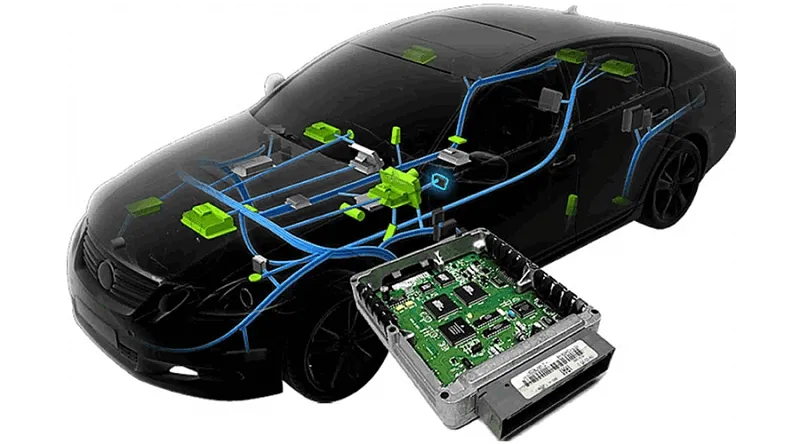
Automotive under-hood electronics, transmission and engine control units, industrial motor drives, agricultural equipment, outdoor lighting and power tools all use oil-resistant boards. The common factor is an environment where hydrocarbons are present continuously rather than occasionally.
In those applications the board is usually coated as well as masked, and the assembly specification should state both the mask type and the coating material, along with the tests used to verify them.
Further reading: conformal coating and board protection, solder mask ink thixotropy, and PCB design quality characteristics.
FAQ
Does the colour itself affect oil resistance? Not directly. Resistance comes from the resin chemistry and cure. Black pigment does change the imaging process, because it absorbs light and requires higher exposure energy.
Is conformal coating necessary if the solder mask is oil resistant? In most harsh environments, yes. The mask covers the board surface, but joints, components and mask edges still need sealing, and most failures begin at those discontinuities.
How is oil resistance verified? By immersion in a reference fluid for a defined time and temperature, followed by adhesion testing and insulation resistance measurement, including at elevated humidity.