Fiberglass PCB: The FR-4 Substrate Explained
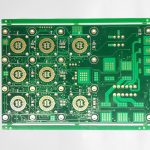
Almost every rigid circuit board in production is a fiberglass PCB, even when nobody uses that term. The familiar green or blue board is a composite of woven glass cloth and epoxy resin, with copper foil bonded to the faces, and the properties of that composite decide how the board behaves electrically, thermally and mechanically.
What a Fiberglass PCB Is
The substrate is a laminate made by impregnating woven glass fabric with a partially cured epoxy resin, drying it into a sheet called prepreg, and then pressing several sheets together under heat and pressure until the resin flows and cures. Copper foil is bonded on one or both faces during the same process.
The result is a rigid, electrically insulating sheet with predictable dielectric properties and enough mechanical strength to survive assembly and service. Everything else about the board, its layer count, its impedance and its thermal rating, is a variation on that basic construction.
Woven Glass Cloth and Epoxy Resin
The glass cloth is the structural element. It is woven from fine filaments into a fabric with a defined thread count and weight, and that weave determines the mechanical strength, the resin content and, indirectly, some of the electrical behaviour.
The resin is a brominated epoxy in the standard grade, with a curing system that determines the glass transition temperature and the thermal endurance. Fillers and additives modify properties such as thermal conductivity, flame retardancy and coefficient of thermal expansion.
Prepreg, Core and Lamination
Prepreg is the intermediate product: glass cloth impregnated with resin in a B-stage state, where it is dry to the touch but will flow and cure when heated. Cores are fully cured laminates clad with copper on both faces.
A multilayer board is built by stacking cores with prepreg between them and pressing the assembly. The resin in the prepreg flows, fills the space around the copper features and then cures, bonding the layers into a single structure. The quality of that fill determines whether the board has voids.
Glass Transition Temperature and What It Means
The glass transition temperature is the point at which the cured resin changes from a hard, glassy state to a softer, more rubbery one. It is not a melting point, and it does not mark an immediate failure, but the resin’s mechanical properties degrade noticeably above it.
Standard grades sit around 130 to 140 °C, mid-range materials around 150 to 170 °C, and high Tg grades above 170 °C. The relevance to assembly is that lead-free reflow peaks above 240 °C, so a board spends a considerable time well above its glass transition temperature. A higher Tg grade tolerates that excursion with less expansion and better dimensional stability.
Dielectric Constant and Loss
The dielectric constant of the laminate sets the relationship between trace geometry and impedance, and it varies with resin content, glass content and frequency. Standard FR-4 sits near 4.2 to 4.6 at low frequency, and the value falls slightly as frequency rises.
Loss tangent describes how much energy the material absorbs, and it rises with frequency and with moisture content. For high-speed designs the loss tangent rather than the dielectric constant is often the limiting property, because attenuation closes the eye diagram. The general compromise is described in the guidance on multilayer boards for high-speed designs.
Weave Effect and Impedance Variation
Glass cloth is woven, which means the dielectric constant varies slightly between the bundles of glass fibres and the resin-rich windows between them. A differential pair routed so that one trace sits over a bundle and the other over a window sees a small impedance difference that varies periodically along the length.
The effect becomes visible at high data rates as a periodic ripple in the channel response. Remedies include routing the pair at an angle to the weave, using a spread-glass fabric that randomises the fibre layout, or choosing a material with a finer weave. It is one of the few layout problems whose solution begins in the laminate datasheet.
Mechanical Properties and Drilling
The laminate’s mechanical behaviour matters throughout fabrication. Drilling glass-reinforced epoxy wears tools and generates heat, and a dull drill raises the temperature enough to smear resin across the conductor, which is why drill life management is a real process parameter.
The coefficient of thermal expansion is anisotropic. In the plane of the board it is close to that of copper, but in the z-axis it is much higher, particularly above the glass transition temperature. That mismatch is what stresses plated barrels during reflow and drives the choice of high Tg material, more plating thickness and better plating quality, as discussed in electroplating practice.
Grades and Variants
Standard FR-4 covers most consumer and industrial products. High Tg grades are used where lead-free assembly or thermal cycling demands more margin. Halogen-free grades replace the brominated flame retardant for environmental reasons. High-frequency grades modify the resin chemistry to reduce loss.
Within each grade there are further variations in weave, thickness and copper adhesion, and the fabricator’s standard construction usually determines which are actually stocked. Choosing from the standard offering is cheaper and faster than specifying a special build.
Choosing the Right Grade
Start with the thermal requirement. If the assembly uses lead-free reflow and the product sees wide temperature swings, a high Tg grade is justified. Then evaluate the electrical requirement: calculate the loss of the longest high-speed trace and compare it with the budget before deciding whether a specialised laminate is needed.
Only then consider mechanical and environmental factors such as thickness, halogen-free requirements and the number of layers, and check the construction against the stackup guidance for boards from one to eight layers before releasing the design.
Environmental Effects: Moisture and Conductive Filament Growth
Epoxy resin absorbs a small amount of moisture from the air, and that absorption changes the dielectric constant slightly and reduces the glass transition temperature. In a humid environment the effect is measurable, which is one reason impedance is specified at a defined condition rather than assumed constant.
A more serious consequence is conductive anodic filament growth. Under a combination of moisture, bias voltage and contamination, copper can migrate along the interface between the glass fibres and the resin, eventually forming a conductive path between two conductors that should be isolated. The failure appears as a low-resistance short after months or years in service.
The prevention is a combination of material and process. A resin system with good adhesion to the glass, a construction that avoids thin dielectric between widely differing potentials, careful control of drilling to avoid resin smear, and a coating that limits moisture ingress all reduce the risk. Where the product operates in a humid or high-voltage environment, the laminate specification should reflect that requirement explicitly.
FAQ
Is FR-4 the same as fiberglass PCB? In practice, yes. FR-4 is the standard grade of glass-reinforced epoxy laminate, and it is what almost every rigid board uses. Other grades exist, but they are variants of the same construction principle.
Does a higher Tg always mean a better board? Not automatically. A higher Tg usually comes with a different resin system, which can change dielectric properties, adhesion and cost. Choose it when the thermal requirement justifies it rather than by default.
Why does my controlled-impedance board vary along the trace? Weave effect, resin content variation and copper thickness variation all contribute. If the variation is periodic, the weave is the likely cause, and a spread-glass or finer-weave laminate removes it.