PCB Assembly and Box Build: Scope, Testing and Handover
Printed circuit board assembly ends with a tested board. Box build ends with a product that can be shipped, including the enclosure, the cables, the labels and the packaging. The two are separate services, and the boundary between them is one of the most useful things to define clearly in a manufacturing agreement.
Where the boundary sits affects the documentation, the test coverage, the traceability and the cost, and moving it after production has started is expensive. It is worth deciding deliberately rather than by default.
What Each Service Covers
PCB assembly covers the procurement of components, the solder paste printing, the placement, the reflow, the cleaning where required, the inspection and the electrical test of the board. It ends with a board that meets its specification.
Box build covers the mechanical assembly of the finished product: the enclosure, the display, the cables, the connectors, the fasteners, the labels and the final functional test. It ends with a unit that is ready to be packed and shipped.
Where the Boundary Is Drawn
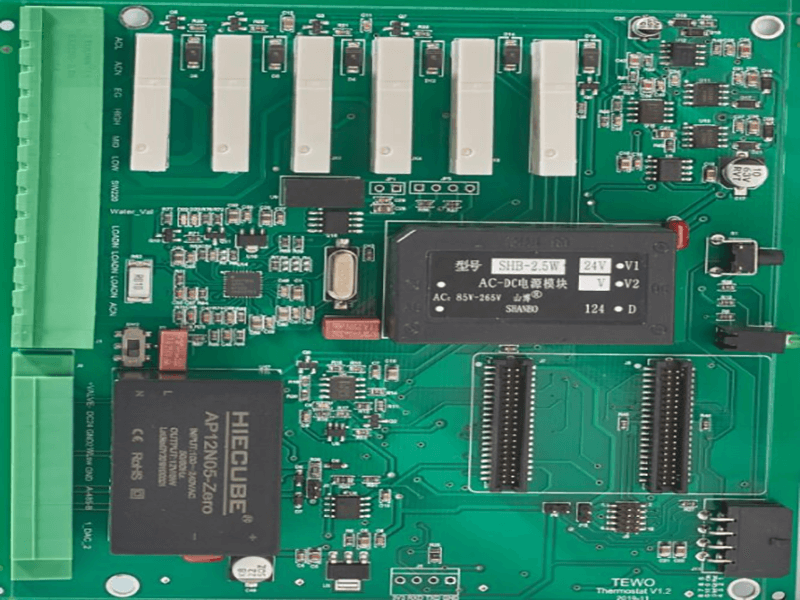
The boundary is usually drawn at the point where the board becomes part of a larger assembly. In some programmes the customer supplies the enclosure and the mechanical parts, and the assembler only fits them; in others the box build includes the procurement of every mechanical part as well.
The decision affects the supply chain more than the process. A box build that includes mechanical procurement requires the assembler to manage more suppliers, more part numbers and more incoming inspection, and it shifts the responsibility for a late mechanical part from the customer to the assembler.
Documentation and BOM Control
The bill of materials for a board is well understood, with reference designators, part numbers and approved substitutes. A box build has a different structure: the mechanical parts, the cables and the labels are identified by drawing rather than by designator, and a change to a drawing has to propagate to the assembly instructions and to the inspection plan.
The revision control has to be explicit. A board revision and a mechanical revision that are not aligned produce an assembly that cannot be built or that is built wrongly, and the error often appears only at the final test. The configuration is therefore managed as a single product revision rather than as two independent ones.
Test Coverage
The board level test verifies the electronics, including in-circuit test where it is used and a functional test of the board on its own. The box level test verifies the product, including the display, the connectors, the switches and the firmware in its final configuration.
The two are not interchangeable. A board that passes its own test can fail at box level because of a cable that is not seated, a connector that is miswired or a firmware setting that only matters when the unit is assembled. The box level test is the one that catches those faults, and it is the reason the boundary matters.

Mechanical Assembly and Cabling
The mechanical steps are where the box build creates most of its value and most of its risk. Cable routing and dressing, torque control on the fasteners, the fitting of a gasket or a seal and the application of a label are all operations that a board assembler may not be equipped to perform.
Tooling and fixtures matter as much as the operations. A jig that holds the unit during assembly, a torque controlled driver and a go no-go gauge for the gasket all reduce the variation, and they are part of the box build quotation rather than an extra.
Logistics and Handover
A box build programme usually includes the packaging, the labelling and the shipping preparation. The packaging specification has to protect the product through the distribution environment, and the label has to carry the identifiers that the customer’s logistics system expects.
The handover of the finished units is a defined event with a defined acceptance test. Where the customer performs the final test, the assembler provides the test data from its own process, and the two records together show the state of the product at the point of transfer.
Quality and Traceability
Traceability in a box build is more complex than in a board assembly, because a single unit contains a board, a cable set, an enclosure and a firmware version, and each of them has its own lot or revision. The record that links them is what allows a field failure to be analysed.
The quality plan covers the incoming inspection of the mechanical parts, the in process checks, the final test and the outgoing inspection. Where the product is regulated, the plan also includes the documentation that the regulation requires, which is easier to satisfy when the scope has been defined in advance.
Choosing the Scope
Choose the narrower scope when the mechanical assembly is technically demanding, when the customer has an existing enclosure supply chain or when the product is assembled close to the market. Choose the broader scope when the product is simple to assemble, when a single supplier reduces the logistics cost or when the assembler already owns the mechanical tooling.
gopcb supplies assembled and tested boards with the electrical test data that a box build programme needs as an input, and can support the transition where the scope includes partial mechanical assembly.
Cost Structure and Quotation
The two services are quoted differently. Board assembly is quoted per unit with the component cost passed through, so the quotation is sensitive to the component market and to the board price. Box build adds labour for the mechanical operations, the cost of the enclosure and the cables, and often the cost of the packaging and the logistics.
A quotation that mixes the two without stating the boundary is a source of dispute later, because the assumption about who supplies the mechanical parts is not written down. The quotation should identify the parts that are supplied by the customer, the parts that are procured, the test that is performed and the point at which the product is handed over, and it should state the expected volume and the order pattern, since a box build with a variable volume carries different overhead from a steady one.
Finally, consider the reverse transition. A programme that grows from board assembly into box build should keep the electrical test data, because the box level test assumes a board that was already verified. Where the two stages are performed by different suppliers, the test record is the interface between them, and it should travel with the units rather than remain with the first supplier.
FAQ
Is box build just final assembly? It includes the mechanical assembly, the cabling, the labelling, the final test and often the packaging and logistics. The scope varies, which is why it should be written down.
Who owns the design authority when both services are outsourced? The customer owns the design and the assembler owns the process. The boundary is expressed in the drawing set and in the change control procedure rather than in a verbal understanding.
Can a box build programme start before the design is frozen? It can start with the quotation and the tooling, but the assembly should not begin until the configuration is controlled, because a late change affects the instructions, the fixtures and the labels.
Related reading: PCBA development process, PCB cable assembly, PCB design quality characteristics, and PCBA burn-in test.