Acidic vs Alkaline Etching for PCB: Chemistry Compared
Once the pattern has been imaged and developed, the panel still has to give up the copper that the resist does not protect, and that step is done in a wet chemistry bath. Two families dominate production: acidic etching, built around cupric chloride or a similar acidic solution, and alkaline etching, built around an ammonia based system. Both can produce excellent fine line work, and neither is inherently superior. What differs is the chemistry, the way the bath is controlled, the profile left behind and the process flow each fits into.
Two Chemistries, One Job
Both processes must dissolve copper quickly, uniformly and selectively, leaving the resist and the substrate alone. The reaction has to be fast enough to clear a panel in a short pass through a spray chamber, controllable enough that the rate does not drift during a shift, and compatible with the metals and the plating already on the panel. Those three requirements shape every choice that follows.
The practical difference between the two chemistries lies in how the dissolved copper is held in solution and how the bath is regenerated. An acidic system based on cupric chloride can be regenerated by oxidising the spent etchant, and an alkaline ammonia system is controlled by maintaining the ammonia and ammonium salt balance. Each demands its own analytical routine and its own waste treatment path.
Acidic Etching in Practice
An acidic etching line typically runs cupric chloride, often as part of a two stage arrangement in which the first chamber does the bulk removal and the second finishes the pattern cleanly. The chemistry is compatible with the plating resists and tin or tin-lead etch resists used on pattern plated boards, and it handles a wide spread of copper thicknesses without a change of equipment.
Regeneration is the main operating task. As copper enters the solution the etch rate falls, so oxidant is added and the specific gravity is held within a window, with the concentration checked by titration or by an automatic controller. Because the chemistry is acidic, the waste stream is handled separately from the alkaline developer and stripper, and copper recovery is usually part of the line design.

Alkaline Etching in Practice
An alkaline etching line runs an ammonia based etchant, most commonly ammonium chloride with free ammonia, which dissolves copper to form a soluble complex. The system usually needs two stages as well, with fresh chemistry in the second chamber so that the final surface is clean and the sidewalls are properly defined.
The bath is maintained by measuring the copper concentration, the pH and the specific gravity, and by adding ammonia and ammonium salt to keep the balance. Vapour management matters because the free ammonia is volatile, so the line is enclosed and extraction is engineered into the tool. In exchange, alkaline etching is fast, holds good uniformity across large panels and fits well into high volume and fine line production.
Sidewall, Undercut and Etch Compensation
Both chemistries are isotropic in principle: the etchant attacks sideways beneath the resist as well as downwards. The finished trace therefore has a trapezoidal cross section with the resist edge overhanging the undercut, and the artwork must carry etch compensation so that the measured width matches the design intent. Compensation is calculated from the copper thickness, the resist type and the measured etch rate on the line that will actually run the job.
The two chemistries reach that result along slightly different paths. Alkaline systems are often valued for a steeper, more controlled sidewall on fine lines because the reaction at the resist edge is easier to manage, while acidic systems are valued for their tolerance of mixed copper loads and their straightforward regeneration. In both cases the dominant variable is how well the operator and the controller hold the bath steady.
Copper Thickness and Heavy Copper Boards
Copper thickness changes the difficulty of the task more than the choice of chemistry does. Removing two ounces of copper takes roughly twice as long as removing one, which gives the sideways attack more time to work and widens the gap between the printed width and the finished width. Traces also narrow more at the top than at the base, so the impedance of a finished board can differ from the calculation.
On heavy copper the process has to be slowed deliberately, run at a lower conveyor speed with stronger spray coverage, and compensated more aggressively in the artwork. Fine features and heavy copper pull in opposite directions, which is why a design that needs both is usually built with a pattern plating flow that starts thin and adds copper where it is required.
Uniformity, Spray and Conveyor Control
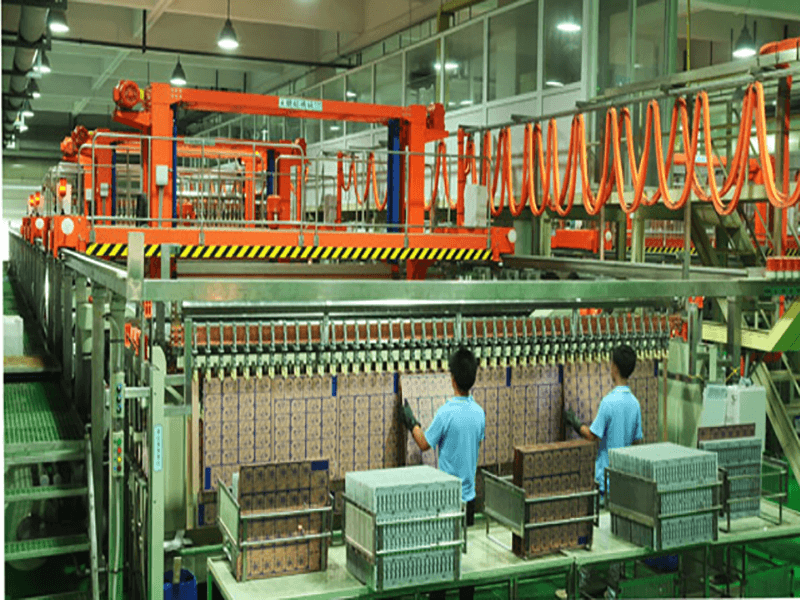
Etch uniformity is a machine characteristic as much as a chemistry one. Nozzle pattern, oscillation, spray pressure, conveyor speed and the distance between the panel and the manifold all influence how evenly the copper clears, and the edge of a large panel generally etches faster than the centre unless the tool is tuned for it.
Keeping that variation inside the process window allows the same compensation to be applied across the panel rather than only in the middle. Shops measure it by etching a test pattern to the point where the last sliver of copper clears, then recording the time difference between points on the panel, and the resulting figure drives the conveyor speed setting for the job.
Defects, Inspection and Yield
Etching defects follow a familiar list: over etched traces that fall below the tolerance, residual copper slivers that bridge adjacent tracks, pinholes in the resist that let the etchant through, and ragged edges where the resist lifted. Each has a process cause, and each is visible under automated optical inspection when the line is equipped for dimensional measurement rather than simple defect detection alone.
Yield depends on keeping the whole chain in balance. The resist must be exposed and developed to a clean edge, the copper must be uniform before it reaches the etcher, and the bath must be analysed on a schedule rather than when a problem appears. Our notes on PCB manufacturing processes and PCB cleaning show how the etching step sits inside the wider flow.
Matching the Etch Line to the Process Flow
The choice between acidic and alkaline chemistry is often settled by the plating flow rather than by the etch result itself. A pattern plating process that leaves tin or tin-lead over the conductors requires a chemistry tolerant of both the resist and the metal, while a panel plating or tenting flow removes that constraint and opens the choice. Most suppliers with both lines in house route each job to whichever process fits the flow and the copper load, and the customer never sees the difference except in the price.
Volume and product mix matter just as much. A line dedicated to one chemistry is easier to control and cheaper to run than a line that switches between two, and the analytical routine, the waste treatment and the copper recovery equipment differ between them. For a buyer, the practical question is which chemistry the chosen supplier has genuinely tuned, because a well controlled process on either chemistry beats a poorly controlled process on the theoretically better one.
FAQ
Is acidic etching better than alkaline etching? Not in general. Both produce high quality boards, and the result depends on copper thickness, minimum width and gap, resist quality, equipment accuracy, chemistry control and the fabricator process capability rather than on the chemistry family alone.
Which process suits fine line work best? Both are used for fine lines. The deciding factor is the whole chain, including imaging accuracy, resist resolution, development, copper thickness, etch uniformity and the compensation applied to the artwork.
Why does etching create undercut? Because the solution removes copper sideways beneath the resist edge as well as downwards. Longer etch time, heavier copper and poor resist adhesion all increase the lateral attack, which is why compensation and process control are essential.