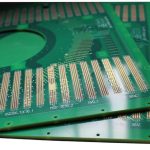
Bare PCB Manufacturing Cost: What a Blank Board Costs
A bare board is a PCB with no components on it, and its price is the clearest view of what fabrication actually costs. Stripping the assembly out of the quotation removes the component and labour noise, leaving laminate, copper, chemistry, drilling, imaging and test. This guide explains how a bare PCB manufacturing cost is built in 2025 and which specification choices move it most.
What a Bare Board Price Covers
Order size also changes which of those five blocks dominates. At small quantities the setup inside imaging and drilling is the largest item, because the programmes have to be written and verified for a handful of panels. At large quantities material and process yield take over, and the setup charge becomes almost irrelevant to the unit price.
Five things are being bought: the laminate and copper foil, the imaging and etching that defines the pattern, the drilling and plating that creates the connections, the chemistry that finishes the surface, and the test that proves the board works. Only the first of those is a commodity. The other four are process time, and process time is what changes with layer count and precision.
That distinction explains why two boards of the same size and layer count can differ substantially. One may be on a standard process with routine tolerances, while the other needs finer lines, a tighter registration or a controlled impedance check. Both are bare boards; only one of them is a standard product.
Layer Count, Thickness and Stackup
Layer count is the first multiplier because each pair of layers adds a lamination cycle and its own imaging and plating steps. A four-layer board is not twice a two-layer board in price, because the first lamination already carries much of the overhead, but a six-layer board is a clear step above four and an eight layer stackup is another step again.
Finished thickness then interacts with the stackup. A standard 1.6 mm board uses common prepreg and core combinations, while an unusual thickness requires material that may not be in stock and a lamination cycle that is harder to control. Staying on a standard thickness keeps the board on a standard flow.
Copper Weight and How It Is Priced
Copper weight is charged across the whole panel, not only on the nets that need it. Moving the outer layers from 1 oz to 2 oz changes the etching process as well as the material, because a thicker foil requires longer etch and tighter compensation, and it reduces the minimum line width the line can hold. Heavier copper above that narrows the supplier list considerably.
The practical approach is to size conductors by trace width and current for the nets that carry power, and to leave the rest of the board on the lighter foil. A partial copper upgrade is not always possible on the same layer, but keeping the heavy current on a plane and the signals on a lighter layer often is.
Surface Finish Options
Shelf life belongs in the same decision. A finish that oxidises before the board is assembled forces the panel to be re-cleaned or scrapped, and that cost never appears in the finish price. If the boards will be stored for months before they are populated, the more stable chemistry is usually the cheaper choice in total.
The surface finish protects the copper between fabrication and assembly, and the choice is a cost decision as much as a technical one. HASL is the cheapest and is adequate for generous pitches; lead-free HASL satisfies the same requirement under a wider specification. ENIG is flat, stable and more expensive, and hard gold on a connector edge is priced by plated area.
Finish also affects yield. A finish that is difficult to control on a dense board produces more rework and more scrap, so the cheapest chemistry on the price list is not always the cheapest chemistry in practice. For a fine-pitch design the flat finish usually pays for itself in assembly yield.

Panel Utilisation and Board Outline
Panel utilisation is the single most controllable cost item. A fabricator buys standard panels and fills them with as many circuits as will fit, so the material and processing charge for each board is effectively the panel price divided by the number that fit. Improving the nesting by ten percent reduces that part of the price by roughly the same amount.
Outline complexity then reduces utilisation. A rectangular board tiles efficiently; a curved or slotted outline leaves scrap around every part, and irregular shapes often need routing time that a straight cut does not. Keeping at least one dimension standard and adding breakaway tabs rather than complex outlines keeps the board on a simple process.
Bare Board Testing and Inspection
Electrical test verifies that every net is connected and no two nets are shorted, which is the minimum acceptance criterion for a bare board. Flying probe is suited to small quantities and dense boards, while a dedicated fixture becomes cheaper per unit above a certain volume. The price depends on the net count rather than on the board area.
Inspection goes further on demanding products. Automated optical inspection checks the pattern, a microsection verifies the plating thickness and the layer registration, and an impedance coupon confirms the stackup. Each of those is a separate charge and each one produces evidence, which is what a regulated product actually needs.
Volume Tiers and Delivery Terms
Packaging and handling are minor items that occasionally surprise buyers. Boards shipped loose in a small order can arrive with edge damage, and a supplier who includes vacuum packing, edge protection and a desiccant bag is charging for a real service rather than padding the invoice.
Volume tiers behave differently at each stage. Small quantities are dominated by setup, mid quantities by panel efficiency and material purchasing, and large quantities by process stability and dedicated tooling. A quotation at one quantity therefore says very little about the price at another, which is why asking for three quantities at once is the most useful request a buyer can make.
Delivery terms must be normalised as well. An ex-works price excludes freight, duty and clearance, while a delivered price includes them. The only figure that belongs in a project budget is the landed cost at the receiving dock, and comparing anything else invites a discrepancy later in the programme.
Reducing Bare Board Cost Without Cutting Quality
The reliable savings are geometric and procedural. Nest the board well, keep the outline simple, stay on a standard thickness, use the lightest copper that satisfies the current, and avoid unnecessary vias and fine-line features. None of those changes touch the electrical performance of the product, and together they can move the price noticeably.
Applying manufacturable design guidelines before the first order is what makes those savings available. What should not be reduced is the plating thickness on a plated hole, the annular ring, or the test coverage, because each of those protects the function of the board rather than its appearance.
Process Control and Verification
Reviewing the design before the data is released is far cheaper than correcting it after the panel is in the tank, because every step downstream inherits the decision made at the front end. Where a value sits close to a process limit, the drawing should say so, since the shop can then open the process window rather than working to a nominal figure that carries no tolerance.
The measurements that matter are the repeatable ones: conductor width and spacing, annular ring, finished hole size, plating thickness and surface finish are all verifiable on a coupon that travels with the panel. Documenting the assumption is part of the design work, and a short note on the drawing prevents a question that would otherwise arrive a day later and cost a day of schedule.
Where a value sits close to a process limit, the drawing should say so, since the shop can then open the process window rather than working to a nominal figure that carries no tolerance. Running a first article through the same checks as the production panel confirms that the two agree, and that comparison is the cheapest form of process control available at prototype stage.
FAQ
Why is a bare board cheaper than an assembled one? Components and assembly labour are removed, leaving only fabrication. The useful comparison is still between bare boards, because the assembly quote depends on the placement count rather than on the board.
Does a heavier copper layer cost more everywhere on the board? Yes. Copper is bought and processed across the whole panel, so a single heavy layer raises the price of the entire board, not only of the nets that need the current.
What is the cheapest way to reduce a bare board price? Improve panel utilisation. It reduces both the material charge and the processing time per board, and it can be changed at layout stage at no cost to the finished product.