
Utilisation: Reading a PCB Quotation: Where the Cost Comes From
An invoice for a printed circuit board is a statement of a process, and a designer who can read it can tell where the cost has been incurred and what to change. The breakdown is not usually itemised, and the structure behind it is consistent enough to reconstruct.
The Price of a Panel
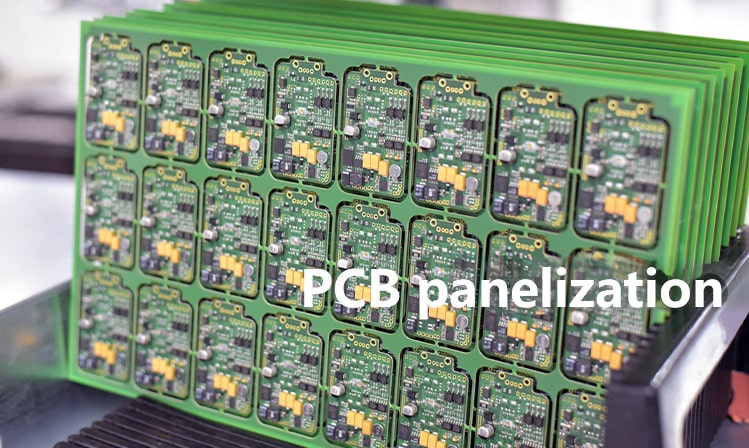
The fundamental cost unit is the panel, not the board, so the first question is how many boards fit on one. The number follows from the outline, the spacing and the border, and it is the single most influential figure in the price.
Utilisation is the measure of how well the panel is used, and it is expressed as a percentage of the panel area that becomes product. Two designs with the same board area can differ by twenty per cent in price because of the way they tile. Our panelization notes describe the arrangement.
Material and Layer Count
The laminate, the copper foil, the prepreg and the finish metal are consumed in proportion to the panel area and the number of layers. A four-layer board uses roughly twice the material of a two-layer board of the same outline.
The material cost is the most visible component and the one most often optimised, although it is rarely the largest. The process cost is usually larger at prototype volume and comparable at production volume.
Process Steps and Their Count
Every layer adds an imaging cycle, an etching cycle and an inspection, and every pair of layers adds a lamination cycle. The number of steps is what determines the machine time, and machine time is what the shop sells.
That is why the layer count is the dominant lever and why a design that reduces it without losing function is a genuine saving rather than a cosmetic one. Our layer count notes describe the trade.
Drilling and Plating
The number of holes, their size and the aspect ratio determine the drilling time, and the plating time is proportional to the copper thickness and to the panel area. Heavy copper occupies the plating line for hours and is priced accordingly.
A high aspect ratio also slows the process, because the chemistry has to penetrate further into each hole. The relationship is not linear, which is why the capability limits are published as bands rather than as a formula.

Yield and the Cost of Being Close to a Limit
A design that sits at the process limit has a lower yield, and the lost panels are charged to the surviving ones. The relationship is exponential near the limit, which is why a small reduction in the minimum feature can produce a large reduction in price.
This is the part of the price that is invisible in a quotation. Two shops quoting the same job at different prices may be assuming different yields for the same design.
Setup, Tooling and Volume
Setup covers the data preparation, the tooling, the first article inspection and the process qualification. It is a fixed cost that is amortised across the order, which is why the price per board falls steeply with quantity at low volume and slowly at high volume.
The tooling is specific to the design, so a change to the data after the order is placed can invalidate it. That is one reason a change late in the flow is expensive. Our change control notes describe the process.
Lead Time and Its Premium
A shorter lead time is bought by displacing other work, and the premium reflects that. Where the schedule is not constrained, the standard lead time avoids a cost that adds nothing to the product.
The lead time is determined by the least available step: lamination for a high layer count, plating for heavy copper, and often the first article inspection for a new design.
What to Change First
The order of examination is the layer count, the panel utilisation, the minimum features, the finish and then the tolerances. The first two account for most of the variation between two quotations, and the last two account for most of the waste.
Where a quotation is higher than expected, the first question is how many boards fit on a panel and what the layer count is. Those two answers explain most of the difference before any process detail is discussed.
Additional Considerations for This Build
Practical attention to setup cost pays for itself here, because it decides whether the finished board behaves as the drawing intended. Where the requirement is not stated on the fabrication drawing or in the assembly notes, the shop has to assume a default, and that default is rarely the value the design was simulated with. Stating setup cost explicitly, together with the tolerance that applies, removes the assumption and keeps the result predictable from batch to batch.
Process Control and Verification
On a design of this kind, yield is the item that decides how the rest of the board is arranged. Keeping a sample from the panel turns a dispute into a measurement, because the same coupon can be re-examined by both parties without rebuilding the batch. Reviewing the design before the data is released is cheaper than correcting it after the panel is in the tank, because every step downstream inherits the decision made at the front end.
Documenting the assumption is part of the design work, and a short note on the drawing prevents a question that would otherwise arrive a day later and cost a day of schedule. The process window is set by the narrowest step in the flow, so an improvement anywhere else shows up as margin rather than as yield until that step is addressed.
A short note on the drawing about handling, storage or packaging is often worth more than an extra decimal place on a tolerance.
Process Control and Verification
On a design of this kind, yield is the item that decides how the rest of the board is arranged. Keeping a sample from the panel turns a dispute into a measurement, because the same coupon can be re-examined by both parties without rebuilding the batch. Reviewing the design before the data is released is cheaper than correcting it after the panel is in the tank, because every step downstream inherits the decision made at the front end.
Process Control and Verification
On a design of this kind, yield is the item that decides how the rest of the board is arranged. Keeping a sample from the panel turns a dispute into a measurement, because the same coupon can be re-examined by both parties without rebuilding the batch. Reviewing the design before the data is released is cheaper than correcting it after the panel is in the tank, because every step downstream inherits the decision made at the front end.
FAQ
Why is a prototype so much more expensive per board? Because the setup is the same as for a production order and it is divided among far fewer boards. The material and process cost per board is similar; the amortisation is not.
Does a smaller board always cost less per unit? It costs less material, and it may cost more if the smaller outline tiles poorly on the panel. The relevant figure is the panel area consumed per good board.
How does gopcb quote? We quote from the stack, the outline, the panel arrangement, the finish and the tolerances, and we state the number of boards per panel and the panel dimensions. Where a different arrangement would be cheaper we quote both so that the choice is visible.