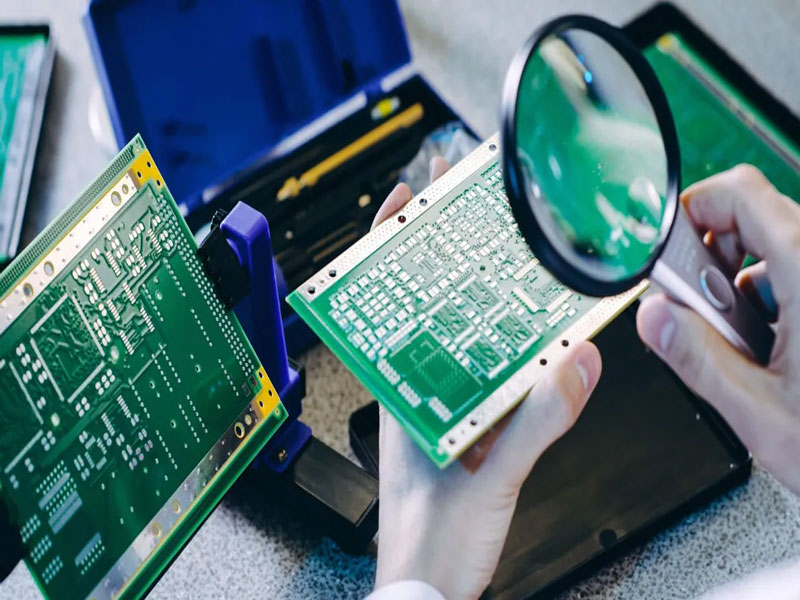
Moisture Sensitivity Level And Why Dry Storage Matters
Plastic packaged components absorb water from the air. It is a slow process and an invisible one, and it matters only when the part is heated rapidly, which is exactly what a reflow oven does. The water turns to steam inside the package, and the pressure it generates is enough to crack the moulding compound, delaminate the die attach or break a bond wire.
This article explains the mechanism, how the industry classifies parts against it, and what storage and handling have to provide to keep the risk under control.
The subject is usually treated as a warehouse matter, which is a mistake. It is a process risk that begins at goods inwards and ends at the reflow oven.
What Moisture Does Inside A Package
The moulding compound around a die is a polymer, and polymers absorb water. The amount depends on the material, the ambient humidity and the time of exposure, and it reaches an equilibrium with the environment rather than stopping at the surface. In a dry room the part gives moisture up; in a humid warehouse it takes it on.
When the part passes through reflow, the temperature rises fast enough that the moisture does not have time to diffuse out before it boils. The steam expands inside the package, and the result is internal pressure that the package was never designed to contain. The damage is known as popcorning, and it can be visible as a bulge in the moulding or entirely invisible, in which case it shows up later as a cracked die attach or an intermittent bond. The move to lead free soldering made the problem worse, because the higher peak temperature raises the pressure inside the package.
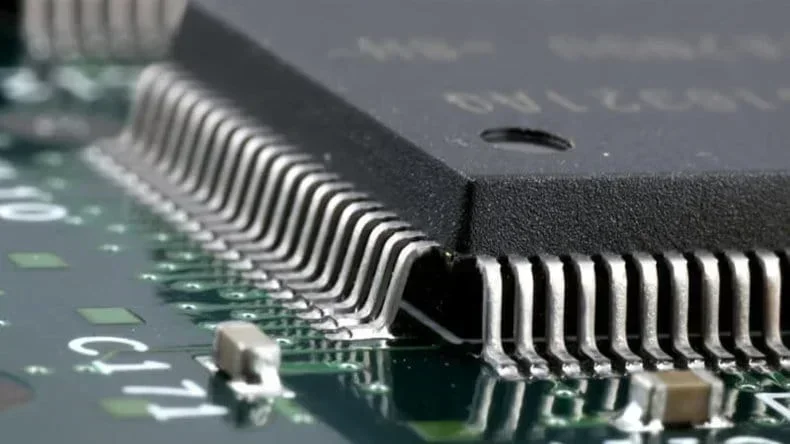
The Classification And The Clock
The industry response is a classification system. Parts are assigned a moisture sensitivity level according to their package size, thickness and material, and the higher the level, the shorter the time the part can be exposed to the ambient after the dry pack is opened. That exposure allowance is the floor life, and it is the number that has to be managed on the shop floor rather than in the warehouse.
Two things follow. The first is that the dry pack matters: a vacuum bag with desiccant keeps the part dry until the moment it is opened, and the humidity indicator card in the bag is evidence that it stayed that way in transit. The second is that once the bag is open the clock starts, and it runs whether or not the parts are being used. Parts that have exceeded their floor life have to be dried again before they can be reflowed, and baking has its own limits, since the tape and reel may not survive the temperature a plastic part needs.
Oxidation Of Terminations
Moisture is not the only reason storage matters. The solderable surfaces of a component oxidise over time, and a termination that has grown a thick oxide layer will not wet properly. The result is a joint that looks formed but is not, or a fillet that is incomplete, which passes a visual check and fails later under thermal or mechanical stress.
Oxidation is accelerated by humidity and by temperature, and it affects the plated surfaces that have to be soldered. A part stored in a controlled atmosphere ages far more slowly than one stored on an open shelf, and the difference shows up as a change in the defect rate rather than as a single failure. This is not a defect the assembler can fix at the oven, and it is not visible in the placement data, which is why it belongs in the storage specification rather than in the process instructions.

What Dry Storage Has To Provide
A dry store keeps the relative humidity in the low single digits rather than in the tens of percent. That is far below what an air conditioned room achieves, and it requires a dedicated cabinet with a desiccant or a refrigeration based dryer, or a nitrogen purge. The requirement is not uniform: a reel of fine pitch parts, a tray of bare dies and a bag of sensitive modules each have their own limits, and a store that applies a single set point to all of them is either wasting capacity or exposing the most sensitive items.
The practical arrangement is to divide the store into zones so that each can be held at the humidity its contents need. That also allows a partially used reel to be put back into a dry environment and its remaining floor life preserved, which is the point of the exercise. Zone control is more useful than an oversized single chamber, because it lets the store match the contents rather than the other way round.
Nitrogen And Oxygen Control
Humidity is the primary variable, and oxygen is the second. Replacing the air in the cabinet with nitrogen lowers the oxygen concentration, which slows the oxidation of plated surfaces and of the solderable finishes, and the effect is measurable over the weeks and months that components spend in storage. The useful refinement is to add nitrogen only when it is needed, based on the measured level, rather than to purge continuously, because nitrogen has a cost of its own.
Controlling both variables together is what changes the storage from a place where parts wait into a step that protects them, and the improvement shows up as a lower and steadier defect rate at the printer rather than as a change in any single measurement. The combination matters most for the parts with the finest pitch and the thinnest plating, which are also the parts that fail most expensively when solderability degrades.
Records And Traceability
A storage system that logs the temperature, humidity and oxygen level over time, and that can be linked to the production system, turns an assumption into a record. When a batch of assemblies develops a solderability problem, the stored data answers whether the parts were in specification and for how long, which is the difference between a diagnosis and a guess.
It is worth recording when a dry pack was opened and when the parts were returned to storage, because the floor life is consumed from the first of those events rather than from the moment the part is used. That record is also what a customer audit will ask for, and the quality characteristics of the assembly are incomplete without it. Where a board is protected after assembly, the coating applied to the finished product addresses a different threat and does not compensate for parts that were reflowed wet.
FAQ
Can a part be used after its floor life has expired? Yes, after being dried again, provided the packaging and the part can survive the bake. Otherwise it should be scrapped.
Does a dry cabinet replace the desiccant pack? No. The pack protects the part in transit and in the bag; the cabinet protects it once the bag is open.
Is nitrogen necessary? Not always. It is the second line of defence, and it is most valuable for parts with fine pitch terminations and thin plating that will be stored for long periods.