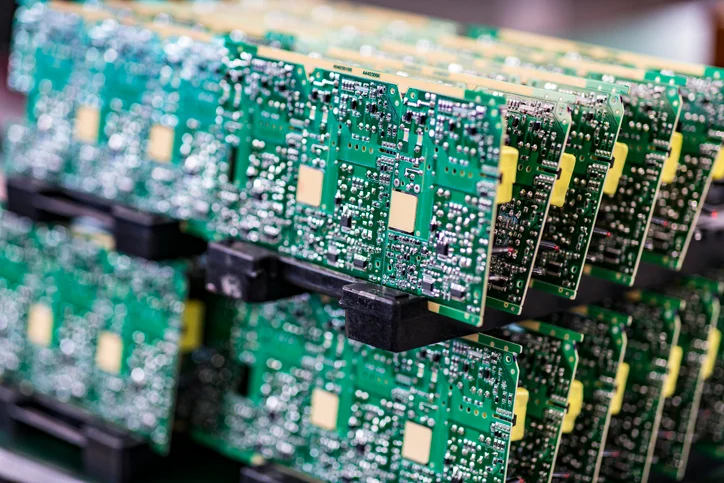
Component Storage, Floor Life and Solderability
A component that has been in a store for two years is not the component that was qualified. The terminations oxidise, the moisture content changes, and the packaging that protected it has been opened and resealed more than once.
Why Components Age
The termination finish is the part that matters most. A tin finish forms an oxide and, over time, an intermetallic layer grows between the tin and the copper underneath, both of which reduce how readily the solder wets.
The body absorbs moisture when the material is hygroscopic, which is the reason for the moisture sensitivity classification and the bake that precedes assembly. Our laminate notes describe the same mechanism in the board material.
Packaging and Its Effect
The original packaging is a moisture barrier with a desiccant, and it is part of the component specification. Once it is opened, the clock starts and the exposure time accumulates.
The floor life is the time a part can stay out of the bag in a controlled environment before a bake is required. It is stated per moisture sensitivity level and it should be tracked, not remembered. Our fabrication notes notes list the records that should be kept.
Storage Conditions
A dry cabinet or a nitrogen cabinet slows the oxidation and holds the moisture out. Where the volume does not justify either, the parts should stay in the sealed bag until they are needed.
Humidity indicators should be used inside any bag that is reopened, and a part that has exceeded its floor life should be baked to the schedule in its datasheet rather than to a general rule.
Bake Limits
A bake removes the moisture and it also drives the growth of the intermetallic layer and the oxidation of the finish. The number of bakes a part can tolerate should be limited and recorded.
Tape and reel packaging cannot be baked at the temperature a bake usually requires, so reels may have to be transferred before the bake. The transfer itself is a handling risk that should be planned.
Solderability Testing
The check is a solderability test on a sample from the batch, using a wetting balance or a dip and look method. The result is a pass or fail against a defined criterion, not an opinion.
Where the test fails, the batch is not necessarily scrap; it may be recoverable by a controlled re-tinning. The decision should be recorded with the test data. Our solderability notes describe how the test is arranged.
Stock Rotation and Traceability
Stock should be consumed oldest first, and the date code should be visible on the reel or the bag. Without visible dates, the oldest stock is used last, which is the opposite of what the process needs.
The component batch should be traceable to the assemblies it was used on, so that a defect pattern can be compared with the batch history rather than with the whole store.
What to Do With Old Stock
An old batch is a batch that requires assessment. Where the volume is high and the application is critical, the assessment is a solderability test plus a first article through the full process.
Where the part is obsolete, the decision interacts with the last time buy and the redesign. Our obsolescence notes describe how the two are considered together.
Process Control and Verification
On a design of this kind, floor life is the item that decides how the rest of the board is arranged. The process window is set by the narrowest step in the flow, so an improvement anywhere else shows up as margin rather than as yield until that step is addressed. A short note on the drawing about handling, storage or packaging is often worth more than an extra decimal place on a tolerance.
Where a value sits close to a process limit, the drawing should say so, since the shop can then open the process window rather than working to a nominal figure that carries no tolerance. A stack-up that is drawn rather than described removes most of the ambiguity from a quotation, and it lets the fabricator price the board against the dielectric and copper weights that will actually be used.
Where the requirement is not written down, the shop supplies its own default, and the default is chosen for the process rather than for the design. The measurements that matter are the repeatable ones: conductor width and spacing, annular ring, finished hole size, plating thickness and surface finish are all verifiable on a coupon that travels with the panel.
Running a first article through the same checks as the production panel confirms that the two agree, and that comparison is the cheapest form of process control available at prototype stage. Keeping a sample from the panel turns a dispute into a measurement, because the same coupon can be re-examined by both parties without rebuilding the batch.
Process Control and Verification
On a design of this kind, floor life is the item that decides how the rest of the board is arranged. The process window is set by the narrowest step in the flow, so an improvement anywhere else shows up as margin rather than as yield until that step is addressed. A short note on the drawing about handling, storage or packaging is often worth more than an extra decimal place on a tolerance.
Where a value sits close to a process limit, the drawing should say so, since the shop can then open the process window rather than working to a nominal figure that carries no tolerance. A stack-up that is drawn rather than described removes most of the ambiguity from a quotation, and it lets the fabricator price the board against the dielectric and copper weights that will actually be used.
Process Control and Verification
On a design of this kind, floor life is the item that decides how the rest of the board is arranged. The process window is set by the narrowest step in the flow, so an improvement anywhere else shows up as margin rather than as yield until that step is addressed. A short note on the drawing about handling, storage or packaging is often worth more than an extra decimal place on a tolerance.
Where a value sits close to a process limit, the drawing should say so, since the shop can then open the process window rather than working to a nominal figure that carries no tolerance.
Process Control and Verification
On a design of this kind, floor life is the item that decides how the rest of the board is arranged. The process window is set by the narrowest step in the flow, so an improvement anywhere else shows up as margin rather than as yield until that step is addressed. A short note on the drawing about handling, storage or packaging is often worth more than an extra decimal place on a tolerance.
A first article check confirms that the process and the drawing agree on the points listed above, and that the coupon data supports the values used in the design.
Where a measurement falls outside the expected window, the sample is retained so that the cause can be established before the balance of the batch is released.
FAQ
Can a component be used past its floor life without a bake? Not safely. The absorbed moisture turns to steam during reflow and the damage is internal and invisible until the part fails.
Does a dry cabinet replace the bag? It replaces the bag for parts that are in use and it does not restore a part that has already absorbed moisture.
What does gopcb provide for component storage? We provide storage conditions matched to the moisture sensitivity level, floor life tracking, humidity indication and controlled bake with a recorded bake count, solderability testing of stored batches, stock rotation by date code, and traceability from the component batch to the assemblies produced.