Flying Probe and Fixture Test Cost Comparison for New Builds
Electrical test is the last gate before a board leaves the shop, and the method used to open it has a cost structure that changes completely with volume. A flying probe needs no tooling and is ready as soon as the program is written, while a fixture costs money and lead time but tests in seconds. Choosing between them is an arithmetic problem dressed up as a technical one, and getting it wrong shows up as either a slow line or an under-used fixture. The test cost of a product is not a single number; it is a curve that changes shape with volume.
What the Two Methods Do
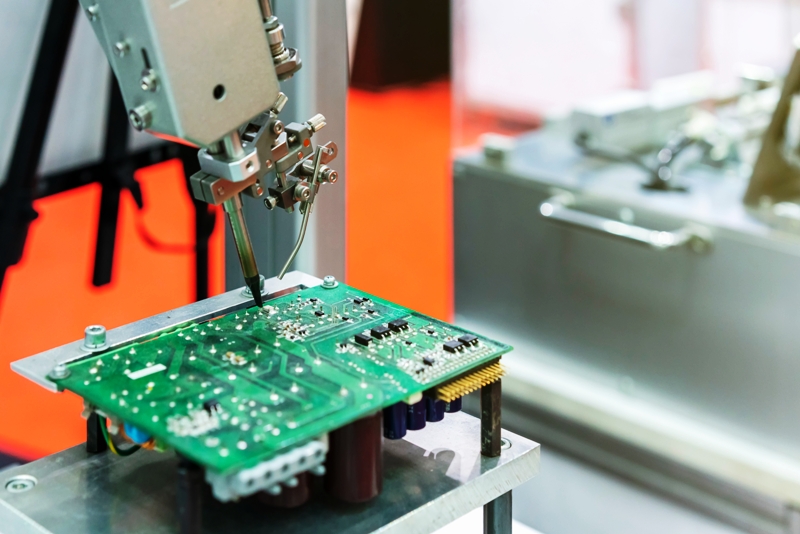
A flying probe test moves a small number of probes to each net in turn, so it can reach a board without any tooling and can be reprogrammed for a design change quickly. A fixture test places the board on a bed of nails that contacts every test point at once, so the whole net list can be checked in a single pass.
Both methods look for the same faults: opens, shorts, wrong values and, with the appropriate instruments, functional behaviour. The difference is in how the access is achieved, and that difference drives everything else. Neither method is inherently more accurate, and both are limited by the quality of the net list they are given. Our flying probe notes describe how the method is set up.
How Each Test Is Programmed
A flying probe program is generated from the same net list and the same fabrication data that the board was built from, which makes it quick to create and quick to change. That is why the flying probe is the natural partner of a design that is still moving. There is no physical tooling, so a design change becomes a data change.
A fixture program needs the same data plus a physical fixture that has to be designed, drilled, assembled and verified. The fixture design depends on the test point locations, the board support requirements and the probe access on both sides, and every one of those details has a lead time attached to it.
Fixture Cost and Lead Time
The fixture cost is a fixed cost that is incurred once for a design, and it has to be amortised over the volume. It includes the design, the mechanical parts, the probes, the wiring and the verification of the assembled fixture. That cost is significant for a complex board and negligible for a simple one.
The lead time matters as much as the cost, because a product that needs to ship next week cannot wait for a fixture. In practice the schedule often decides the first build, and the cost comparison decides what happens afterwards. A fixture that arrives late is expensive even when its price was low.
Flying Probe Cycle Time
The cycle time of a flying probe is dominated by the number of nets and the travel between them. A board with a large net count and widely separated test points takes much longer than one with a few nets in the centre. Dual sided probes and multiple heads reduce the time but do not remove the fundamental relationship.
A fixture test is effectively constant per board regardless of the net count, because all the points are contacted at once. That is why the flying probe is competitive on a small board with few nets and uncompetitive on a large backplane. Doubling the net count roughly doubles the cycle time, and that relationship drives the whole comparison.
Coverage and Access Limits
Test coverage is limited by access. A flying probe can reach pads that a fixture cannot, because it does not need a probe tower on every point, and it can test a point that is surrounded by tall components. A fixture has to fit the probes into the space above and below the board, and a tall component or a connector can block a point entirely.
Both methods are limited by the test points the designer provides. A net with no test point cannot be probed, which is why the test point requirement belongs in the design rules and in the design review. Our short circuit inspection notes describe how a short is located once the test has flagged it.
Volume Thresholds and Crossover
The crossover point is where the fixture amortisation per board falls below the extra cycle time cost of the flying probe. It depends on the fixture price, the difference in cycle time, the hourly rate of the test area and the volume expected.
The calculation is sensitive to the volume forecast, and a forecast that changes by a factor of two can move the crossover by the same factor. The comparison should therefore be run at the low and high ends of the forecast rather than at a single point. The hourly rate used in the calculation should include the operator, the floor space and the maintenance rather than the machine hour alone.
When a Fixture Pays Back
A fixture pays back when the volume is high enough and the design is stable enough that the fixture will not be obsoleted by a change. A design that is still being modified is a poor candidate, because a fixture change costs almost as much as a new fixture.
The fixture also pays back when the boards are large or the net count is high, because those are the cases where the flying probe cycle time is longest. On a large board, the fixture cost can be recovered in a surprisingly small number of panels.
Hybrid Approaches
Many programmes use both methods. A flying probe is used for the prototype and the first production builds, and a fixture is introduced once the design is frozen and the volume justifies it. That sequence also gives the test engineer the opportunity to debug the program on the flying probe before the fixture is committed.
A fixture can also be used for the dense digital area of a board while the flying probe covers the analogue and the connector nets that the fixture cannot reach. The two methods are complementary rather than exclusive.
Deciding for a Given Product
The decision should be documented with the volume assumption, the fixture price, the cycle times and the hourly rate, so that it can be revisited when the assumptions change. A decision recorded only as a preference cannot be reviewed. Our design release checklist asks for the test method to be identified before the order is placed, and our quality guide describes how a test escape is classified.
The other input is the cost of a defective board reaching the customer. That figure rarely changes the comparison between two test methods, but it does decide how much test coverage is worth having in the first place.
FAQ
At what volume does a fixture become cheaper? It depends on the fixture price and the cycle time difference, and the answer is different for every product. The comparison should be run with the actual numbers rather than by a rule of thumb.
Can a flying probe replace a fixture entirely? On low and medium volume, yes, provided the coverage requirement can be met and the cycle time fits the schedule. On high volume with a large net count, the cycle time usually becomes the deciding factor.
Does a fixture give better test coverage? Not necessarily. Coverage is limited by access and by the test points the designer provides, and a flying probe can sometimes reach points that a fixture cannot.