Solder Paste Jetting For Small Volumes
Solder paste jetting deposits paste by ejecting a small droplet from a nozzle rather than by pushing it through a stencil aperture. It removes the stencil from the process entirely, which makes it possible to print a board that is not flat, to add paste to a single footprint on an otherwise printed board, and to place a volume that no aperture could deliver.
This article covers how the valve works, where it beats printing, and how its parameters are set.
How The Valve Works
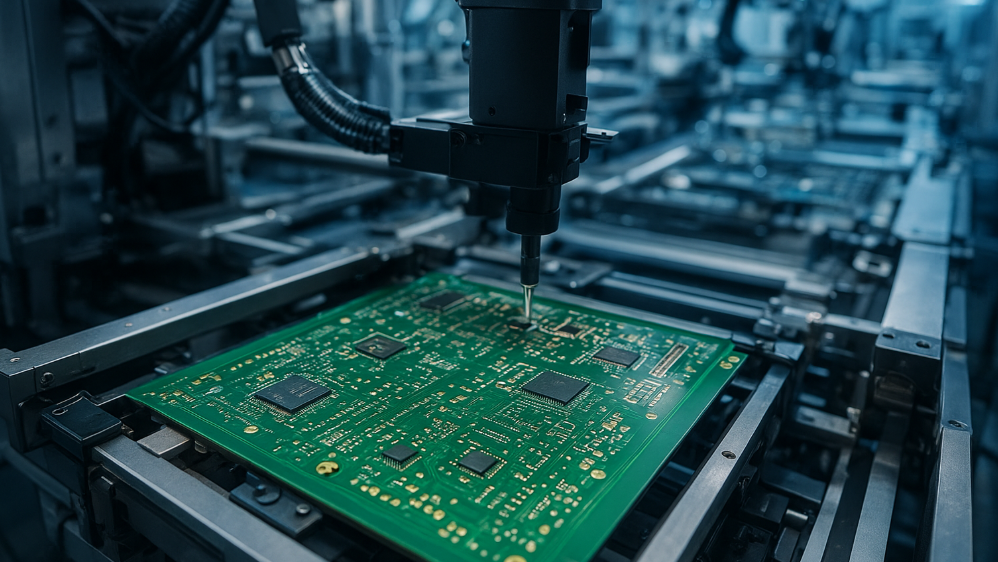
A jetting valve holds a small volume of paste in a chamber and ejects it through a nozzle with a pulse of pressure or with a piezoelectric actuator. The droplet is formed in flight and lands on the pad, where it stays as a deposit with a shape determined by its volume and by the paste rheology. Successive droplets can be placed at the same location to build a larger deposit, or at different locations to fill a footprint.
The deposit is therefore built by count rather than by aperture area, which is the fundamental difference from printing. The volume is set by the droplet size and the number of droplets, and the accuracy of the deposit depends on the repeatability of the valve rather than on the stencil and the squeegee. The way the deposit then interacts with placement is the same as for a printed deposit, described under placement order and pad positioning.
Where It Beats Printing
The clearest case is a board that cannot be printed. A board with a large height difference between areas, an assembly with a component already fitted on one side, or a board that is part of a larger structure cannot be brought into contact with a stencil. Jetting deposits paste without contact, so the geometry of the board does not matter.
The second case is a small volume of production where a stencil is not economic, or where a design changes frequently and the stencil would have to be remade. The third is a selective addition: a footprint that needs more paste than the stencil delivered, or a rework in which the original deposit is no longer present. In each case the advantage is flexibility or access rather than speed. The design rules that make such an operation possible are part of design guidelines for manufacturability.
Nozzle And Droplet Size
The nozzle diameter sets the droplet size range. A smaller nozzle produces smaller droplets and a finer deposit, and it also limits the particle size of the paste that can be jetted, because a particle larger than roughly a fraction of the nozzle will clog it. The paste therefore has a particle size specification for jetting that is tighter than for printing, which is a constraint on the material rather than on the machine.
The number of droplets per deposit is set from the required volume. A large pad for a power component may need many droplets placed in a pattern, and the pattern has to fill the pad evenly so that the component lands flat. Placing them all at one point builds a tall column that collapses and spreads unpredictably, so the placement pattern is part of the programme.
Standoff And Process Window
The nozzle has to stand off from the board, because no contact is intended, and the standoff distance affects the droplet in flight. Too close and the droplet is disturbed by the nozzle or by the board; too far and the droplet deforms in flight or is deflected by air movement. The usable range is a fraction of a millimetre to a few millimetres, set by the valve and the droplet size.
The process window is narrower than for printing in some respects and wider in others. It is narrower in that the paste has to be within its jetting specification, which is a smaller set of materials, and that the valve needs cleaning on a schedule to prevent a partial clog that changes the droplet size. It is wider in that the deposit does not depend on the stencil, the squeegee or the board flatness, so a change in the board does not change the volume.
Verifying The Deposit
Verification is by inspection of the deposit, using the same optical systems that measure a printed deposit, and by the joints after reflow. The useful measurement is the volume, which is derived from the height and the area, and it is compared with the window that the joint needs. Because the deposit is built from droplets, the volume distribution across a footprint is the parameter of interest, not only the mean.
The valve is also verified on a schedule by weighing a fixed number of droplets, which gives a direct measure of the droplet mass and detects a drift that the optical inspection might not see. A change in droplet mass with the same programme indicates a partially blocked nozzle or a change in the paste, and both are corrected before production continues.
Design And Material Constraints
The paste has to be supplied in a form that jettons, which usually means a tighter particle size distribution and a rheology that allows the droplet to detach cleanly. Not every paste qualified for printing is qualified for jetting, so the material choice is part of the process rather than a free decision. Where the assembly uses an alloy that is only available in a printing formulation, jetting may not be an option.
The pad design also matters, because a deposit that is built from droplets has a height that the surrounding mask has to contain. A pad with a narrow mask dam next to it is less tolerant of a deposit that spreads, and the jetting parameters have to be set so that the deposit stays inside the opening. The pad and mask geometry that makes this possible is described under PCB pad design standards.
Additional Considerations for This Build
Practical attention to deposit volume pays for itself here, because it decides whether the finished board behaves as the drawing intended. Where the requirement is not stated on the fabrication drawing or in the assembly notes, the shop has to assume a default, and that default is rarely the value the design was simulated with. Stating deposit volume explicitly, together with the tolerance that applies, removes the assumption and keeps the result predictable from batch to batch.
Process Control and Verification
On a design of this kind, process window is the item that decides how the rest of the board is arranged. Running a first article through the same checks as the production panel confirms that the two agree, and that comparison is the cheapest form of process control available at prototype stage. Keeping a sample from the panel turns a dispute into a measurement, because the same coupon can be re-examined by both parties without rebuilding the batch.
FAQ
Is jetting faster than printing? For a full board it is slower, because the deposit is built droplet by droplet. Its advantage is access and flexibility rather than throughput.
Can any solder paste be jetted? No. The particle size has to be small enough to pass the nozzle and the rheology has to allow clean droplet formation, so the paste is specified for the process.
Does the deposit need to be inspected differently? The same optical measurement is used, and the volume is derived from the height and area. Weighing a fixed number of droplets is a useful additional check on the valve itself.