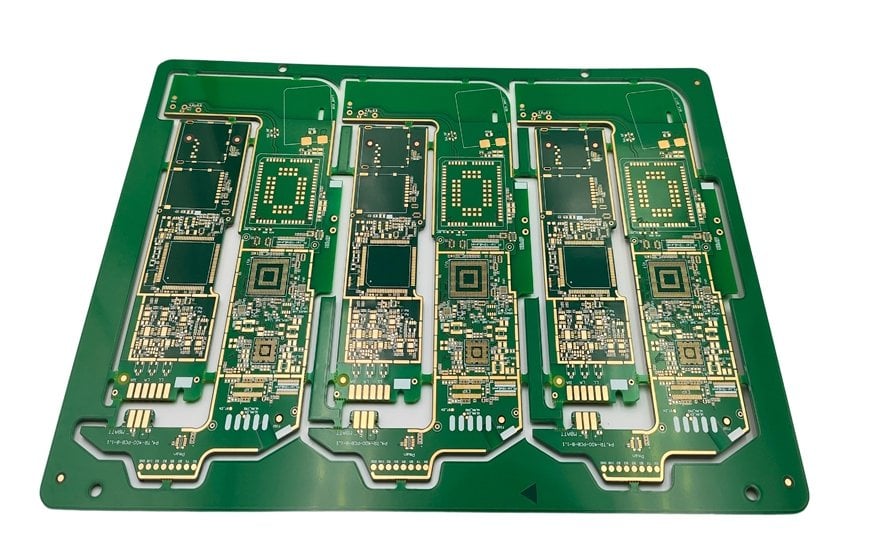
Warpage Control in Lamination
Warpage is a permanent deformation of the board that appears after lamination, after the surface finish or after a reflow pass. It matters because a warped board does not sit flat on a printer, does not sit flat in a reflow oven and does not fit into an enclosure. The cause is almost always an imbalance in the construction, and the correction is almost always made in the design or in the layup rather than in the press.
What Balance Means
A laminated stack is balanced when the material on one side of the centre line matches the material on the other in thickness, in copper content and in resin flow. When it does not, the two sides shrink differently as the resin cures and the panel curls.
The imbalance can be in the layer count, in the copper distribution or in the dielectric thickness. A stack with four layers of prepreg above the core and two below will curl, even if the total thickness is correct.
Symmetry is the design rule that follows. A stack should mirror itself about the centre, and where that is not possible the difference should be small and understood rather than ignored.
Copper Balance
Copper does not shrink during lamination, while the resin does. A layer with a large copper area therefore restrains the shrinkage locally more than a layer with little copper, and the two sides of the stack move differently.
The balance should be considered layer by layer rather than as a total across the board. A design that has the same total copper on two layers but concentrated in different places will still warp.
Thieving is the standard remedy. A pattern of small copper features is added to a sparse area so that the local density approaches that of the dense areas, and the pattern is designed with the same care as the circuit.
<img src="https://www.gopcba.com/wp-content/uploads/2026/08/1744382671349.jpg" alt="Circuit board panel checked for flatness on a surface plate” />
The Press Cycle
The press applies temperature and pressure to cure the resin. The ramp rate, the pressure and the dwell all influence the flow and therefore the shrinkage, and a cycle that is too fast will lock in a stress gradient.
The cooling stage matters as much as the heating. A panel that is removed from the press while it is still hot will distort, and the distortion becomes permanent as the resin hardens below its transition temperature.
A press that is not flat produces a panel that is not flat. The platen and the press pads should be checked on a schedule, because a small variation in flatness is reproduced in every panel that is pressed. The same applies to the separator plates and the press pads, which should be replaced on a schedule rather than after a defect appears.
Thickness Uniformity and Warpage
A thickness variation across the panel is both a symptom and a cause of warpage. Where the resin has flowed unevenly, the thinner side shrinks differently and the panel curls toward the thin side.
The copper distribution is the main variable that the designer controls. A design with a dense area at one corner and a sparse area at the opposite corner will produce a panel that is thick in one place and thin in the other.
The measurement of the finished thickness at several positions is therefore a useful check on the balance as well as on the specification. A thickness map that shows a gradient is a warning about the next reflow pass.
Warpage After Assembly
A board that leaves the fabricator flat can warp during assembly. The reflow profile heats the board above its transition temperature, where the resin is compliant and the internal stresses are released.
The moisture absorbed during storage contributes. Water in the laminate expands as it is heated and softens the resin, and a board that has not been baked before assembly will warp more than the same board that has.
The components also contribute. A large package with a high thermal mass heats unevenly, and a board with a heavy component on one side will distort locally during the process. A board that is evenly loaded behaves differently in the oven from one that carries its mass on a single side, and the difference shows in the flatness afterwards.
Measuring Warpage
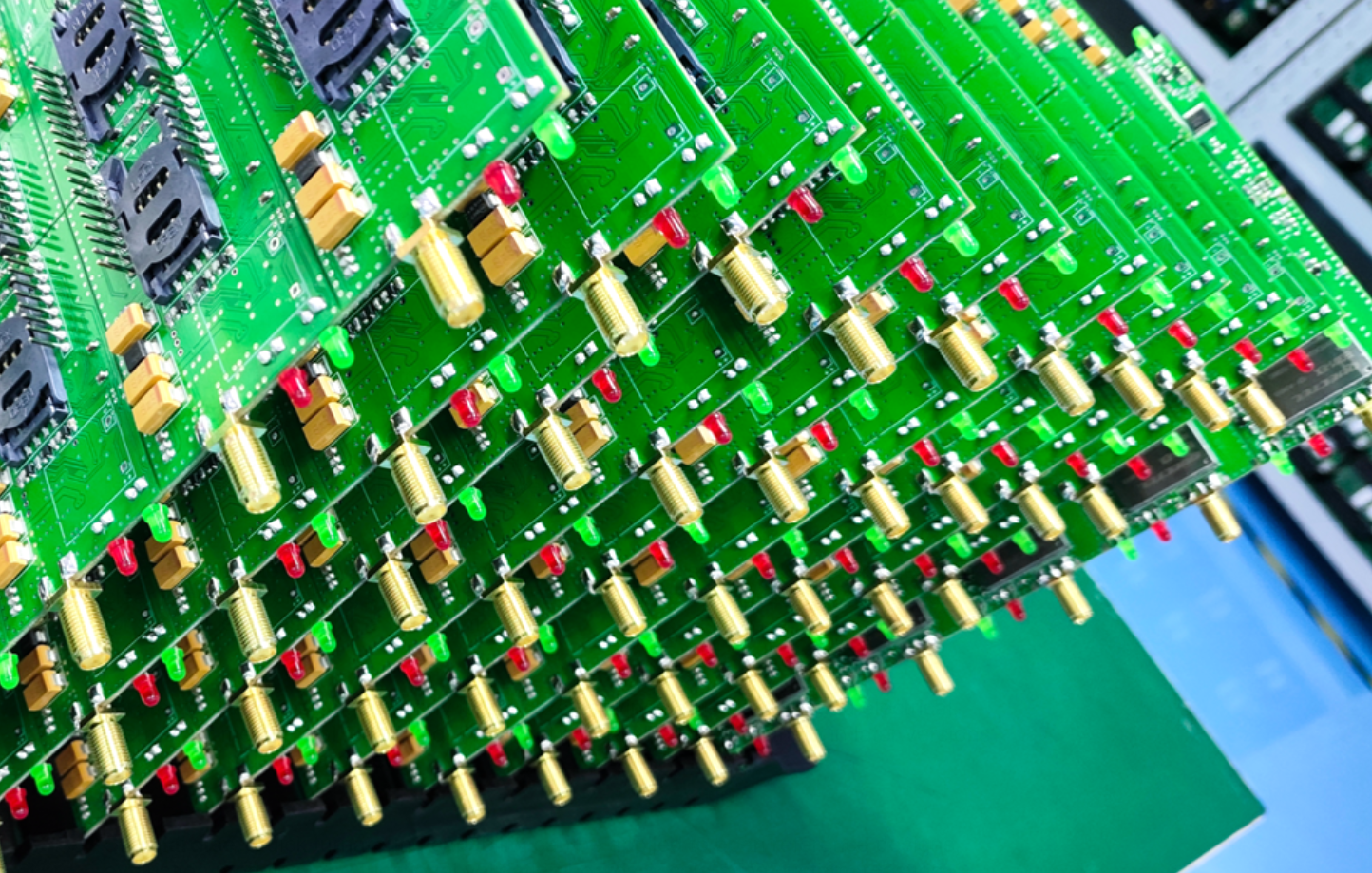
The measurement is made on a flat surface with the board resting on its own weight, so that only the deformation is measured. A board that is pressed flat measures nothing, and a board supported only at its corners measures the sag between the supports rather than the warpage of the board itself.
The result is expressed as a maximum deviation over a defined span, or as a percentage of the diagonal length. The figure is meaningless without the span and without the temperature at which it was measured.
The measurement should be made after the finish and after any reflow simulation, because the deformation changes with the thermal history. A measurement taken directly after lamination describes only one stage of the process.
Design Rules That Reduce It
Keep the stack symmetrical, keep the copper distribution even and use thieving where it is not. Avoid a design in which one large plane sits on one side of the centre and nothing balances it.
Keep the layer count even where the routing permits, and avoid a construction in which a thick core is combined with several thin prepreg layers on one side only.
Where a design must be unbalanced, the expectation should be set with the fabricator and the acceptance criteria should be agreed before the first panel is built rather than disputed afterwards.
Fabrication and Handling
The panels should be stored flat and supported, because a panel that is stored leaning will take a set. The stacking should avoid a heavy load on a small area.
Baking before assembly relieves the moisture and part of the stress, and the bake schedule should suit the material. A bake that is too hot will damage the board, and one that is too short will not remove the water.
The depaneling and the handling after separation should avoid a permanent bend. A board that is bent while it is hot, immediately after reflow, will hold the deformation when it cools.
Practical Rules
Design a symmetrical stack with balanced copper, check the press cycle and the cooling stage, and measure the flatness after the finish rather than after lamination. Store and bake the panels correctly.
Record the layup and the measurements with the build records and the dimensional stability data, and review the copper balance guide and the thickness tolerance when a stack is arranged.
FAQ
What is the main cause of warpage? An unbalanced stack. If the material, the copper or the dielectric thickness differs on either side of the centre line, the two sides shrink differently and the panel curls.
Why can a flat board warp during assembly? Reflow heats the board above its glass transition, where the internal stresses are released and the resin is compliant. Absorbed moisture makes the effect worse.
How is warpage measured? On a flat surface with the board resting under its own weight, expressed as a maximum deviation over a defined span and at a stated temperature.