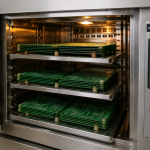
Board Storage and Humidity Control
Boards and components absorb moisture from the air, and the rate depends on the material and on the environment. Storage control is the practice of keeping that absorption within the limits the process can tolerate.
The controls are simple: a defined environment, sealed packaging, a recorded exposure and a rule for what to do when the limit is exceeded. The discipline is in the recording rather than in the equipment.
What the Storage Has to Prevent
Moisture absorbed by a laminate or a package causes damage at reflow, through popcorning, delamination and voiding. The storage control exists to keep the moisture content below the level at which those occur.
Oxidation of the finish is the second concern, since a surface that has oxidised wets poorly. Both are managed by the same packaging and environment.
Humidity Control
The storage area should be held within a humidity range that the product was qualified for, and the range should be monitored and recorded. A warehouse that fluctuates with the weather does not provide control.
Where the ambient cannot be controlled, a dry cabinet provides a defined environment for the material that needs it, and it is the practical solution for small volumes.
Dry Cabinets
A dry cabinet holds a low humidity and allows parts to be stored open, which removes the exposure clock. The humidity should be recorded and the cabinet should be maintained, since a failed desiccant or a door left ajar removes the protection.
The cabinet is most useful for parts that are used repeatedly in small quantities, where bagging and unbaging each time is impractical.
Packaging
A moisture barrier bag with desiccant and an indicator card is the standard protection for a shipment or a stored reel. The bag must be sealed and the seal must be verified.
The bag size should match the contents, since a large bag is difficult to seal flat and is easily punctured. The indicator card is what shows whether the protection held.
Floor Life and Recording
Floor life is the exposure the material may accumulate, and it should be recorded where the material is used rather than where it is stored. The record is what allows a decision when the limit is reached.
The limit applies to the most sensitive item in the assembly, which should be identified in the documentation.
Baking as the Remedy
Material that has exceeded its floor life is baked rather than rejected, using the schedule for the package or the laminate. The bake count should be limited and recorded.
The bake schedule is described for board moisture bake and for component levels, and the two are managed with the same records.
Handling in the Storage Area
Material should be handled by the edges, and open bags should be resealed as soon as the required quantity is removed. A bag that is left open on a shelf while the operator searches for a part accumulates exposure.
The storage area should also be clean and free of sources of contamination, since a surface that has been contaminated will not wet. This is the same requirement that applies at the line.
Records and Audit
The records should include the humidity logs, the bag seal checks, the exposure records and the bake records. Together they describe the condition of the material at the point of use.
The audit should verify the records and observe the practice, since the two can diverge. This is the same approach described for the process audit.
Process Control and Verification
On a design of this kind, humidity control is the item that decides how the rest of the board is arranged. A stack-up that is drawn rather than described removes most of the ambiguity from a quotation, and it lets the fabricator price the board against the dielectric and copper weights that will actually be used. Where the requirement is not written down, the shop supplies its own default, and the default is chosen for the process rather than for the design.
The measurements that matter are the repeatable ones: conductor width and spacing, annular ring, finished hole size, plating thickness and surface finish are all verifiable on a coupon that travels with the panel. Running a first article through the same checks as the production panel confirms that the two agree, and that comparison is the cheapest form of process control available at prototype stage.
Keeping a sample from the panel turns a dispute into a measurement, because the same coupon can be re-examined by both parties without rebuilding the batch. Reviewing the design before the data is released is cheaper than correcting it after the panel is in the tank, because every step downstream inherits the decision made at the front end.
Documenting the assumption is part of the design work, and a short note on the drawing prevents a question that would otherwise arrive a day later and cost a day of schedule. The process window is set by the narrowest step in the flow, so an improvement anywhere else shows up as margin rather than as yield until that step is addressed.
Process Control and Verification
On a design of this kind, humidity control is the item that decides how the rest of the board is arranged. A stack-up that is drawn rather than described removes most of the ambiguity from a quotation, and it lets the fabricator price the board against the dielectric and copper weights that will actually be used. Where the requirement is not written down, the shop supplies its own default, and the default is chosen for the process rather than for the design.
The measurements that matter are the repeatable ones: conductor width and spacing, annular ring, finished hole size, plating thickness and surface finish are all verifiable on a coupon that travels with the panel. Running a first article through the same checks as the production panel confirms that the two agree, and that comparison is the cheapest form of process control available at prototype stage.
Process Control and Verification
On a design of this kind, humidity control is the item that decides how the rest of the board is arranged. A stack-up that is drawn rather than described removes most of the ambiguity from a quotation, and it lets the fabricator price the board against the dielectric and copper weights that will actually be used. Where the requirement is not written down, the shop supplies its own default, and the default is chosen for the process rather than for the design.
Process Control and Verification
On a design of this kind, humidity control is the item that decides how the rest of the board is arranged. A stack-up that is drawn rather than described removes most of the ambiguity from a quotation, and it lets the fabricator price the board against the dielectric and copper weights that will actually be used. Where the requirement is not written down, the shop supplies its own default, and the default is chosen for the process rather than for the design.
A first article check confirms that the process and the drawing agree on the points listed above, and that the coupon data supports the values used in the design.

Where a measurement falls outside the expected window, the sample is retained so that the cause can be established before the balance of the batch is released.
A first article check confirms that the process and the drawing agree on the points listed above, and that the coupon data supports the values used in the design.

Where a measurement falls outside the expected window, the sample is retained so that the cause can be established before the balance of the batch is released.
FAQ
Does a dry cabinet replace the bag? It provides an equivalent protection for material that is used frequently, and the humidity has to be recorded.
How is the exposure counted? From the moment the bag is opened until it is resealed or the parts are baked, recorded at the station.
Can an oxidised finish be restored? It can be improved by a suitable flux, and a heavily oxidised surface should be assessed with a solderability test.
What happens if the indicator card shows a problem? The material is baked on the appropriate schedule, or tested, rather than used as it is.