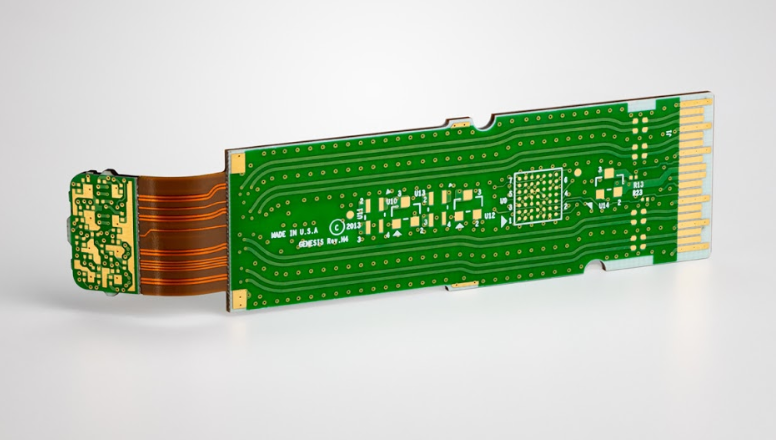
PCB Warpage Measurement and Acceptance Criteria Guide
Warpage is the deviation of a board from flat, and it is one of the few defects that can make an otherwise perfect panel impossible to assemble. A board that bows will not sit flat on a printer table, will not register properly in a placement machine and may not pass through a reflow oven without touching a rail. It is also one of the hardest defects to correct after the fact, because it is created by the balance of materials rather than by a single process step. Warpage is a design and material interaction that shows up in the finished product, which is why the fix usually belongs at the stack up rather than at the press.
What Warpage Is and Why It Matters
The laminate and the copper expand at different rates when they are heated, and they shrink at different rates when they cool. If the two sides of a board are not balanced, the difference accumulates as a curvature that remains after the board has cooled to room temperature.
At assembly the consequences are immediate. A warped board moves under the stencil, misplaces components, and in the worst case lifts a corner off the conveyor. Vacuum hold down on a printer table can flatten a small amount of bow, but it cannot correct a board that has twisted along its diagonal. A twisted board also stresses the solder joints of the components already placed, which is a reliability concern rather than only a placement one.
Bow, Twist and Their Definitions
Bow is a curvature along one axis, so the board takes on the shape of a shallow cylinder. Twist is a deformation in which one corner rises relative to the others, and it is the more damaging of the two because it cannot be corrected by a single hold down force.
The two are measured differently because they have different causes. Bow usually follows the direction of the copper distribution, while twist often indicates an imbalance in the weave orientation or a press cycle that allowed the stack to cool unevenly. Distinguishing between them is therefore the first step in any investigation, because they lead to different corrective actions.

How Warpage Is Measured
The standard method is to place the board on a flat surface and measure the maximum deviation from that surface, or to measure the height of each corner and calculate the difference. The result is expressed as a percentage of the diagonal or of the longest dimension, depending on the specification being applied.
Consistency matters more than the instrument. The same support points, the same temperature and the same orientation should be used every time, because a board measured on a curved surface or at a different temperature will give a different answer. Supporting the board on three points and measuring the fourth gives the most repeatable result for a twist measurement in the shop.
The Effect of Stack Up
Symmetry is the primary defence. A stack in which the copper thickness, the resin content and the glass style are balanced about the centre line will move less than one that is not, because the opposing forces cancel rather than accumulate. A symmetrical stack is easier to press consistently, so it also produces a more repeatable dielectric thickness across the panel.
Where symmetry is impossible, the design should keep the imbalance small and predictable. Our laminate guide describes how the material properties interact when the stack is pressed. Where a customer supplies an unbalanced stack, the fabricator should raise the risk at the quotation stage rather than after the first build.
<img src="https://www.gopcba.com/wp-content/uploads/2026/08/PCB-Box-Build-Assembly.jpg" alt="Bow and twist measurement points on a multilayer panel” />
Press Cycle and Cooling
The press cycle creates the internal stress that later appears as warpage. A fast ramp and a fast cool lock in more stress than a slow one, and a stack that is unloaded while it is still warm will continue to move as it cools in the rack.
Cooling under pressure to a defined temperature is the standard control, and the unload temperature should be low enough that the panel is dimensionally stable when the book is opened. Every change to the cooling part of the recipe should be treated the same way as a change to the heating part, because its effect on warpage is just as large. Changing that temperature changes the warpage of every panel in the book.
Copper Balance
Copper balance is about area as well as thickness. A side that is mostly solid plane behaves very differently from a side that is mostly fine traces, even when the nominal copper weight is the same, because the resin and glass fraction between the traces also changes the local stiffness. Comparing the copper area per side, rather than only the nominal copper weight, is the calculation that actually predicts the behaviour.
Where the design cannot be balanced, a thieving pattern or a grid of dummy copper can be added to the sparse side to bring the two closer together. The pattern should be added at the design stage rather than after the first panels have warped. A thieving pattern also helps the plating and the etching steps, so it has benefits beyond flatness.
Moisture and Thermal History
Absorbed moisture changes the dimensions of the laminate, and a board that has been baked will not measure the same as one that has been stored in a humid room. Reflow has the same effect, and a board can pass a flatness check before assembly and fail it afterwards. Where a customer measures warpage after reflow, the criterion should be defined at that point rather than at delivery.
That is why a warpage specification should state the condition of the board when it is measured. A figure quoted on a dry board and a figure quoted on a conditioned board describe two different products, and most disputes come from exactly that ambiguity. Writing the conditioning step into the specification removes the ambiguity before it becomes a rejected shipment.
Acceptance Criteria in Practice
Most acceptance criteria are expressed as a maximum percentage of the diagonal, with a tighter limit for surface mount boards than for through hole ones. The criterion is also usually applied before assembly rather than after, because the thermal history of the assembly changes the answer. A criterion that is applied at the wrong point in the flow will reject good boards and accept bad ones at the same time.
The criterion should be agreed in writing and measured the same way by both parties. Our outline guide covers the related dimensional requirements that the board has to meet at the same time. Outline tolerance and warpage are usually specified together, because a board that meets one and fails the other is still not usable.
Process Control Points
The controls are the stack up symmetry, the copper balance, the press cycle and the cooling, the moisture content of the material, and the measurement method used to confirm the result. Our quality documentation describes how these conditions are classified at gopcb.
A warpage trend is more useful than a pass or fail decision, because it shows whether a change in the press or in the material has moved the process. Recording the measurement with the lot makes that trend visible without any additional testing. Flatness is therefore best managed with the same discipline as thickness or copper weight, as a measured value with a trend behind it.
FAQ
What is the difference between bow and twist? Bow is a curvature along one axis and twist is a deformation where one corner rises relative to the others. Twist is harder to correct because hold down forces cannot flatten it.
Can a warped board be fixed? Sometimes. A bake under a flat weight can reduce the curvature, but the effect is not permanent and the board may return to its original shape after reflow.
When should warpage be measured? At a defined and agreed condition, usually after the board has cooled and stabilised. Measuring a warm or a freshly conditioned board gives a different and often misleading figure.