Copper Balance: Design Rules and Process Limits
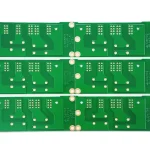
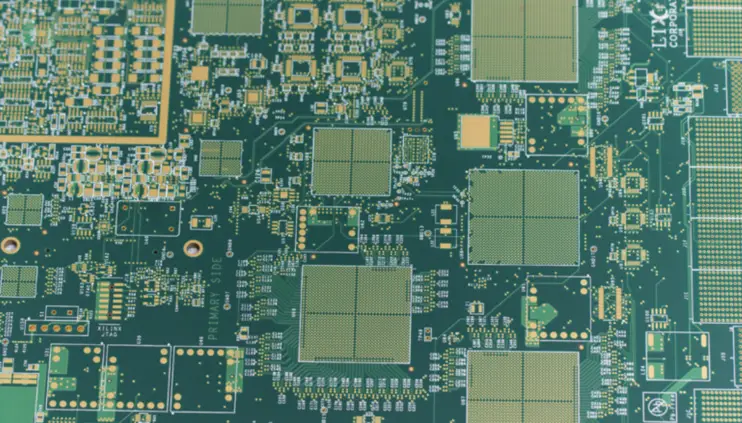
Inner layer copper is rarely uniform, and that is a design decision as much as a manufacturing one. Where one area of a layer is solid copper and the next is bare laminate, the board behaves differently under heat, under lamination pressure and under the etching chemistry.
Why Balance Matters
Copper and laminate expand at different rates and absorb process chemistry differently. A layer that is heavy on one side and light on the other can bow during lamination, and the effect shows up as registration problems on the layers above.
The same asymmetry affects the finished board. Warpage measured after reflow is frequently traced back to a stackup whose layers were never balanced in the first place. Our article on warpage control covers the measurement side.
Copper Thickness and Its Effect
Heavier copper etches differently. The etch that clears a 0.5 ounce layer leaves a different profile on a two ounce layer, and the minimum trace width and gap have to be set from the heavier one.
Thicker copper also needs more resin to encapsulate, which changes the dielectric thickness after lamination. A stackup calculated from nominal prepreg is optimistic unless the copper content of the inner layers is taken into account. Our article on copper weight selection covers that trade off.
Designing Balanced Layers
Balance does not mean uniform. It means that the distribution of copper at any cross section through the board is roughly symmetrical, so that the stresses from one side are countered by the other.
Practical measures include filling large empty areas with a grounded hatch or grid, avoiding a signal layer whose routing is concentrated in one corner and pairing a heavy plane layer with a heavy plane on the opposite side of the centre line.
Zoning and the Etch Process
Etch chemistry is consumed as it works, and a large copper area consumes it faster than a sparse one. Uneven copper distribution therefore produces an uneven etch, which shows as trace width variation across the panel.
This is one reason a thieving pattern is added on outer layers. Our article on PCB etching process describes how the pattern and the chemistry interact.
Thermal Effects in Assembly
A board with unbalanced copper heats unevenly during reflow, and the temperature difference across the board can be measured. Joints on the heavy side lag, and the profile that suits one area is wrong for the other.
The compensation is usually thermal relief in the planes and a slower ramp, rather than a higher peak. Our article on mixed thermal mass reflow explains the profiling method.
Communicating the Requirement
The stackup drawing should show the copper weight for each layer and should note any balance requirement that the designer cares about. A note that says balance is required without defining it will be interpreted as good practice rather than as a tolerance.
Where the shop is expected to add thieving, the drawing should say so and should state the pattern and the clearance. Leaving it to the shop produces a result that varies between orders and between suppliers.
Verification
The measured result is warpage after reflow and the registration accuracy of the inner layers. Both can be checked on a sample, and both should be part of the first article record for a new stackup.
Where a stackup is reused across products, the verification does not have to be repeated, but the record should show which products it has been proven on.
Checks Before Release
A measurement taken at the wrong point of the process describes the wrong thing, however carefully it is made. Where the supplier and the user both measure the same property, they should agree on the method before the first delivery.
A parameter that is set once and never re verified drifts, and the drift is usually discovered by a defect rather than by the record. The first article confirms that the setup matches the intent, and it is the cheapest point at which a wrong setup can still be corrected.
The cost of verification is small compared with the cost of a field failure, and it is paid at a point where the product can still be corrected. Documentation exists so that a person who was not present can reproduce the work and reach the same conclusion.
The acceptance criteria should be written before the work starts, so that the decision is made by the specification rather than by the person inspecting. The environment around the process, including temperature, humidity and cleanliness, sets limits on what the process can hold.
A result that cannot be reproduced is not a result, and reproducibility should be demonstrated rather than assumed.
Points to Confirm at First Article
Sampling is a compromise between cost and confidence, and the sample size should follow from the failure rate that has to be detected. The sequence of operations is part of the specification, because a different order produces a different result from the same steps.
Handling between operations is part of the process, and the damage it causes is often attributed to the operation that preceded it.
Verification and Records
The checks that matter are the ones performed on the product rather than on a sample kept for the purpose, because a coupon that travels with the panel is the only evidence about that panel. Where a requirement can be measured, it should be measured at the point of manufacture and recorded against the board or the lot it applies to.
The tooling, the material and the profile form one system, and a change to any of them should be assessed against the other two before it is released.
FAQ
Does balancing copper slow the design? It adds a little layout time and can cost a small amount of routing area. Both are small compared with the cost of a warped board discovered after assembly.
Is thieving always necessary? It is most useful on outer layers where the etch uniformity and the plating current density are affected. Inner layers are usually balanced during layout instead.
Can a warp be corrected after the fact? Mechanical flattening can bring a board back within tolerance for assembly, but it does not remove the internal stress, so the board may move again after reflow.