ESD Floor and Wrist Strap Testing
An ESD protected area depends on a chain of controls, and a chain is only as strong as the test that proves each link is intact. Floors, wrist straps, footwear, benches and ionisers all have a resistance or a decay time that can be measured, and the measurements are what turn a policy into a working environment.
What the Standards Require
The relevant documents set limits for the resistance of a floor, the resistance of a wrist strap and the decay time of an ioniser, and they set the test method for each. The method matters as much as the limit, because a measurement made the wrong way can pass a defective item.
The programme should state which items are tested, at what interval, with what instrument and against which limit, and it should record the result against the item rather than against the day.
Floor and Bench Resistance
A conductive or dissipative floor is tested with electrodes placed at a defined spacing, and the result depends on the electrode weight, the contact area and the condition of the floor surface. A dusty or waxed floor reads differently from a clean one.
The measurement points should be marked on a plan so that the same locations are tested each time, and the trend at one location is often more informative than the average across the room. Our article on production floor zoning describes how the areas are defined.
Wrist Straps and Their Testing
A wrist strap has a resistor in the cord and a band that couples to the skin. Both can fail: the cord can break internally, and the band can lose contact as it stretches or as the conductive fibres wear.
The continuous monitor at the workstation is the most effective control, because it checks the loop while the operator works rather than once a shift. A daily test with a meter is the minimum, and it has to include the band and the cord together. Our article on ESD packaging materials covers the handling side.
Footwear and Floor Systems
Where operators walk rather than sit, the path to ground runs through the footwear and the floor. Both have to be measured, and the combination has a wider range than a wrist strap, which is why a footwear test is usually done at the entrance to the area.
A person who has just walked in from outside may have insulated soles, particularly in dry weather, so the test should be repeated rather than treated as a one time entry requirement.
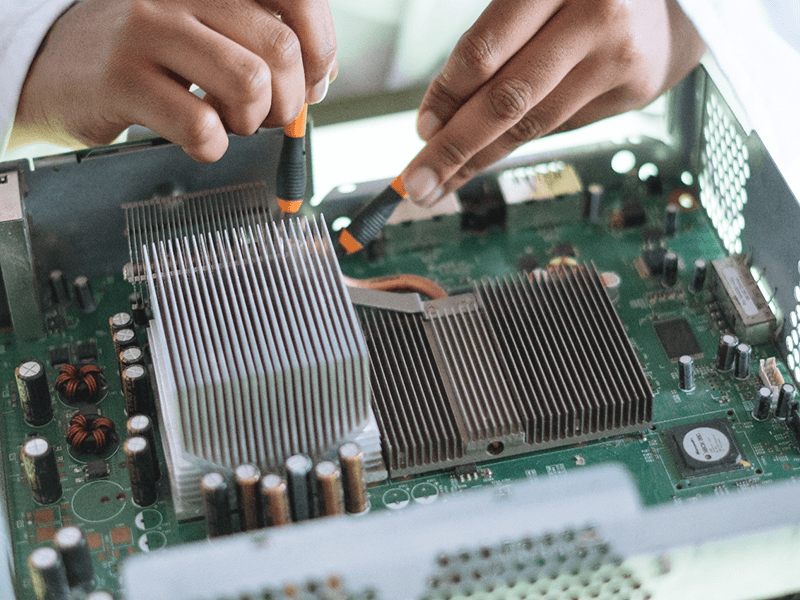
<img src="https://www.gopcba.com/wp-content/uploads/2024/09/Through-Hole-PCB-Assembly2.png" alt="Electrodes measuring floor resistance in an ESD protected area” />
Ionisers and Charge Decay
An ioniser removes static from insulating surfaces by supplying ions to the air. Its performance is measured as the time for a charged plate to decay to a defined fraction of its initial voltage, and the balance between positive and negative ions is measured separately.
Emitters wear and collect debris, so the decay time drifts upward with use. A failed ioniser does not stop the line; it quietly stops protecting the parts that a wrist strap cannot reach.
Records and Audits
The record should be per item with a unique identifier, so that a failed wrist strap can be removed from service and its history examined. A record that only states that the area passed on a date cannot do that.
An audit should check the records and repeat a sample of the measurements, which is the only way to know whether the routine is being performed. Our article on control plan development places the ESD controls in the wider process plan.
Common Failures
The most common findings are wrist straps with a broken cord, floors that read high because of a coating applied by the cleaning contractor, and ionisers that have never been cleaned since installation. All three are invisible until they are measured.
A second group of findings concerns practice rather than hardware: a strap worn over a sleeve, a bench mat that has been cut and not re bonded, or a common point disconnected during a repair. Our article on electrical overstress investigation describes how a failure is traced.
Checks Before Release
The narrowest feature on the board usually sets the process window for the whole product, so it deserves the closest attention at review. Where a requirement can be measured, it should be measured at the point of manufacture and recorded against the board or the lot it applies to.
Sampling is a compromise between cost and confidence, and the sample size should follow from the failure rate that has to be detected. Where a decision is made by judgement, a boundary sample makes the judgement repeatable between operators and between shifts.
Where a process is at the edge of its capability, the margin should be bought deliberately rather than discovered during production. A record that identifies the operator, the date and the settings is worth more than a record that identifies only the result.
A measurement taken at the wrong point of the process describes the wrong thing, however carefully it is made.
Verification and Records
A result that cannot be reproduced is not a result, and reproducibility should be demonstrated rather than assumed. Where an operation cannot be verified afterwards, it has to be controlled during the operation, and that control has to be visible in the record.
Where the supplier and the user both measure the same property, they should agree on the method before the first delivery.
FAQ
How often should a wrist strap be tested? Daily as a minimum, and continuously where a monitor is fitted. A strap should also be tested after any repair or after the band has been adjusted.
Can a conductive floor be painted on later? It can, but the coating has to be maintained and re tested, and many floor treatments used by cleaning contractors will raise the resistance above the limit.
Does an ioniser need to be tested even if it runs? Yes. Airflow and emitter condition both affect the decay time, and a unit that runs can still be outside its specification.