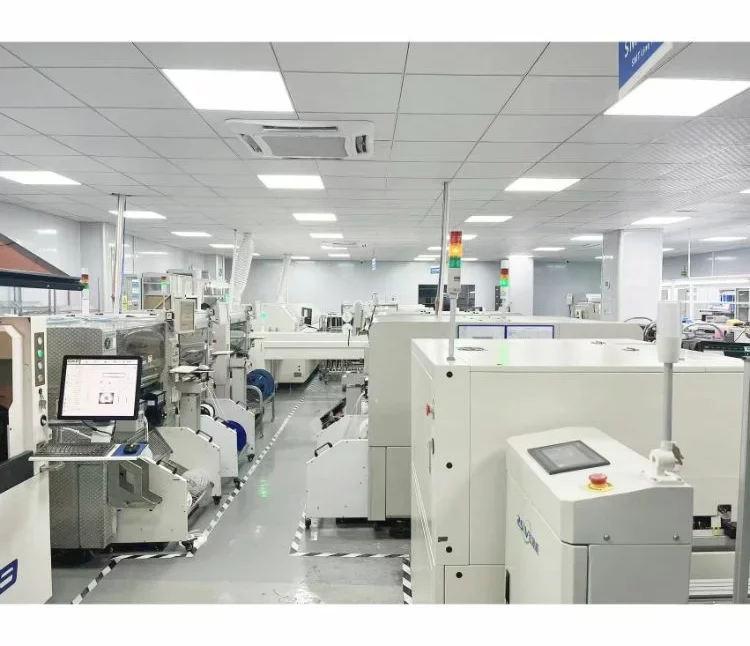
Production Floor Zoning for ESD, Cleanliness and Humidity
A production floor is divided so that the conditions a product needs can be maintained in the places where they matter and not everywhere. The division is a design decision about the space, not a policy statement.
Why Zone at All
Maintaining a controlled environment over an entire building is expensive and mostly unnecessary. The parts of the process that need control are identified, and they are grouped so that the control covers them.
The zones also define the boundary where a product changes condition, and that boundary is where the handling rules apply. Our workmanship notes describe how the rules are carried into the standard work.
ESD Zones
An ESD protected area has a defined boundary, a common ground reference, controlled materials and a measurement routine that confirms the conditions.
The boundary matters because a board carried outside it is unprotected, and the transfer is where the exposure happens. The transfer point should be defined and equipped, not simply crossed. Our ESD notes describe the measurement that verifies the zone.
Cleanliness Zones
Where the product has a cleanliness requirement, the area where the board is exposed should be controlled for particles and for contamination sources. That excludes cardboard, certain markers, and uncovered lubricated equipment.
The requirement should be stated as a measured result rather than as a room class, so that the zone can be verified rather than assumed. Our cleanliness notes describe the measurement.

Humidity Control
Where paste is printed and where moisture sensitive parts are exposed, the humidity is controlled. The same room usually serves both, and the requirement is the tighter of the two.
The control should be recorded rather than assumed from the building system, because a system that is running is not the same as a room that is in specification. Our storage notes describe the floor life that the humidity sets.
Material Flow
The flow through the zones should be one way wherever possible: raw material in, product out, and no return path through the clean area with a contaminated container.
Where the flow has to cross itself, the crossing should be defined and controlled by a step such as a change of container or a wipe. Our panel notes describe the handling containers that move between stations.
People and Movement
The people in a zone are the largest source of particles and of charge. The requirements for garments, gloves and movement should be defined per zone and applied at the boundary.
A rule that applies inside a zone and not at its entrance is a rule that will be broken at the entrance. The boundary should have what is needed to comply. Our error proofing notes describe how the boundary is made self-enforcing.
Verification
Each zone should have a defined measurement, an interval and a record. The measurements are the resistance and field for ESD, the particle count or the ionic result for cleanliness, and the temperature and humidity for the environment.
A zone without a measurement is a zone without a boundary, because nothing defines where the control stops being effective. Our quality notes describe how the records are used.
Additional Considerations for This Build
Practical attention to ESD area pays for itself here, because it decides whether the finished board behaves as the drawing intended. Where the requirement is not stated on the fabrication drawing or in the assembly notes, the shop has to assume a default, and that default is rarely the value the design was simulated with. Stating ESD area explicitly, together with the tolerance that applies, removes the assumption and keeps the result predictable from batch to batch.
Process Control and Verification
On a design of this kind, zoning is the item that decides how the rest of the board is arranged. A stack-up that is drawn rather than described removes most of the ambiguity from a quotation, and it lets the fabricator price the board against the dielectric and copper weights that will actually be used. Where the requirement is not written down, the shop supplies its own default, and the default is chosen for the process rather than for the design.
The measurements that matter are the repeatable ones: conductor width and spacing, annular ring, finished hole size, plating thickness and surface finish are all verifiable on a coupon that travels with the panel. Running a first article through the same checks as the production panel confirms that the two agree, and that comparison is the cheapest form of process control available at prototype stage.
Keeping a sample from the panel turns a dispute into a measurement, because the same coupon can be re-examined by both parties without rebuilding the batch. Reviewing the design before the data is released is cheaper than correcting it after the panel is in the tank, because every step downstream inherits the decision made at the front end.
Documenting the assumption is part of the design work, and a short note on the drawing prevents a question that would otherwise arrive a day later and cost a day of schedule. The process window is set by the narrowest step in the flow, so an improvement anywhere else shows up as margin rather than as yield until that step is addressed.
Process Control and Verification
On a design of this kind, zoning is the item that decides how the rest of the board is arranged. A stack-up that is drawn rather than described removes most of the ambiguity from a quotation, and it lets the fabricator price the board against the dielectric and copper weights that will actually be used. Where the requirement is not written down, the shop supplies its own default, and the default is chosen for the process rather than for the design.
The measurements that matter are the repeatable ones: conductor width and spacing, annular ring, finished hole size, plating thickness and surface finish are all verifiable on a coupon that travels with the panel. Running a first article through the same checks as the production panel confirms that the two agree, and that comparison is the cheapest form of process control available at prototype stage.
Process Control and Verification
On a design of this kind, zoning is the item that decides how the rest of the board is arranged. A stack-up that is drawn rather than described removes most of the ambiguity from a quotation, and it lets the fabricator price the board against the dielectric and copper weights that will actually be used. Where the requirement is not written down, the shop supplies its own default, and the default is chosen for the process rather than for the design.
A first article check confirms that the process and the drawing agree on the points listed above, and that the coupon data supports the values used in the design.

Where a measurement falls outside the expected window, the sample is retained so that the cause can be established before the balance of the batch is released.
FAQ
Is a whole building ESD safe? It can be declared so, and the declaration is only meaningful with measurements at the boundaries and the equipment within them.
Does a zone need a physical barrier? It does not need a wall and it does need an unambiguous boundary, because the rules change there and people have to know it.
What does gopcb provide for floor zoning? We provide zone definition by process requirement, ESD boundaries with a common ground and measured verification, cleanliness and humidity control stated as measured results, one way material flow with defined crossings, garment and handling rules applied at the boundary, and a measurement interval and record for every zone.