What Is an Aluminum PCB?
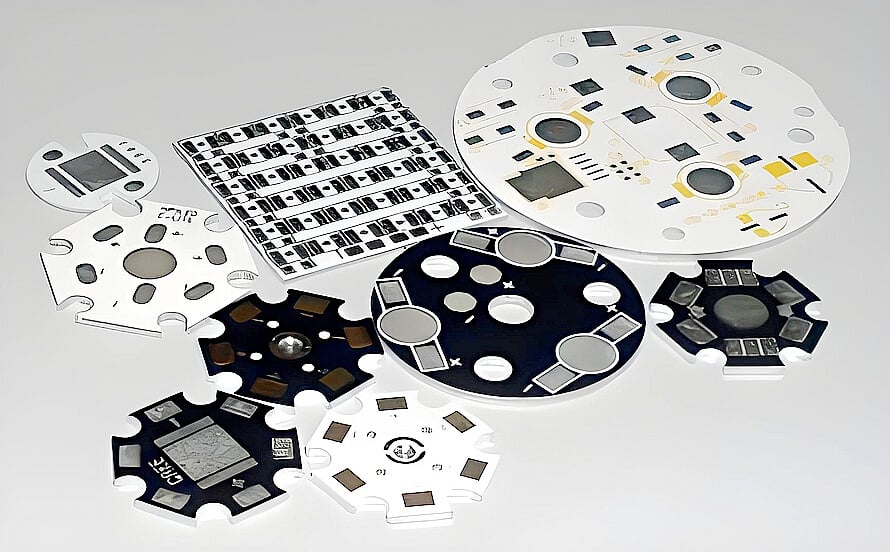
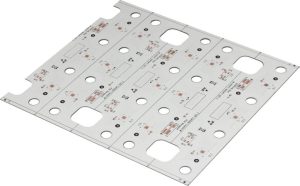
An Aluminum PCB is a type of metal-based printed circuit board designed to provide efficient heat dissipation while maintaining electrical insulation between the conductive circuit layer and the metal substrate. Unlike conventional FR-4 PCBs, an Aluminum Core PCB uses aluminum as the primary heat-dissipation layer.
A typical aluminum circuit board consists of a copper circuit layer, a thermally conductive dielectric layer, and an aluminum base. The dielectric layer provides electrical insulation while allowing heat generated by electronic components to transfer efficiently toward the aluminum substrate.
Because aluminum has excellent thermal conductivity, relatively low weight, good mechanical strength, and favorable cost characteristics, Aluminum PCB technology is widely used in applications where thermal management is a critical design requirement.
Typical applications include high-power LED lighting, automotive electronics, power supplies, motor controllers, industrial equipment, telecommunications equipment, and renewable energy systems.
Common Types of Aluminum PCBs
Depending on the circuit structure, thermal requirements, and application, aluminum-based boards can be designed in several configurations.
1. Single-Layer Aluminum PCB
A single-layer Aluminum PCB generally consists of an aluminum base, a thermally conductive dielectric layer, and a copper circuit layer.
This structure is relatively simple and is widely used in applications where heat dissipation is more important than high circuit density. LED lighting, power modules, automotive lighting, and basic power electronics are common examples.
The main advantages of a single-layer structure include:
- Simple manufacturing process
- Efficient heat dissipation
- Relatively low production cost
- Good mechanical stability
- Suitable for high-power components
2. Double-Layer Aluminum PCB
A double-layer aluminum-based PCB incorporates two copper circuit layers separated by dielectric materials and supported by a metal core or thermal management structure.
Compared with a single-layer board, a double-layer configuration provides greater routing flexibility and can accommodate more complex circuits. Components and conductive traces can be distributed more efficiently, helping designers increase circuit density.
Double-layer metal-core structures are commonly considered for motor controllers, power converters, industrial control equipment, and other applications that require both improved thermal performance and greater circuit complexity.
3. Metal Core PCB (MCPCB)
A Metal Core PCB uses a metal substrate—most commonly aluminum or copper—as its thermal core. The metal core is integrated with one or more dielectric and copper layers to provide both electrical insulation and thermal conduction.
MCPCB technology can be designed using aluminum, copper, or other suitable metal substrates depending on the required thermal performance, weight, mechanical strength, and cost.
Compared with standard FR-4 materials, a metal-core structure can provide a more direct thermal path from heat-generating components to the metal substrate.
Aluminum-based MCPCB designs are particularly popular because aluminum provides a practical balance of thermal conductivity, weight, machinability, mechanical strength, and cost.
Key Factors in Aluminum PCB Manufacturing
Producing a reliable Aluminum PCB requires careful control of materials, dielectric performance, copper thickness, circuit geometry, and thermal characteristics.
Aluminum Material Selection
The aluminum substrate is one of the most important components of an aluminum-based PCB. Different aluminum alloys and substrate specifications can be selected according to mechanical and thermal requirements.
Common aluminum alloys include 6061 and 5052, although the appropriate material should be selected according to the board’s thermal performance, mechanical requirements, thickness, and manufacturing process.
The aluminum substrate must provide sufficient mechanical stability while maintaining an effective thermal path from the circuit layer to the metal base.
Thermally Conductive Dielectric Layer
The dielectric layer is a critical part of the Thermal Management structure.
It must provide sufficient electrical insulation while also minimizing thermal resistance. Thermally conductive dielectric materials are therefore commonly used between the copper circuit and aluminum substrate.
A lower thermal resistance dielectric layer can improve heat transfer, but the material must also maintain appropriate dielectric strength, adhesion, reliability, and resistance to thermal cycling.
For this reason, material selection should consider the complete operating environment rather than thermal conductivity alone.
Copper Thickness
Copper thickness directly affects current-carrying capability, electrical resistance, mechanical strength, and thermal performance.
For high-current applications, thicker copper may be required to reduce resistance and minimize temperature rise. However, increasing copper thickness can also affect etching, dimensional control, manufacturing tolerances, and overall cost.
Therefore, copper thickness should be selected according to the application’s current requirements, trace geometry, heat generation, and manufacturing capability.
Conductive Trace Etching
The copper circuit pattern is formed through a controlled PCB manufacturing and etching process.
During this stage, circuit width, spacing, copper thickness, etching compensation, and dimensional tolerances must be carefully controlled.
For high-power aluminum PCB designs, trace geometry should be evaluated together with current capacity and thermal requirements rather than considering electrical routing independently.
Thermal and Electrical Testing
Quality control is another important part of PCB Manufacturing. Depending on the application, aluminum PCBs may require electrical testing, dielectric withstand testing, dimensional inspection, copper thickness verification, thermal performance evaluation, and solderability testing.
For demanding applications, thermal cycling and reliability testing can also help verify the stability of the dielectric layer, copper circuitry, and aluminum substrate under repeated temperature changes.
Advantages of Aluminum PCBs
Improved Heat Dissipation
The primary advantage of an Aluminum PCB is its ability to provide an efficient thermal path.
Heat generated by LEDs, power transistors, MOSFETs, motor drivers, and other high-power components can be transferred through the dielectric layer to the aluminum substrate. The aluminum base then helps distribute and dissipate the heat into the surrounding environment.
Effective Thermal Management can reduce component operating temperatures and contribute to improved reliability and service life.
Enhanced Electrical and Thermal Performance
An aluminum-based PCB combines electrically conductive copper circuitry with a thermally conductive but electrically insulating dielectric layer.
This structure allows designers to manage heat without directly electrically connecting the circuit to the aluminum base.
When properly designed, the board can provide a practical combination of electrical performance, thermal management, and mechanical reliability for high-power electronic systems.
Compact and Lightweight Design
Aluminum is relatively lightweight compared with copper and many other metals. This makes aluminum-based boards attractive for applications where weight and space are important design considerations.
By improving heat dissipation directly through the PCB structure, designers may also be able to reduce the dependence on bulky external heat sinks in certain applications.
Good Mechanical Strength
The aluminum substrate provides a strong and stable mechanical foundation for the PCB.
This can be particularly useful in automotive, industrial, lighting, and outdoor applications where the board may experience vibration, mechanical stress, or temperature fluctuations.
Cost-Effective Thermal Solution
Compared with some advanced cooling solutions, an aluminum-based MCPCB can provide an economical approach to thermal management.
Its relatively simple construction and widely available aluminum materials make it suitable for large-scale production while maintaining useful thermal performance.
Limitations of Aluminum PCBs
Although aluminum PCBs provide significant thermal advantages, they also have limitations that designers should consider during the early stages of PCB development.
Design Complexity and Layer Limitations
Compared with conventional FR-4 multilayer PCBs, aluminum-based structures can be more challenging to manufacture when a design requires a high number of layers, complex interconnections, or extensive via structures.
However, metal-core PCB technology is not inherently restricted to only single- or double-layer configurations. Specialized manufacturers can produce more complex metal-core structures when the required materials and manufacturing processes are available.
Therefore, designers should evaluate the manufacturer’s actual PCB Manufacturing capabilities before selecting the stackup.
Limited Flexibility
Aluminum is a rigid metal substrate, so an Aluminum Core PCB is not suitable for applications that require repeated bending, folding, or dynamic flexing.
When mechanical flexibility is a fundamental requirement, flexible PCB or rigid-flex technology is generally more appropriate.
Thermal Expansion Considerations
The coefficient of thermal expansion (CTE) of aluminum differs from that of copper, dielectric materials, components, and solder joints.
Repeated heating and cooling can therefore introduce mechanical stress into the PCB assembly. Proper material selection, dielectric design, component placement, solder-joint design, and thermal cycling evaluation are important for applications exposed to significant temperature fluctuations.
Metal Substrate Manufacturing Considerations
The presence of a metal core introduces additional manufacturing considerations compared with standard FR-4 boards.
Drilling, routing, dielectric bonding, thermal design, surface treatment, and assembly processes may require specialized equipment or process controls.
Working with an experienced manufacturer such as Kingda can help designers evaluate material selection, stackup configuration, thermal requirements, and manufacturability before production.
Cost Considerations
Although aluminum is relatively economical, an aluminum-based PCB may cost more than a conventional FR-4 board depending on its material structure, dielectric requirements, copper thickness, thermal performance, surface finish, and manufacturing complexity.
However, the total system cost should also consider thermal performance. If an aluminum PCB reduces the need for external heat sinks or improves component reliability, it may provide better overall value at the system level.
Aluminum PCB Applications
LED Lighting
LEDs generate considerable heat during operation. Excessive junction temperature can negatively affect light output, efficiency, and service life.
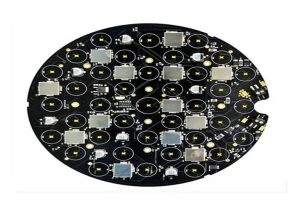
For this reason, Aluminum PCB Applications are particularly common in LED bulbs, street lights, automotive headlights, high-power lighting modules, and other LED products.
The aluminum substrate helps transfer heat away from the LED package and distribute it across a larger area.
Power Supplies
Power supplies and switch-mode power supplies (SMPS) often contain components such as MOSFETs, diodes, inductors, and power transistors that generate significant heat.
An Aluminum PCB can help provide a shorter thermal path and improve temperature control in suitable power electronics designs.
Automotive Electronics
Automotive electronics increasingly require compact designs, high power density, and reliable thermal performance.
Aluminum-based PCBs may be used in applications such as:
- LED headlights and lighting modules
- Motor controllers
- Power converters
- Battery management systems
- Automotive power electronics
- Electric vehicle control systems
Automotive applications also require careful consideration of vibration, temperature cycling, moisture, and long-term reliability.
Industrial Electronics
Industrial equipment often operates continuously and may generate significant amounts of heat.
Aluminum Core PCB technology can be used in motor controllers, industrial automation equipment, PLC-related systems, power control modules, and other high-power electronic assemblies.
Telecommunications Equipment
Thermal management is increasingly important in telecommunications and networking equipment as component density and power consumption increase.
Metal-core PCB structures can be considered for suitable power modules and thermal-sensitive circuits where efficient heat transfer is required.
Renewable Energy Systems
Solar inverters, battery systems, power conversion equipment, and wind-energy control systems can benefit from effective thermal management.
In these applications, MCPCB technology can help manage heat generated by power semiconductor devices and other high-power components.
Consumer Electronics
Certain high-performance consumer electronic products can also use aluminum-based circuit boards for thermal management.
Examples include high-power audio amplifiers, gaming equipment, power modules, and other products where compact construction and heat dissipation are important.
Aluminum PCB vs. FR-4 PCB
The choice between an aluminum PCB and a conventional FR-4 PCB should be based on the application’s thermal, electrical, mechanical, and cost requirements.
| Feature | Aluminum PCB | FR-4 PCB |
|---|---|---|
| Thermal performance | Excellent for heat dissipation | Moderate |
| Mechanical strength | High | Good |
| Weight | Relatively low | Relatively low |
| Flexibility | Low | Low |
| High-power suitability | Excellent | Application-dependent |
| Circuit complexity | Moderate to high depending on structure | Excellent |
| Cost | Moderate | Generally lower |
| Typical applications | LED, power electronics, automotive | General electronics, digital systems, control boards |
For applications where heat generation is a primary concern, an aluminum-based solution can offer significant advantages. For complex multilayer routing and high-density digital circuits, FR-4 may remain the more practical option.
How to Choose the Right Aluminum PCB
When selecting an Aluminum PCB, engineers should evaluate more than the aluminum substrate itself.
Important considerations include:
- Thermal requirements – Determine the amount of heat generated and the required thermal resistance.
- Dielectric material – Select a dielectric layer that provides an appropriate balance between thermal conductivity and electrical insulation.
- Aluminum thickness – Choose the substrate thickness according to mechanical and thermal requirements.
- Copper thickness – Match copper thickness to current-carrying and circuit requirements.
- Circuit density – Evaluate whether the metal-core structure can support the required routing and interconnection technology.
- Operating environment – Consider temperature, vibration, humidity, corrosion, and thermal cycling.
- Manufacturing capability – Confirm that the PCB manufacturer can meet the required material, tolerance, layer, copper, and surface-finish specifications.
- Assembly requirements – Ensure compatibility with SMT, reflow soldering, component placement, and final assembly processes.
At Kingda, these factors can be evaluated during the design and manufacturing process to help develop an aluminum PCB solution that balances thermal performance, electrical reliability, manufacturability, and cost.
The Future of Aluminum PCB Technology
As electronic devices continue to become smaller while their power density increases, thermal management is becoming an increasingly important part of PCB design.
Future Aluminum PCB development is expected to focus on higher-performance dielectric materials, lower thermal resistance, improved electrical insulation, higher current capability, and more advanced metal-core structures.
Emerging applications such as electric vehicles, 5G infrastructure, renewable energy systems, industrial automation, high-power LED lighting, and advanced power electronics will continue to create demand for efficient PCB thermal solutions.
At the same time, improvements in materials and PCB Manufacturing processes may allow metal-core PCBs to support more complex circuit configurations while maintaining reliable thermal performance.
For engineers designing high-power electronic systems, selecting the appropriate Aluminum Core PCB at the beginning of the design process can help improve thermal reliability, reduce system size, and optimize overall product performance.