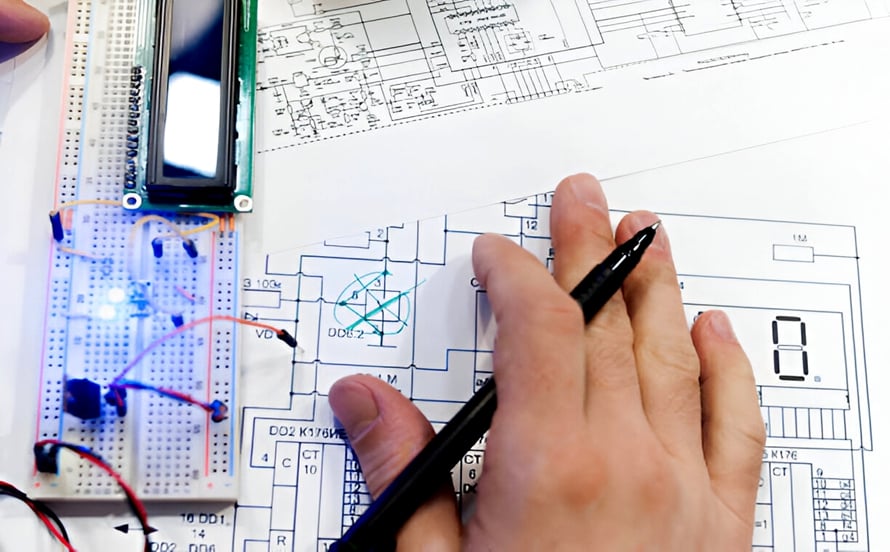
Crystal and Oscillator Layout: Load Capacitance and Jitter A crystal oscillating at twenty megahertz is a resonator with a very high quality factor, and it will oscillate at whatever frequency the circuit around it presents. The layout is part of that circuit. How the Oscillator Works The crystal sits in…
Inductive Proximity Sensor Circuit Design An inductive proximity sensor detects a metal target without touching it, using a coil that generates an alternating magnetic field and a circuit that notices when the field loses energy to a nearby conductor. It works in dust, oil and water where optical sensors fail,…
Thermal Shock Testing of Plated Holes and Vias on PCBs Thermal shock testing exposes plated holes to repeated changes in temperature and then inspects them for cracks, and it is the standard way to demonstrate that a barrel can survive the assembly process. The test is simple to describe and…
Sensor Interface Layout: Protecting Low Level Signals A sensor that produces a few millivolts is competing with a board full of switching currents. The layout decides how much of the board’s noise reaches the measurement, and the countermeasures are geometric rather than electrical. What Makes a Low Level Signal Vulnerable…
Ultrasonic Sensor Interface Circuit Design An ultrasonic sensor measures distance by timing how long a burst of sound takes to travel out and back, which means the electronics has to do two quite different jobs. It has to drive a transducer with enough energy to produce a detectable echo, and…
PCB Audio Circuit Layout: Keeping Analog Quiet Audio is usually the last subsystem to receive attention on a dense board and the first that a user notices. A receiver that hisses, a headphone output that clicks when the radio transmits or a speaker that distorts at high volume are layout…
Placement Force and Z-Axis Control on SMT Placement Machines Placement accuracy is usually discussed in the X and Y directions, because that is what vision systems measure. The Z-axis, which controls how far the nozzle travels down and how hard it presses, receives far less attention and causes a surprising…
Flux Activity and Activation Temperature in Soldering Flux is the part of the soldering process that does the chemistry. It removes the oxide layer from the metal, keeps the surface clean while it is hot, and lowers the surface tension so that molten solder can spread. How well it does…
Replacing Leaded Inductors With SMD Parts Safely Moving a design from leaded inductors to surface mount parts is a routine step during a cost reduction or a mechanical redesign. A leaded inductor needs a hole, a manual insertion step and a taller mechanical envelope, while a surface mount part can…
Capacitor Package Sizes And SMT Process Compatibility Choosing a capacitor package is often treated as a question of size alone, but the package also has to survive the placement and soldering process that the board will go through. A part that is electrically correct can still cause defects if its…