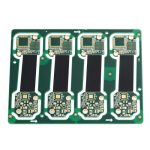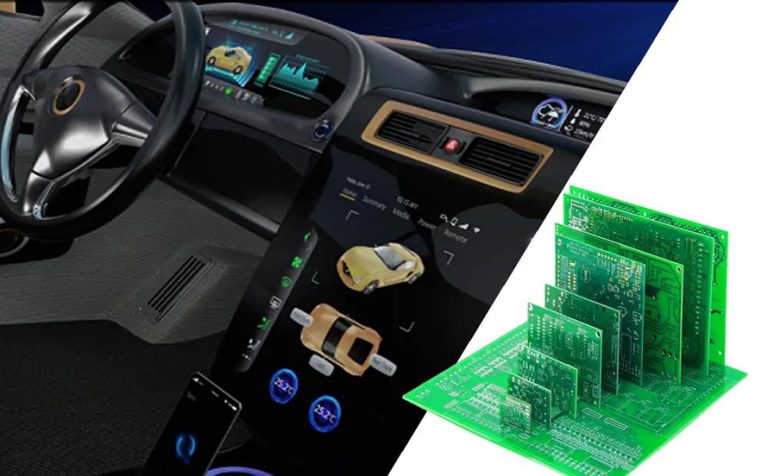
An Automotive PCB is a printed circuit board specifically designed for electronic systems used in vehicles. From engine control and lighting to infotainment, navigation, advanced driver assistance systems (ADAS), and electric vehicle power management, PCBs provide the electrical interconnections and control functions required by modern automotive electronics.
As vehicles become increasingly electrified, connected, and intelligent, the number of electronic control systems inside a vehicle continues to increase. This has made the Automotive Circuit Board a critical component in modern vehicle architecture.
Unlike many conventional consumer-electronics PCBs, automotive boards must operate reliably under demanding conditions, including temperature fluctuations, vibration, mechanical shock, humidity, electrical transients, and exposure to automotive fluids and contaminants. Therefore, automotive PCB design and manufacturing require careful consideration of reliability, thermal performance, signal integrity, and manufacturing consistency.
Basic Types of Automotive PCB
Different vehicle systems require different PCB structures and materials. Common automotive PCB types include rigid, flexible, and rigid-flex boards.
Rigid FR-4 PCB
FR-4 remains one of the most widely used materials for automotive electronics because it offers a good balance of electrical performance, mechanical strength, thermal stability, and cost.
Rigid FR-4 PCBs are suitable for many control modules, body electronics, infotainment systems, and other applications where a stable mechanical structure is required.
Aluminum PCB
Aluminum PCBs provide efficient heat dissipation and are commonly used in automotive lighting and other applications where thermal management is important.
LED lighting modules can generate considerable heat during operation. An aluminum substrate can help transfer heat away from high-power components and improve overall thermal performance.
Flexible PCB
Flexible PCBs use flexible substrates that allow the circuit to bend or conform to irregular spaces.
They are useful in automotive applications where wiring space is limited or where the PCB needs to accommodate movement, vibration, or complex mechanical structures.
Typical applications include instrument clusters, sensors, steering-wheel electronics, lighting systems, and compact electronic modules.
Rigid-Flex PCB
Rigid-flex PCBs combine the mechanical stability of rigid sections with the flexibility of flexible circuits.
This structure can reduce the number of connectors and cables required in certain applications while providing greater freedom for three-dimensional packaging.
Rigid-flex technology is particularly useful when space, weight, reliability, and mechanical integration are important design considerations.
Common Materials Used in Automotive PCB
Material selection has a direct influence on the reliability and electrical performance of an automotive PCB.
FR-4
FR-4 is widely used because of its favorable electrical insulation, mechanical strength, dimensional stability, and cost-effectiveness.
For automotive applications exposed to elevated temperatures, engineers may select higher-temperature laminate systems according to the actual operating requirements.
Aluminum
Aluminum substrates provide excellent thermal conductivity compared with conventional FR-4 structures.
They are particularly suitable for LED lighting and other automotive applications where efficient heat dissipation is a major design requirement.
Polyimide
Polyimide is commonly used for flexible circuits because it provides good flexibility and thermal resistance.
It can be suitable for applications requiring repeated bending, compact packaging, or routing through restricted spaces.
High-Performance Materials
More demanding automotive applications may require specialized high-Tg, low-loss, high-frequency, or thermally optimized materials.
Material selection should be based on the operating temperature, frequency, mechanical conditions, electrical requirements, and expected service life of the complete vehicle system.
Applications of Automotive PCB
The Automotive Circuit Board has become a fundamental part of almost every modern vehicle electronic system.
Engine Control Units
Engine control units (ECUs) rely on PCBs to process sensor inputs and control critical engine functions.
The PCB may support functions such as:
- Fuel injection control
- Ignition timing
- Engine temperature monitoring
- Air-fuel ratio management
- Emission control
- Sensor signal processing
Because ECU operation directly influences engine performance and reliability, the PCB must provide stable electrical and thermal performance.
Infotainment and Navigation Systems
Modern vehicles integrate audio, video, navigation, wireless communication, smartphone connectivity, and user interfaces into centralized infotainment systems.
The PCB supports processors, memory, display interfaces, communication modules, audio circuits, and other electronic functions.
As infotainment systems become more sophisticated, high-speed signal integrity and electromagnetic compatibility become increasingly important.
Safety Systems
Safety-critical automotive systems rely heavily on reliable electronic control.
Examples include:
- Airbag control systems
- Anti-lock braking systems (ABS)
- Electronic stability control
- Tire pressure monitoring
- Collision detection
- Emergency braking systems
These systems require reliable sensing, rapid signal processing, and accurate control. PCB design must therefore account for electrical noise, thermal conditions, vibration, and long-term reliability.
ADAS and Autonomous Driving
Advanced driver assistance systems use multiple sensors and high-performance processing hardware to understand the vehicle’s surroundings.
Automotive PCBs can be found in systems supporting:
- Radar
- Cameras
- LiDAR
- Ultrasonic sensors
- Blind-spot detection
- Adaptive cruise control
- Lane-departure warning
- Automatic emergency braking
These applications often require high-speed digital circuits, RF circuits, high-density routing, and advanced thermal management.
Automotive Lighting
PCBs are widely used in headlights, taillights, daytime running lights, interior lighting, and other vehicle lighting systems.
LED lighting generates heat, so thermal management is an important design consideration. Aluminum-based PCBs may be selected when efficient heat dissipation is required.
Electric Vehicle Systems
The rapid growth of electric vehicles has created additional demand for advanced automotive PCBs.
Applications include:
- Battery management systems (BMS)
- Motor control units
- On-board chargers
- DC-DC converters
- Power distribution systems
- Charging interfaces
- Thermal management systems
These applications can involve high currents, high voltages, high switching frequencies, and substantial heat generation. PCB design must therefore address power integrity, electrical isolation, creepage and clearance, thermal performance, and electromagnetic compatibility.
Body Electronics
PCBs are also used in numerous body-control functions, including:
- Power windows
- Door control
- Seat control
- Mirror adjustment
- Central locking
- Wiper control
- Climate control
- Interior lighting
Although these systems may not always be as power-intensive as propulsion electronics, they still require reliable operation over the vehicle’s service life.
Key Automotive PCB Design Considerations
Automotive electronics require a more rigorous approach to PCB Design than many general-purpose electronic products.
Thermal Management
Vehicles can expose electronics to substantial temperature variations. Components located near engines, power electronics, exhaust systems, or other heat sources may experience elevated temperatures.
Designers should evaluate:
- Component power dissipation
- Copper area
- Thermal vias
- Heat sinks
- Heat-spreading structures
- PCB material selection
- Airflow and enclosure design
Thermal simulation and testing can help identify potential hot spots before production.
Vibration and Mechanical Shock
Automotive electronics are continuously exposed to road vibration and mechanical shock.
PCB designers should consider:
- Board thickness
- Component weight
- Component placement
- Connector strength
- Mounting-hole design
- Mechanical support
- Solder-joint reliability
Large and heavy components should be positioned carefully to reduce mechanical stress on solder joints and PCB structures.
Signal Integrity
Modern vehicles contain high-speed communication networks, processors, sensors, cameras, and RF systems.
High-speed signals require appropriate impedance control, routing geometry, reference planes, via design, and grounding.
For RF applications such as automotive radar, the PCB may also require specialized high-frequency materials and controlled RF transmission structures.
Electromagnetic Compatibility
Automotive electronics operate in an electrically noisy environment.
Motors, switching power supplies, ignition systems, wireless modules, and high-current circuits can generate electromagnetic interference.
PCB designers should therefore consider:
- Grounding
- Shielding
- Filtering
- Signal separation
- Power integrity
- Return-current paths
- Component placement
Good EMC design can help prevent unwanted interference between electronic systems.
Creepage and Clearance
High-voltage automotive systems, particularly electric vehicle power electronics, require careful consideration of creepage and clearance distances.
The appropriate spacing depends on factors such as voltage, pollution environment, insulation system, material properties, and applicable product requirements.
Automotive PCB Manufacturing Process
A reliable Automotive PCB Manufacturing process requires close control of materials, fabrication parameters, assembly processes, and inspection.
| Manufacturing Step | Description |
|---|---|
| Material Selection | Select PCB laminate and copper structures according to electrical, thermal, mechanical, and environmental requirements. |
| Circuit Pattern Formation | Transfer the circuit design to the copper layer through imaging, etching, and related fabrication processes. |
| Drilling and Plating | Create through-holes, vias, and other interconnections, followed by copper plating to establish reliable electrical connections. |
| Layer Lamination | Multilayer boards are laminated under controlled temperature and pressure to form a stable multilayer structure. |
| Solder Mask and Surface Finish | Apply solder mask and select a suitable surface finish according to assembly and reliability requirements. |
| Component Placement | Automated equipment accurately places electronic components onto the PCB. |
| Soldering | Components are soldered using processes such as reflow soldering or selective/wave soldering, depending on the assembly design. |
| Inspection and Testing | AOI, electrical testing, X-ray inspection, functional testing, and other methods may be used according to product requirements. |
| Final Inspection | The completed boards are inspected to verify appearance, dimensions, assembly quality, and other specified requirements. |
Automotive PCB Assembly
Automotive PCB Assembly requires precise component placement and reliable solder connections.
Surface-mount technology is widely used to achieve high component density and automated production. Through-hole components may also be required for connectors, large components, or applications involving higher mechanical stress.
Important assembly considerations include:
- Component placement accuracy
- Solder-joint quality
- Thermal profiles
- Component traceability
- Moisture sensitivity
- Inspection requirements
- Rework control
- Functional testing
The assembly process should be optimized according to the actual component mix and reliability requirements of the vehicle system.
Automotive PCB Quality Control and Testing
Quality control is an essential part of automotive PCB production because electronic failures can affect vehicle functionality, safety, and reliability.
Thermal Cycling
Thermal cycling exposes the PCB and assembled components to repeated temperature changes to evaluate mechanical and electrical stability.
It can help identify potential weaknesses such as solder-joint fatigue, material delamination, or mechanical stress.
Vibration Testing
Vibration testing simulates mechanical conditions encountered during vehicle operation.
It evaluates whether the PCB, components, connectors, and solder joints can withstand expected vibration levels.
Humidity and Environmental Testing
Automotive electronics may encounter humidity, condensation, chemicals, dust, and other environmental stresses.
Environmental testing can help evaluate the ability of the finished product to maintain reliable operation under specified conditions.
Electrical Testing
Electrical tests can verify circuit continuity, isolation, and other specified electrical characteristics.
For more complex automotive modules, functional testing can verify whether the assembled PCB performs its intended system-level functions.
Industry Standards
Automotive electronics may be developed and manufactured according to applicable industry standards and customer-specific requirements.
Commonly referenced frameworks include IPC standards for PCB quality and assembly, IATF 16949 for automotive quality management systems, and relevant environmental, reliability, and product-specific requirements.
The exact standards applicable to a product should be determined according to its intended use, customer requirements, geographic market, and vehicle-system classification.
Challenges in Automotive PCB Development
| Challenge | Description |
|---|---|
| Harsh Environmental Conditions | Automotive PCBs may experience high and low temperatures, humidity, vibration, mechanical shock, and exposure to chemicals or contaminants. |
| Long-Term Reliability | Electronic systems are expected to operate reliably throughout the vehicle’s service life, making material selection, component selection, and process control critical. |
| Miniaturization | Increasing electronic functionality must fit into limited vehicle space while maintaining adequate thermal and electrical performance. |
| High-Density Integration | ADAS, connectivity, electrification, and autonomous-driving technologies require more components and higher-speed interfaces within increasingly compact modules. |
| Thermal Management | High-power components and dense layouts can create significant heat, requiring effective heat dissipation strategies. |
| EMI and EMC | Multiple electronic systems operating simultaneously can create electromagnetic interference and compatibility challenges. |
| Supply Chain and Component Lifecycle | Long vehicle development and service periods make component availability, lifecycle management, and alternative-component planning important considerations. |
These challenges require automotive PCB manufacturers to combine precise fabrication, advanced engineering, process control, and comprehensive testing.
How to Choose an Automotive PCB Manufacturer
Selecting an Automotive PCB Manufacturing partner should involve more than comparing unit prices.
Important factors include:
Manufacturing Capability
The manufacturer should have appropriate equipment and processes for the required PCB structures, layer count, materials, line widths, vias, surface finishes, and assembly technologies.
Quality Management
A systematic quality-management process helps maintain consistency throughout PCB fabrication and assembly.
For automotive projects, customers should evaluate whether the manufacturer’s quality system and production controls are appropriate for the intended application and customer requirements.
Engineering Support
Automotive PCB designs can involve complex thermal, mechanical, RF, high-speed, and power requirements.
An experienced engineering team can identify potential manufacturability problems and provide DFM feedback before production.
Testing Capability
The manufacturer should be able to support appropriate electrical, visual, dimensional, and reliability testing based on the product’s requirements.
Production Flexibility
Automotive projects may progress from prototypes to pilot production and eventually to larger-volume manufacturing.
A flexible supplier should be able to support different production stages while maintaining consistent quality.
Why Choose Kingda for Automotive PCB?
Automotive electronics require a combination of reliable PCB fabrication, accurate assembly, engineering support, and strict process control.
Kingda provides customized PCB manufacturing and assembly solutions for automotive electronic applications, supporting different board structures and technical requirements.
Customized Solutions
Different vehicle systems require different PCB technologies. Kingda can provide customized solutions based on requirements such as board size, layer count, material, copper thickness, flexibility, thermal performance, and component density.
High-Reliability PCB Manufacturing
A High-Reliability PCB should maintain stable electrical and mechanical performance under its intended operating conditions.
Kingda focuses on process consistency and quality control throughout PCB fabrication and assembly to help customers achieve reliable products.
Engineering and DFM Support
Design-for-Manufacturing reviews can help identify potential production issues before fabrication.
Early communication between the design team and manufacturer can reduce unnecessary redesigns and improve production efficiency.
Support for Advanced Automotive Electronics
The increasing adoption of ADAS, vehicle connectivity, electrification, and intelligent control systems is driving demand for more sophisticated PCBs.
Kingda can support PCB requirements for applications involving high-density layouts, mixed-signal circuits, power electronics, flexible structures, and other advanced automotive technologies.
Conclusion
The Automotive PCB has become a fundamental part of modern vehicle electronics. It supports critical functions ranging from engine control and lighting to infotainment, safety systems, ADAS, battery management, and electric vehicle power electronics.
As vehicles become more connected, electrified, and intelligent, automotive PCBs must deliver higher reliability, greater integration, improved thermal performance, and stronger signal integrity.
Successful automotive electronics depend on the entire product chain, from material selection and PCB Design to fabrication, Automotive PCB Assembly, testing, and final quality control. Choosing an experienced manufacturing partner can help ensure that the finished Automotive Circuit Board meets the electrical, mechanical, thermal, and environmental requirements of its intended application.
With customized manufacturing and engineering support, Kingda can provide PCB solutions for automotive electronics and other demanding applications where reliability and consistent performance are essential.