
Bake Cycles and Residual Floor Life After Opening
A dry packed component has a floor life that starts when the bag is opened. Managing that life across partial reels, part used bags and returns is where most popcorning problems originate.
How Residual Life Is Calculated
The total floor life comes from the moisture sensitivity level, and the time already consumed is subtracted when a partial reel is returned to a bag. Where the residual is recorded, the next use is a calculation rather than a guess.
The record should travel with the reel. Our floor control notes describe the arrangement.
When a Bake Is Required
A bake is required when the floor life has been exceeded, when the humidity indicator shows a change, or when the storage history is unknown. The bake removes the absorbed moisture rather than resetting the clock on the label.
The decision follows the recorded history rather than the appearance. Our bake schedule notes describe the temperature and duration.
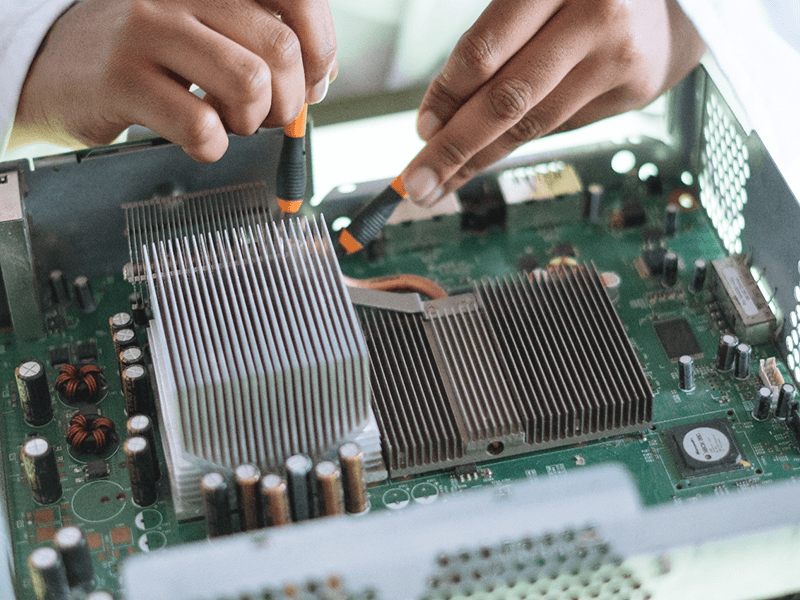
Controls During the Bake
The bake temperature has to be below the limit for the packaging, and the parts have to be in trays that tolerate it. Tape and reel packaging often sets the temperature ceiling.
A bake above the packaging limit deforms the carrier tape and changes the pitch. Our tape and reel notes describe the consequence.
Counting Bake Cycles
Each bake is a thermal exposure for the component and for its terminations, and the number is limited. The count should be recorded on the reel along with the floor life.
Our component reliability notes describe the accumulation.

Resealing and Desiccant
When a partial reel is returned to a bag it needs fresh desiccant and a new indicator card, and the bag has to be sealed above the old seal. A reused bag with the original desiccant has lost most of its capacity.
Our bag sealing notes describe the practice.
Storage Environment
A dry cabinet at a controlled humidity slows the accumulation of moisture between uses. Where a cabinet is used, its humidity should be recorded rather than monitored occasionally.
The cabinet extends the working window rather than removing the need to record it. Our fabrication notes list the points to confirm.
Verification
The verification is a residual life recorded with each partial reel, a humidity indicator read before opening, a bake temperature inside the packaging limit with the cycle counted, and a fresh desiccant and card whenever a bag is resealed.
Our quality notes describe how the records are kept.
Process Control and Verification
A stack-up that is drawn rather than described removes most of the ambiguity from a quotation, and it lets the fabricator price the board against the dielectric and copper weights that will actually be used. Where the requirement is not written down, the shop supplies its own default, and the default is chosen for the process rather than for the design.
The measurements that matter are the repeatable ones: conductor width and spacing, annular ring, finished hole size, plating thickness and surface finish are all verifiable on a coupon that travels with the panel. Running a first article through the same checks as the production panel confirms that the two agree, and that comparison is the cheapest form of process control available at prototype stage.
Keeping a sample from the panel turns a dispute into a measurement, because the same coupon can be re-examined by both parties without rebuilding the batch. Reviewing the design before the data is released is cheaper than correcting it after the panel is in the tank, because every step downstream inherits the decision made at the front end.
Documenting the assumption is part of the design work, and a short note on the drawing prevents a question that would otherwise arrive a day later and cost a day of schedule. The process window is set by the narrowest step in the flow, so an improvement anywhere else shows up as margin rather than as yield until that step is addressed.
Checks Before Release
The checks that matter are the ones performed on the product rather than on a sample kept for the purpose, because a coupon that travels with the panel is the only evidence about that panel. Where a requirement can be measured, it should be measured at the point of manufacture and recorded against the board or the lot it applies to.
A parameter that is set once and never re verified drifts, and the drift is usually discovered by a defect rather than by the record. The tooling, the material and the profile form one system, and a change to any of them should be assessed against the other two before it is released.
Where the process window is narrow, the measurement resolution has to be better than the window, or the data cannot distinguish a good part from a marginal one. A record that identifies the operator, the date and the settings is worth more than a record that identifies only the result.
The acceptance criteria should be written before the work starts, so that the decision is made by the specification rather than by the person inspecting.
FAQ
Does a bake reset the floor life? It removes the absorbed moisture and the clock starts again from the bake, which is why the bake has to be recorded.
Can a reel be baked in its packaging? Only within the packaging temperature limit, which is often lower than the temperature the component would tolerate.
What does gopcb provide for floor life control? We provide a residual life recorded on every partial reel, a humidity indicator read before opening, a bake temperature inside the packaging limit with the cycle counted, fresh desiccant and a new card on every reseal, and a recorded dry cabinet humidity.