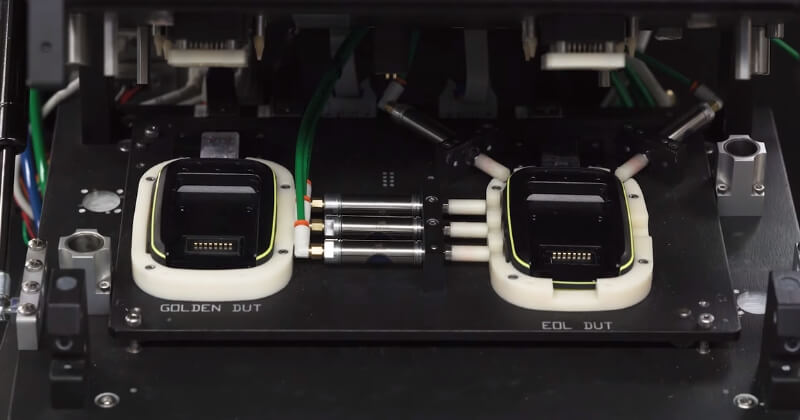
Bend Test Methods for Flexible Printed Circuits A flexible printed circuit is specified with a bend life, and that number is only meaningful if the test used to obtain it is the same as the test used to qualify the part. Two suppliers can quote very different numbers for the…
Mounting a Shielding Can on a Dense Mixed Signal PCB A shielding can is a small metal box soldered or clipped over a sensitive circuit, and it looks simple until the details are examined. The lid, the walls, the fence, the attachment method and the holes above the components all…
Blind via and Buried via Production: Process Limits A blind via reaches only some of the layers, and a buried via connects inner layers without reaching either surface. Both exist to free routing space, and both change the way a board is built: the layers are laminated in stages, the…
PCB Connector Launch Design: The First Millimetre Buyers and engineers often focus on the finished product and forget the production line behind it. In practice, most field failures can be traced back to process decisions made during assembly. Understanding PCB connector launch design gives you a practical advantage when you…
PCB Coplanar Waveguide: A Line With Ground Beside It Electronics manufacturing has become a discipline of small details. Solder paste volumes, placement accuracy, temperature profiles and inspection limits all add up to the final result. This guide looks at PCB coplanar waveguide from the perspective of a PCBA factory floor,…
PCB Grounded Coplanar Design: Ground Above and Beside Buyers and engineers often focus on the finished product and forget the production line behind it. In practice, most field failures can be traced back to process decisions made during assembly. Understanding PCB grounded coplanar design gives you a practical advantage when…
FPC Copper Thickness And Line Width: Working Limits On a flexible printed circuit, or FPC, the copper is doing three jobs at once. It carries the current, it provides the mechanical strength that lets the part be handled and bent, and it has to survive repeated flexing without cracking. Copper…
Conductive Adhesive Versus Soldering for High Frequency Boards Soldering attaches a component by forming an alloy with the pad. Conductive adhesive attaches it by suspending metal particles in a polymer that cures around the joint. The two mechanisms produce joints with different resistances, different temperature limits and very different process…
Copper Pour: What It Does And Which Form To Use Copper pour is the practice of filling the unused area of a board with copper and connecting it, usually to the ground net. It is one of the simplest things a designer can add and one of the easiest to…
Pressure Sensor Interface Circuit Design A pressure sensor turns a mechanical deflection into an electrical signal, and the circuit that follows has to remove a set of errors that are larger than the signal itself. Offset, span, temperature drift and nonlinearity are all specified separately on the datasheet, and a…