Cleaning After Hand Soldering
Hand soldering leaves more residue than any machine process, because the operator applies flux locally, often more than the joint needs, and the heat source is a tip rather than a controlled profile. Some of that residue is harmless and some of it is not, and the difference depends on the flux chemistry, the environment the product will operate in and what happens to the board afterwards. Cleaning is a decision rather than a default.
What Hand Soldering Leaves Behind
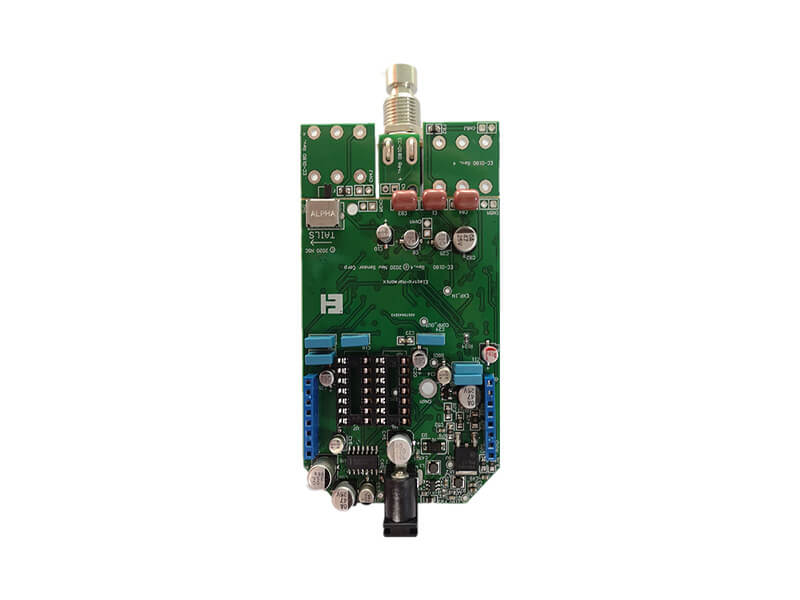
Rosin and resin fluxes leave a gummy residue that is generally benign at room temperature but can become conductive when it absorbs moisture, which is why a humid environment changes the assessment. Water-soluble fluxes leave ionic material that must be removed, because the ions remain mobile and can produce electrochemical migration between adjacent conductors under bias. No-clean fluxes are formulated to leave a residue that is safe under stated conditions, which is not the same as leaving nothing.
Hand soldering also produces spatter. Small spheres of solder and fragments of flux land on the board surface and, where a coating or a conformal film is applied later, they can lift it or create a void. That physical contamination is separate from the chemical question and is often the more immediate problem. No-clean flux behaviour depends on the specific chemistry rather than on the label alone.
Deciding Whether to Clean
The decision should follow from the product rather than from the process. A board that will be conformally coated usually needs to be clean, because adhesion and coverage depend on it. A board that carries fine-pitch components, high impedance nodes or a battery has a low tolerance for ionic contamination. A board in a benign, dry, sealed enclosure with generous spacing may not need cleaning at all, and adding a cleaning step introduces its own risks.
The risks are real: water and solvent can be trapped under components, aggressive cleaning can remove markings or damage certain parts, and an incompletely dried board is worse than an uncleaned one. Where cleaning is specified, the method, the drying and the verification all have to be defined, otherwise the process produces a board that looks clean and fails later. Residue removal practice covers the compatibility question that decides the method.
Cleaning Methods
Manual cleaning with a brush and a solvent is common at a repair bench, and it is the least repeatable method. The result depends on the operator’s technique, the freshness of the solvent and how thoroughly the board is rinsed. It is acceptable for touching up a small area after a repair, provided the solvent and the drying are controlled, but it is a poor choice for a whole assembly that has a cleanliness requirement.
Batch and inline cleaning with water-based chemistry gives a repeatable result when the parameters are controlled. The variables are the chemistry concentration, the wash temperature, the mechanical energy and, most importantly, the rinse and the drying. Deionised water for the final rinse and a monitored drying step remove the water that would otherwise remain under components. Ultrasonic cleaning is effective for complex assemblies but must be assessed against the components, since some parts are damaged by the energy.
Effects on Coating and Test
Cleaning interacts with the processes that follow. A conformal coating applied over residue may lift at the boundary or craze, and the failure appears weeks later in the field rather than at inspection. Test probes make contact through residue with increased resistance, producing false failures that are attributed to the board. Both effects are arguments for cleaning before coating and before functional test, where the product’s requirements justify it.
The cleaning process is not always benign either. Some coatings and markings are removed or dulled by certain solvents, and some connectors retain liquid that later causes corrosion. Where a board carries parts that cannot be cleaned, they should be added after the cleaning step, or protected with a mask. Solder mask touch-up and cleaning often happen in the same repair operation, and the order matters.
Verification of Cleanliness
Cleanliness should be verified rather than assumed, and the method should match the contamination of concern. Ionic contamination testing measures the conductivity of a solvent extract and reports the result as an equivalent of sodium chloride per unit area, which addresses the ionic risk directly. Surface insulation resistance testing applies a bias and measures leakage over time, which is closer to the failure mechanism but slower.
Visual inspection under ultraviolet light shows flux residue where the material fluoresces, and it is fast enough for routine use. It does not detect ionic contamination that has been rinsed away from the visible areas, so it complements rather than replaces the extract test. Choosing the method and the frequency should follow from the product requirement, and the result should be recorded against the cleaning process rather than against the board alone. Coating selection should be made with the cleaning capability in mind.
Documenting the Decision
Whether the product is cleaned or not, the decision should be written down with its justification. A no-clean process specification that states the flux, the maximum residue, the environment the product will see and the verification method is far more defensible than a line that says no cleaning required. It also survives a change of operator, which is where unwritten decisions usually fail.
Where cleaning is required, the specification should define the chemistry, the parameters, the drying and the acceptance test, and the process should be monitored at the intervals the risk justifies. A cleaning process that is not monitored drifts quietly as the bath ages, and the drift appears as a coating adhesion failure or a leakage failure months later, long after the connection to the cleaning bath has been forgotten.
Acceptance and Its Evidence
On a design of this kind, cleaning is the item that decides how the rest of the board is arranged. The tooling, the material and the profile form one system, and a change to any of them should be assessed against the other two before it is released. Handling between operations is part of the process, and the damage it causes is often attributed to the operation that preceded it.
A change that is not recorded is a change that cannot be explained when the result moves, which is why the record is part of the process.
Checks Before Release
On a design of this kind, cleaning is the item that decides how the rest of the board is arranged. The narrowest feature on the board usually sets the process window for the whole product, so it deserves the closest attention at review. Where a requirement can be measured, it should be measured at the point of manufacture and recorded against the board or the lot it applies to.
FAQ
Is hand soldering always a reason to clean? No. It is a reason to assess the residue against the product’s environment and the following processes. Many assemblies are built and shipped without cleaning.
Can a no-clean flux be left on a coated board? Only if the coating and the residue are compatible and adhesion has been verified. Test it on a sample rather than assuming.
Is alcohol a suitable cleaning solvent? It removes some residues and leaves others, and it evaporates quickly without rinsing them away. For a cleanliness requirement, a defined process with a rinse is more reliable.
How is cleanliness verified? Ionic contamination testing for the ionic risk, surface insulation resistance where the failure mechanism matters, and ultraviolet inspection for visible residue.