Conveyor Finger Maintenance and Board Support in Reflow
The conveyor finger is the only contact the board has with the machine, and it defines where the board sits in every zone. A finger that has bent, worn or picked up a crust of flux changes the board position, the heat it receives and the datum that the placement machine used upstream.
Maintenance of the transport system is usually treated as housekeeping, yet the defects it prevents are thermal and positional. This article sets out what to check, how often, and which process signals point back to the conveyor rather than to the paste.
What the Conveyor Does to the Board
The transport system carries the board, sets its height above the heater plates and holds it flat while the paste reflows. Any variation in that height changes the distance to the radiating surfaces and the velocity of the air that reaches the board surface.
Fingers also define the usable edge of the panel. A board that is narrower than the specified edge clearance sits on the rail rather than on the fingers, which alters both the height and the support at the corners of the array. The reflow oven is a passive environment apart from the conveyor: the zones hold their set points and the board is carried through them at a speed the transport system controls.
Finger Wear and Board Position
Fingers are spring steel or stainless, and they wear where the board edge rubs against them. A worn finger loses its spring, so the board sits lower on that side and the panel tilts slightly as it travels through the tunnel.
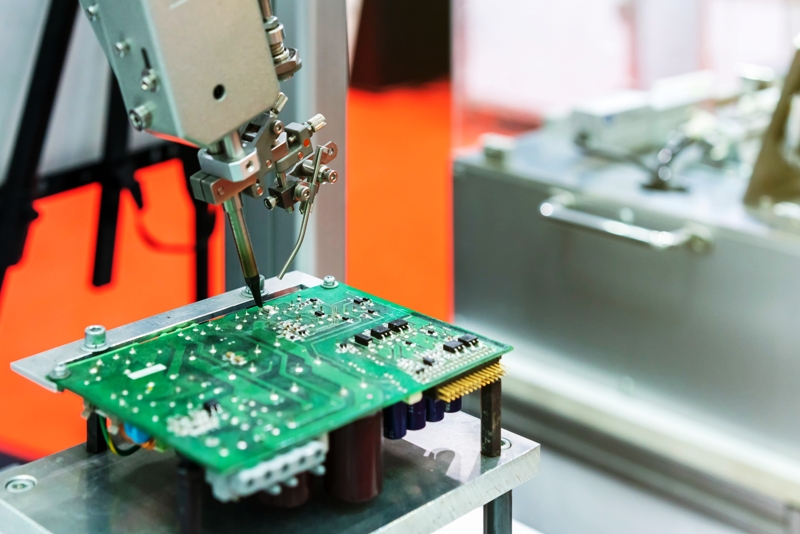
The tilt is small, typically under a millimetre, but it is enough to move the board closer to one heater bank. Boards that tilt show a wider spread in peak temperature between their two long edges, and the difference follows the finger that carries them. Plated or coated fingers hold their shape better under repeated thermal cycling, while plain steel ones rust and scale in a humid plant.
Chain Rail Tension and Alignment
Chain rail tension keeps the two rails parallel and the pitch of the fingers constant. A slack chain lets the board lag on one side, and the lag appears as a skew in the placement of parts rather than as a transport fault.
Alignment is checked with a straight edge and a gauge across the full length of the oven, and the check should be done with the conveyor at operating temperature, because a hot rail and a cold rail do not sit at the same height. Rails should be levelled against each other at both the entrance and the exit, since a rail that is level at one end and high at the other sets up a twisting load on the panel.
Board Support and Sag
Large, thin panels sag between the rails, and the sag changes the distance to the lower heater bank. Support pins or a pallet hold the panel flat, and their placement follows the same logic as the support used in printing, as described in the notes on support tooling.
Boards under 1 mm thick are the most sensitive, because the flexure is proportional to the cube of the thickness. Where sag cannot be controlled, a carrier keeps the panel flat and the transport repeatable, as covered in the material on carriers for thin boards. Support pins on the underside of a large panel follow the same rules as pins used under a printing table, and a pin that cannot reach the board leaves a low spot that reflows differently.
Transport Speed and Dwell
Conveyor speed sets the time the board spends in each zone, and it is the same variable that the profile depends on. A speed change made to improve throughput alters every soak and peak value in the curve, so it belongs in the profile record.
Speed should also be verified, not trusted. Encoder drift or a slipping drive shows up as a millimetre per second error that no operator notices until the profile is measured against a reference board. Dwell time is the transport variable that appears in every thermal calculation, and it should be confirmed on each shift against a marked reference board rather than assumed from the controller.
Effects on the Thermal Profile
Finger wear, rail tension and support all feed into the thermal profile, which is why a profile that was approved on a well-maintained machine can drift after a transport repair. The measurement should be repeated after any change to the conveyor, including a finger replacement.
Where two boards run at different heights on the same pass, the difference in peak temperature can reach 5 to 10 °C. That is enough to change the appearance of a joint and to alter the grain structure of the solder. Where the two rails run at different heights, the panel spends different amounts of time close to the upper and lower heater banks, which changes the appearance of joints on the top and bottom sides.
Inspection and Maintenance Checks
Daily checks cover the obvious: a bent finger, a crust of flux on the rail, debris in the tunnel and a board that does not sit flat. Weekly checks cover chain tension, finger pitch and rail parallelism.
Quarterly maintenance should measure rail height at several points along the tunnel, inspect the drive sprockets for wear and confirm that the fingers still hold the board at the specified height above the heater plates. A crust of flux on a finger changes the height it holds, so cleaning the transport is a thermal action rather than a cosmetic one.
Symptoms of Transport Problems
Transport faults leave positional signatures. Tombstoning or head-in-pillow at one edge, a consistent offset in solder joint appearance from one side of the panel to the other, and a profile that reads differently on the left and right rails all point to the conveyor.
The same symptoms can come from an unbalanced oven, so the two investigations should be separated by measuring the board height first. A height check costs minutes and rules out half of the possibilities before the oven is opened. A board that arrives skewed shows placement-like errors even though nothing moved in the placement machine, which is why transport checks belong in the same routine as the profile check.
Records and Replacement Rules
Records should carry the finger part number, the date of the last replacement, the rail height measurements and the profile that was verified afterwards. gopcb keeps those values with the oven rather than with the operator.
Replacement should be driven by measurement rather than by failure. A finger that has lost more than a fraction of its original height, or that fails to hold a gauge block at the specified position, is due for replacement before it produces a batch of boards with a shifted profile.
FAQ
How does the conveyor affect the reflow profile? It sets the board height above the heater plates and the time spent in each zone, so any change in height, rail tension or speed shifts the peak temperature the board sees.
When should conveyor fingers be replaced? When they no longer hold a gauge block at the specified height, when they are visibly bent, or when a profile check shows a difference between the two rails.
Can a pallet replace board support pins? For thin or flexible panels a carrier is the more repeatable option, because it holds the whole outline rather than supporting a few points.