



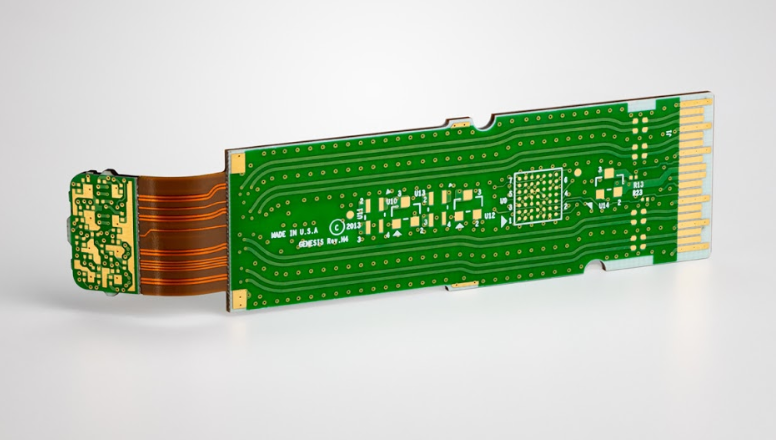
Lamination, Drilling and Plating on a Deep Stack
A board with thirty or more layers is not simply a taller version of a six-layer one. The processes are the same in name, but each of them is performed under tighter conditions, and the tolerances accumulate in a way that makes the later stages dependent on choices made at the first.
Understanding where that dependency sits is useful for a customer, because it explains why the lead time is long, why the measurements matter and why a change to the stack-up late in the process is expensive. The three stages that decide most of the outcome are lamination, drilling and plating.
Inner Layers and the Cost of a Late Discovery
The sequence begins with the inner layers, which are patterned and then inspected before anything is pressed together. The inspection at this stage is what prevents a defective layer from being laminated into a stack that has to be scrapped as a whole.
That is the commercial argument for taking the inspection seriously: a fault found on an inner layer costs one layer, while the same fault found after lamination costs the entire board and the material that went into it. The imaging itself is performed with fine tolerances, and the registration of each layer to its neighbours is established from the first step onwards.
Where the customer’s design requires a specific layer arrangement, the stack-up has to reflect it exactly, including the thickness of each dielectric, the copper weight and the position of the planes. A stack-up that is approximate produces a board that cannot meet an impedance target, however well it is made.
Lamination: Temperature, Pressure and Time
Lamination is where the layers become one board, and it is performed in cycles. Each cycle applies heat and pressure for a defined period, and the parameters have to suit the material system rather than a generic recipe.
The heating rate is the first parameter. Applied too quickly, the resin in the prepreg flows before it has filled the space around the traces, and the layers move relative to one another as it does. Applied too slowly, the cycle becomes unnecessarily long. The peak temperature is chosen for the material, and it has to be high enough to cure the resin and low enough not to degrade it.
Pressure is applied in stages for the same reason. A lower pressure at the start allows the resin to flow and fill; a higher pressure afterwards consolidates the stack. Too much pressure early on drives the resin out and can leave the layers short of material; too little at the end leaves voids and poor adhesion.
Time completes the three. The material needs to remain at temperature long enough to cure, and a stack with more layers and more mass requires longer than a thin one. These parameters are recorded per batch, because they are what makes the second delivery comparable with the first.
Registration and Why It Accumulates
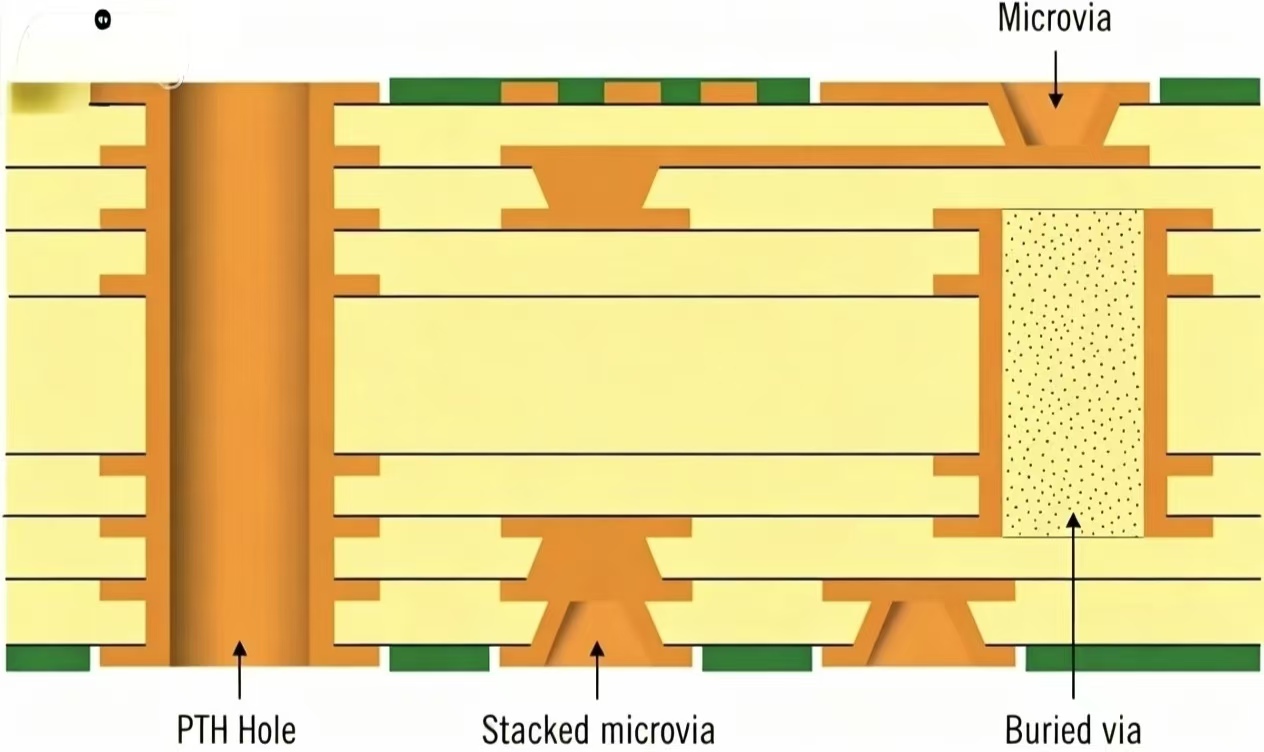
Each cycle moves the layers slightly. Over one or two cycles the movement is absorbed by the tolerances; over several, the registration of an inner layer relative to its neighbours becomes a measurable quantity in its own right.
Misregistration has two consequences. Dimensionally, a pad or an annular ring is displaced from where it was intended. Electrically, the distance between a trace and the plane beside it changes, and with it the impedance that was calculated for the design.
This is why the number of lamination cycles appears in the specification of a deep stack, and why a structure requiring several of them carries a longer schedule and a narrower set of capable suppliers. A cross-section taken from a finished panel is the evidence that the registration was held.
Drilling: Parameters That Follow the Stack
Drilling a deep stack is a question of removing material cleanly from a hole whose depth is many times its diameter. The drill parameters are set accordingly: a higher rotational speed and a controlled feed rate, with the drill withdrawn periodically to clear the chips rather than allowing them to pack into the hole.
The consequence of getting this wrong is not only a broken tool. Heat generated by a worn drill can damage the resin around the hole wall, and a rough wall makes the subsequent plating less reliable. Where the design depends on a plated connection, the quality of the hole is the foundation of that connection.
Vias that stop at an inner layer add a further requirement, since the depth has to be controlled precisely enough to reach the intended layer without passing through it.
<img src="https://www.gopcba.com/wp-content/uploads/2026/06/Edge-AI-Computing-Module-PCBA.jpg" alt="plating thickness measurement on a drilled panel” />
Plating and Plating Thickness
Plating forms the connection through the hole wall and the copper on the surfaces. Its thickness and its uniformity are the two properties that matter, and both are harder to achieve in a deep hole than a shallow one, because the chemistry must reach the middle of the barrel as effectively as the ends.
The thickness is specified as a minimum rather than an average, and it is verified by measurement on samples. A barrel that meets the specification on average but is thin in the middle is a connection that will fail with thermal cycling, and the failure will appear in the customer’s equipment rather than at the fabricator.
Finishing, Testing and the Evidence
The remaining stages apply the surface finish, form the outer layers and prepare the board for assembly. The finish is chosen for the assembly and the product, and its thickness is specified, since too little affects solderability and too much affects the geometry of fine features.
Testing a deep stack is a combination of measurements rather than a single pass or fail. Electrical testing verifies continuity across every network, impedance coupons verify the controlled traces, and a cross-section verifies the internal geometry. On boards intended for demanding applications, environmental testing may follow.
Those measurements are the delivery’s evidence, and they are what a customer should ask for by name. The assembly that follows the boards is carried out as SMT assembly, with verification through PCBA testing and the controls described under quality management.
What a Change Costs at Each Stage
The cost of a modification depends on when it is made, and the increase between stages is steep.
A change to the stack-up made before the artwork is prepared is a conversation. Made after the inner layers have been imaged, it means new artwork. Made after lamination, it means a new board. Made after plating and finishing, it means the material, the entire process and the schedule are consumed again, and the customers waiting behind the order are affected as well.
That progression is the reason the review at the beginning matters so much on a deep stack. The questions that seem pedantic at that point — the thickness of a dielectric, the copper weight on a plane, the target impedance on a particular layer — are the ones that are expensive to revisit later, and they are cheap to settle while the data is still on a screen.
FAQ
Why is a deep stack more difficult than several thin boards? Because the layers are pressed together in successive cycles, and the movement of each cycle accumulates into the registration of the final board.
Why does drill quality matter so much? Because the plating inside the hole depends on a clean wall, and a plated connection that is thin or poorly bonded will fail under thermal cycling.
What evidence should accompany the boards? Electrical test results, impedance measurements from coupons and, where the design requires it, a cross-section showing the internal geometry.



2 Comments
10-Layer PCB Fabrication Challenges
[…] The consequence for a designer is that the drilling characteristics of a stackup should be discussed before the stackup is fixed. Aspect ratio and material choice both affect what the shop can produce repeatably, and the trade-offs are the same ones described in this look at lamination, drilling and plating for deep stacks. […]
Ultra-Thick Copper Multilayer PCB Manufacturing - Kingda
[…] Lamination is the step where most heavy-copper work fails, and the principles involved are the same ones that govern deep stacks, as described in this look at lamination, drilling and plating for deep stacks. […]